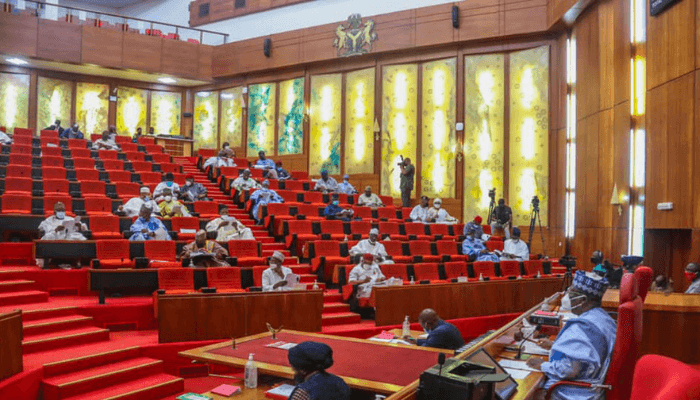
The Senate has dismissed multiple memoranda calling for a return to the Regional System of Government also known as the parliamentary system as the Constitution Review process progresses.
BusinessDay observed that proposals for regional governance were not considered in the regional public hearings held across the country.
According to a sectoral breakdown of memoranda given by the Senate Constitution Review Committee, and seen by our correspondent, areas currently under review include: fundamental rights, government structure, judicial reforms, inclusive governance, local government creation, devolution of powers, fiscal and electoral reforms, state creation, the legislature, and the role of traditional institutions.
The call for Regional Government emerged from several memoranda submitted by individuals and groups during the public input phase of the review.

Out of 56 major submissions, proposals included demands for a unicameral legislature, state Police, gender equality, inclusion of traditional rulers in the constitution, and notably, a shift back to regional governance.
Read also: Lagos council polls was fraudulent, unconstitutional, ADC leaders say
Many of the proponents for regional government are from Southern Nigeria.
The push gained momentum after a draft document authored by Dr. Akin Fapohunda titled “A Bill for an Act to Substitute the Annexure to Decree 24 of 1999 with a New Governance Model for the Federal Republic of Nigeria” began circulating.
The bill proposed a new constitution to be known as “The Constitution of the Federal Republic of Nigeria: New Governance Model for Nigeria Act, 2024.”

The Kwara South Consultative Forum, in its submission, demanded the reintroduction of the regional constitution as it existed before 1988, along with a reversal from a bicameral to a regional Assembly System.
The All Middle Belt Youth Forum also supported a return to parliamentary governance and urged the Senate to adopt the 2014 National CONFAB report, which recommends creating new regions including: North West, North East, Middle Belt East, Middle Belt West, South West, Mid-West, South East, and South-South.
The EGI Professors and Academic Doctors Forum argued for power devolution, stating, “The current federal structure is too centralized, and resources are often misallocated.”
Similarly, the Okun Development Association proposed restructuring the central government and converting the six geopolitical zones into self-governing regions with their own constitutions.
“Each region should control its economy and contribute to the running of the federation,” their memo stated.
The Ijaw National Congress and Bayelsa State Elders Council also supported regionalism, proposing the creation of 10 regions with autonomy to form sub-national governments and control their resources, remitting taxes to the Federal Government.
However, not all submissions backed the regional model.
The Southern Kaduna People’s Union rejected it, instead advocating for a federation with eight redefined geopolitical zones, including new Middle Belt regions.
During the Constitution Amendment Retreat held recently in Kano State, lawmakers debated the feasibility and desirability of regionalism.
Senate Leader, Opeyemi Bamidele emphasised that any major governance restructuring would require broad political consensus, not just a bill.
“Moving towards a regional form of Government is not something that can be accomplished by a single bill, whether sponsored by a lawmaker or the executive.
“Even replacing a single constitutional provision requires layers of approval, public hearings, two-thirds majority in the National Assembly, and endorsement from at least 24 state Houses of Assembly”, Bamidele said.
Bamidele added that the process for such sweeping reforms must be democratic and participatory.
“People often argue that Nigeria needs a new constitution. While such arguments are easy to make, replacing the entire constitution cannot be done without political will and national consensus,” he said.
Former Deputy Senate Leader, Abdul Ningi (Senator, Bauchi Central), expressed strong opposition to a return to regionalism.
“My constituency did not benefit from the regional government structure of the First Republic based in Kaduna. We are not going back there,” he said. “We want reform, yes, including fiscal federalism, but not regional government.”
Read also: Constitutional review must engage rural Nigeria to avoid elite capture and failure
Ningi also questioned the legitimacy of non-elected groups advocating constitutional changes.
“The National Assembly alone has the mandate to review and amend the constitution. Who authorized these ethnic associations to speak on behalf of entire regions?” he asked.
Muntari Dandutse (Senator, Katsina South) echoed Ningi’s stance.
“Every region in this country is blessed with natural resources. Our problem is not structure but responsible governance. We need leaders who can manage what we already have,” he said.
In contrast, Senator Fatai Buhari (Oyo North) supported regionalism, arguing that it promotes local accountability and reduces the unhealthy competition for federal power.
“In the First Republic, regions harnessed their resources effectively. The North had groundnuts, the West had cocoa. Regionalism made governance more productive,” he noted.
“It’s time we made the center less attractive.”
Despite increasing public interest, especially after President Bola Tinubu signed the North West, North Central, South South, South West and South East Development Commission bills into law, the Senate has clarified that no bill proposing a regional government has been sent to the National Assembly by the Executive.
Speaking on the Senate leaving out memos on regional government, Yemi Adaramodu, the Senate spokesperson said, “No memo can be rejected by the Committee that is conducting a public hearing.
“The reports of all regional public hearings would be presented to the National Assembly, where these would be considered, for further Legislative procedures, including debates, stakeholders interactions and resolutions.”