…CBN target singled digit inflation after rebasing
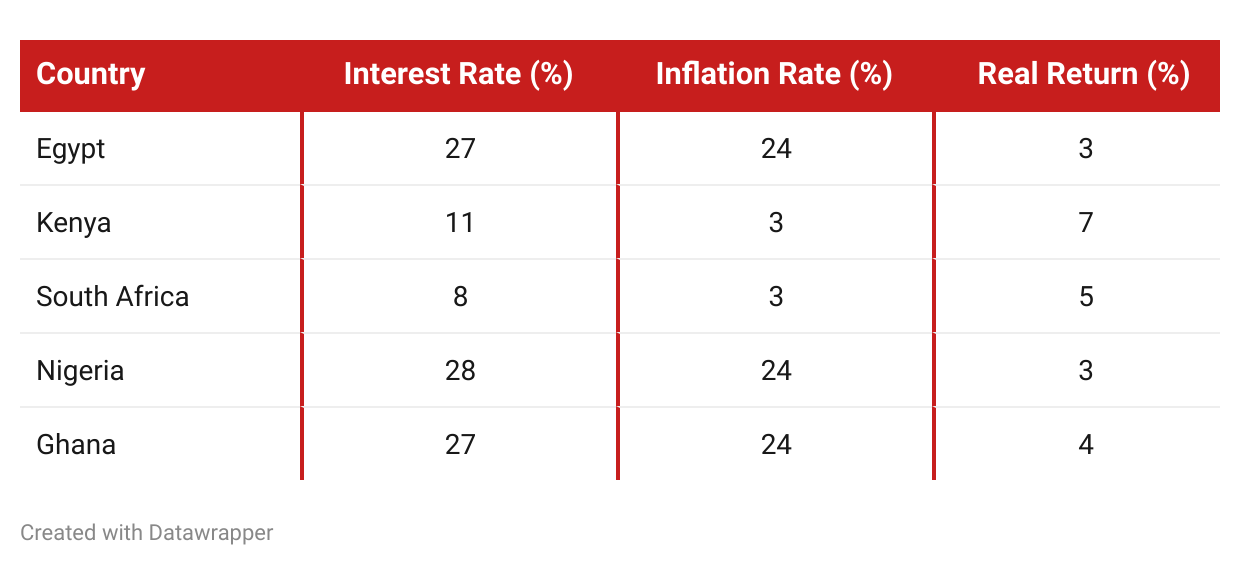
The real return on Nigerian assets is technically positive for the first time in over five years, with the benchmark interest rate exceeding inflation rate.
The CBN left the interest rate unchanged at 27.5 percent on Thursday, above the rebased inflation rate of 24.48 percent in January 2025.
That real return is however only on face value, as the inflation rate has crept above the return on the one-year Treasury bill which is now at 22 percent, after falling from 25 percent at an auction this week.

“On face value, real rates are now positive in Nigeria as interest rates are higher than inflation,” Tilewa Adebajo, Chief Executive Officer of the CFG Advisory, said.
“Value has been restored to financial markets and assets,” Adebajo said.
Read also: Here’re analysts views on stocks ahead of inflation data, MPC outcome
The Monetary Policy Committee (MPC) on Thursday maintained the benchmark interest rate, known as the Monetary Policy Rate (MPR), at 27.5 percent following the rebasing of the consumer price index (CPI), signaling the return of a real rate environment.
After its first two-day meeting of the year, all 12 members in attendance unanimously agreed to keep the MPR at 27.5 percent, retain the asymmetric corridor around the MPR at plus 500 and minus 100 basis points, maintain the cash reserve ratio (CRR) at 50 percent for deposit money banks and 16 percent for merchant banks, and uphold the liquidity ratio at 30 percent.

Olayemi Cardoso, governor of the CBN said the Monetary Policy Committee noted with satisfaction recent macroeconomic developments which are expected to positively impact price dynamics in the near to medium term. These include the stability in the foreign exchange market with the resultant appreciation of the exchange rate and the gradual moderation in the price of Premium Motor Spirit (PMS).
“Members, however, were not oblivious of the risk of persisting inflationary pressures driven largely by food prices. The Committee noted the recent rebasing of the Consumer Price Index (CPI) by the National Bureau of Statistics (NBS) which reviewed the weights of items in the consumption basket to reflect current consumption patterns,” he said.
The NBS on Tuesday rebased the CPI reading, which revealed a sharp reduction in Nigeria’s headline inflation rate to 24.5 percent y/y in January 2025 (post-rebasing) compared with the pre-rebasing reading of 34.8 percent y/y in December 2024.
A poll of economists showed that most expected a hold, citing the CPI rebasing and the need to allow the previous hikes in interest rates to reflect on the economy.
“The dynamics of lagging inflationary data and the stability of the primary cost push factors, fuel prices and exchange rate devaluation, suggest that the Monetary authorities should observe the financial markets and the dynamics of the economy, until the next MPC, to ensure the trajectory of inflation is indeed on the downward trend,” Adebajo of CFG said.
Razia Khan, managing director, Chief Economist, Africa and Middle East Global Research at Standard Chartered Bank, said there was a commitment to bring inflation down to single digits in the ‘medium-to-long-term’.
Read also: Stock market dips by 0.04% as MPC retains benchmark rates
“In our view this is an encouraging message. Given the recency of Nigeria’s inflation experience, it would have been too soon to signal the all-clear. The next meeting is scheduled for May 20th. Depending on both the inflation releases between now and then, and crucially, how FX behaves, market expectations of the start of the easing cycle may well build.”
Ayo Teriba, an economist and CEO of Economic Associates (EA), said the MPC meeting held against the backdrop of three important fundamental reliefs- the threats of fiscal expansion is constrained by inadequate funding that resulted in less than 50 per cent 2024 budget performance; reduced weights of food and energy in the CPI basket; and a strengthening Naira exchange rate.
“The MPC might have overreacted to the threats from these sources in the last one year in their policy tightening,” Teriba said. “They will inevitably begin to ease if these reliefs persist,” he said.
Analysts at Parthian Partners said the MPC’s decision reflects a cautious policy approach in response to prevailing economic conditions, ensuring financial system stability while monitoring inflationary pressures and growth dynamics.
The MPC applauded recent measures adopted by the CBN such as the Electronic Foreign Exchange Matching System (EFEMS) and the Nigerian Foreign Exchange Code to foster transparency and credibility in the market. Since the last MPC meeting held on the 26th November 2024, the Naira has appreciated by 9.03% against the US dollars in the NAFEM window.
The MPC expressed optimism that the ongoing monetary and fiscal policy reforms would continue to attract Foreign Portfolio Investments (FPI) and Foreign Direct Investments (FDI) flows, as well as diaspora remittances. These reforms appear to be increasing investor and stakeholder confidence in the economy.
The next MPC meeting is scheduled to be held on 19th and 20th of May 2025.
Analysts at Coronation Merchant bank are anticipating “A potential shift towards a more accommodative/dovish policy stance, reversing its current hawkish approach if the current inflationary trend continues,” the analysts said in a note to clients.