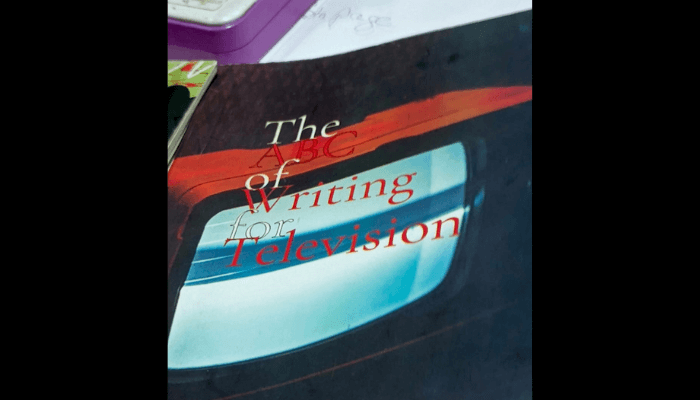
Nneonyediri Ukoha and Cordelia Eke, The ABC of Writing for Television (2022). Lagos: First Continental Resource Limited.
The ABC of Writing for Television, by Nneonyediri Ukoha and Cordelia Eke (2022), is a comprehensive guide for aspiring television writers. The book emphasises the foundational principles of screenwriting and focuses on the unique aspects of television writing.
The authors bring decades of practical scriptwriting experience with the Nigerian Television Authority (NTA) to this book. Cordelia Eke later drilled young undergraduates at the School of Media & Communication, Pan-Atlantic University.
The book benefits from the imprimatur of Nigeria’s Mr Television, Engr Vincent Maduka, who served as Director General of the Nigerian Television Authority from 1977 to 1986. He watched the authors develop from young post-NYSC staff to formal training by the BBC and other stellar broadcasting outfits.

He testifies: “The ABC of Writing for Television provides the learner and, indeed, the professional practitioner with the tool to progress from a blank sheet of paper to a story script and, therefore, to a professional production script. To deliver the outstanding video, we need the genius of a storyteller or story writer at the beginning and a creative producer and director at the far end.”
Here’s an overview of this instructive book’s key themes and structure
Key Themes
• Understanding Television Structure: The book explains the importance of episodic television’s A, B, and C storylines. The A story typically drives the main action, while the B story often explores character development. The C story may add lighter or comedic elements.
• Character Development: Ukoha and Eke stress the necessity of creating compelling characters that resonate with audiences. They provide techniques for developing character arcs throughout a series.
• Storytelling Techniques: The authors explore various storytelling techniques specific to television, including pacing, cliffhangers, and episodic structure. They highlight how these elements keep viewers engaged across multiple episodes.

• Practical Writing Skills: The book includes practical exercises and templates to help writers develop their skills in writing scripts, creating outlines, and revising their work effectively.
Structure of the Book
The book is organised into several parts that cover different aspects of writing for television:
1. Introduction to Television Writing: An overview of what makes television writing distinct from other forms of writing.
2. Story Structure: Detailed exploration of the A, B, and C stories, including how to weave them together for a cohesive narrative.
3. Character Creation: Techniques for developing multi-dimensional characters that can carry a series.
4. Writing Techniques: Practical advice on dialogue, scene construction, and pacing tailored for television formats.
. Revision and Feedback: Strategies for revising scripts based on feedback from peers or industry professionals.
6. Career Guidance: Insights into navigating a career in television writing, including networking and understanding the industry landscape.
Chapter 8, Types of Television Drama, details what professionals do with producing the many TV shows audiences love. The types include Series, Serial, One-Off, Action-Drama Series, Historical Drama (period drama), Children’s Drama, and Comedy. They also list musical drama, science fiction drama, and docudrama (documentary drama). Readers will find the step-by-step details of the process, from idea to research to script and execution.
An updated and sharper cover design would benefit the book, as would its online presence. The authors should hire modern designers to work on the cover and then post images of the book and the actual book online. Internet searches yielded nothing.
Nneonyeodiri Ogbeyalu Ukoha joined the Nigerian Television Authority following her BA in English/Journalism from the University of Missouri, USA. She worked in documentaries. The BBC’s Victor Pemberton trained her in scriptwriting. She then trained NTA staff drawn from all stations and independent writers on the art of writing for television. She received on-location production training from the Canadian Broadcasting Corporation in 1992. She got commendations and won many NTA awards, including the Director-General’s Award for Excellence.
As a creator, scriptwriter and script editor, Nne Ukoha was associated with Portrait of A Culture, Tales By Moonlight, The Honourable, Blow Dry, Second Chance, and Memorial Hospital, among others.
She served NTA as Head of Corporate Affairs and General Manager, NTA Makurdi and Yenagoa. She retired as the Zonal Director of the NTA Enugu Network Centre.
Cordelia Eke graduated in Modern Languages from the University of Nigeria, Nsukka. BBC’s Victor Pemberton trained her in scriptwriting and additional Television and Drama Production training at the Canadian Broadcasting Corporation. She received the Nigerian Television Authority’s Outstanding Performer in Writing. She was a jury member in adjudicating programmes at the 9th International Festival of Television Programmes for Children and Youth in Bratislava, Czechoslovakia. She wrote most of the long-running Third Eye detective drama series episodes on the NTA network.
Cordelia Eke won the Nigerian Media Merit Award in 1992 for her documentary Light At The End of The Tunnel. She retired as the General Manager of NTA, Calabar, in 2009.
The ABC of Writing for Television is a valuable resource for novice and experienced writers who want to hone their craft in television scriptwriting. It compares favourably with standard texts and guidance on TV production and scripting. Ukoha and Eke provide a roadmap for success in this competitive field by combining theoretical insights with practical applications.
It earns a highly recommended tag. It joins the growing list of books authored by professionals to enrich the curriculum of Nigerian academe with practical guidance.