As food inflation continues the upward swing affecting the affordability of many Nigerians, many citizens have since bade bye to their once-cherished staples.
According to the National Bureau of Statistics (NBS), the food inflation rate in June 2024 rose 40.87 percent on a year-on-year basis, which was 15.62 percent points higher compared to 25.25 percent recorded in June 2023.
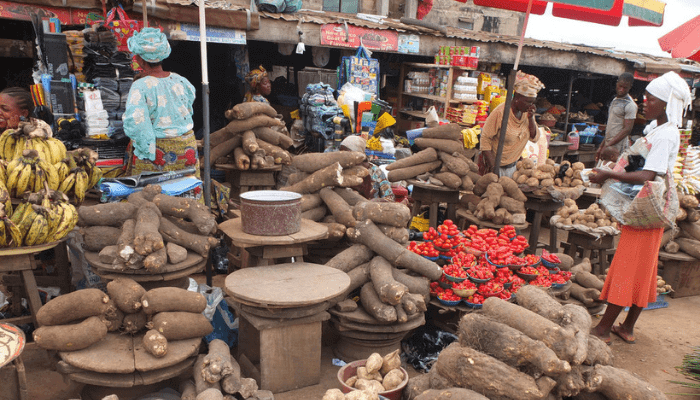
Yam, one of the major staples, seems to have gone out of the menu list of many families as a result of the high cost.
Currently, a tuber of yam that can satisfy a family of five now costs N10,000 as against N3,000 or N3,500 this period last year.

The current cruel economic condition of the country has negatively altered the choice of many Nigerians in many ways. This is evident in what they eat as prices of food items have gone beyond their affordability.
The effect of the constant pressure on the prices of the common food has created holes in many pockets leaving a lot of Nigerians hungry, and malnourished.
Read also: Food prices edge Nigeria inflation to 34. 19%
The drastic surge in the price of yam, particularly, has made it less of an option in the food list of several families, making it almost impossible to satisfy the wants and cravings of both kids and adult individuals.
Local food vendors find it difficult to keep up the dishes that involve the use of yam. Likewise, yam traders, both wholesalers and retailers do not find it favourable either.

As a result of the decline on the part of both buyers and sellers, retailers have resorted to making it easier to not only retain customers but also keep the market running by selling yam in pieces in order to make it affordable to those who cannot buy a whole tuber.
Read also: High food prices eat away at Nigerians’ income
In a brief interview with BusinessDaySunday, Mama Ogieva, a yam dealer at Ijesha market in Surulere, Lagos, revealed that “Many customers no longer buy yam as much, and as often as they bought last year.
“Not everyone who was used to buying a whole tuber of the big-sized yams can afford it now because it’s now very expensive. I used to sell the big tubers for around 5000 naira last year but as I speak to you today, it is exactly double the price, N10,000.
“In the course of offloading and shading the goods, we often end up having lots of broken tubers which eventually brings satisfaction to some customers due to the price hike.
“That’s the reason we now cut some tubers into smaller sizes, some into halves, some into smaller pieces depending on the amount the customers have. Besides doing that to clear out stock and avoid loss due to decay and waste, it also seems to be making a lot more sense than whole tubers nowadays.”
She further said that people are putting a lot of thinking in whatever they do now and how they spend their money. They do not want waste.
According to her, “Another reason why people buy the ‘cut yam’ is to avoid buying a whole tuber only to find out some parts are bad. But you know that this is a result of not having enough money. When people had money and could afford tubers of yam, they did not bother if the tubers were going to be bad inside of not. They could afford it then.”
Speaking on the implication of the high cost for the sellers, she said: “Before now, two or three people could contribute to buy a full truckload of yam tubers comfortably, not anymore. Now, big yam stores buy a truckload of yams in pairs of 5s, 6s, and as many as 10s.”