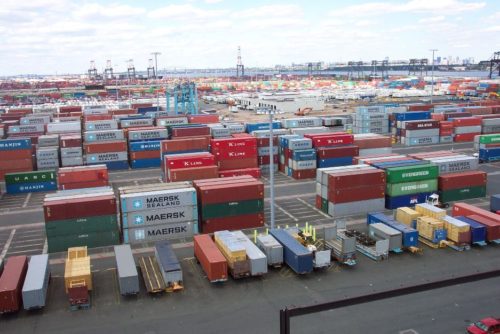
Nigerian ports are experiencing their worst congestion since the cargo handling aspect of the port business was handed over to private terminal operators 14 years ago.
Vessels with laden containers, which ordinarily should seamlessly discharge their consignments within 48 hours, now wait up to three weeks before accessing the ports to berth, indicating a roll-back of the high level of efficiency achieved with the port reform exercise in 2006.
Hapag-Lloyd, a German shipping firm, recently raised alarm that vessel waiting time for berth has increased to more than 20 days in Apapa Container Terminal and exceeds 10 days in Tin-Can Container Terminal.
Jonathan Nicol, president, Shippers Association of Lagos State, pointed to an apparent increase in the volume of cargo, suggesting that the ports in Lagos need to be expanded.

“Our port system lacks the basic infrastructure. The Nigeria Customs Service (NCS) also lacks functional scanning machines to ease cargo inspection, rather they rely on 100 percent physical examination, which elongates the dwell time of cargo at the ports. We have an increased volume of empty containers that litter almost all the port terminals because shipping companies are not retrieving their empties,” Nicol said.
“The ports lack government warehouses where overtime cargoes can be kept, rather such cargoes are kept in the same terminal where laden cargoes should berth. Overtime containers are government property and in most cases government can abandon them in the terminal for more than three years, thereby occupying space and creating congestion,” he said.
Tony Anakebe, managing director, Gold-Link Investment Ltd, a Lagos-based clearing and forwarding firm, said the problem the port industry is facing has to do with managing the success of the border closure.
“Several ships now queue on Nigerian waters without berthing due to lack of space. Several terminals are filled to the brim, and importers are made to pay demurrage as well as storage charges,” Anakebe said.
He said that in addition to congestion, importers also bear the brunt of the congestion on roads leading to Apapa as trucks queue for days to have access into the port to lift laden containers while shipping lines are making money from demurrages charged through container deposit.

“Given the situation of the roads, the cost of haulage has escalated such that importers pay between N600,000 and N700,000 to move 20-foot and 40-foot containers to warehouses in Lagos, and close to N1.2 million to go to other parts of the country,” he said.
To deal with congestion problem, the Nigerian Ports Authority (NPA) said it would begin to divert vessels that have waited for long to berth at any terminal within the Lagos Pilotage District to other terminals with capacity to berth vessels within the district, or to eastern ports, in the event that all terminals in Lagos cannot discharge any vessels within four days.
Nicol said there was nothing wrong with diverting vessels from Lagos to Warri or Port Harcourt Port but that the industry operators were concerned about the economic implication. He said the cost of transportation would be heavy on shippers, especially importers who bring in about 400 to 500 units of containers every week.
“The question is how the shipper will cater for the cost of moving the cargo back to his base in Lagos. When such number of containers are taken to eastern ports, it becomes the shipper’s headache as to how to move them back to his destination,” he said.
He further noted that it’s very expensive to clear goods in Port Harcourt, estimating the cost to be double the cost in Lagos ports.
“Nigeria conceptualised the idea of establishing a deep seaport in order to become West African hub, but that vision is yet to be actualised many years down the line. We have also failed to understand the role of multimodal transport system as well as good road network in ensuring effective cargo movement as well as decongesting Apapa,” said Boniface Aniebonam, founder, National Association of Government Approved Freight Forwarders (NAGAFF).
He said if government had appreciated the relevance of eastern ports, the current congestion problem would not have occurred.
AMAKA ANAGOR-EWUZIE