The Federal Government, on Wednesday, unveiled a national agricultural traceability and environmental monitoring framework designed to shield Nigeria from losing more than $4 billion in annual export value under the European Union’s new deforestation-free regulation (EUDR).
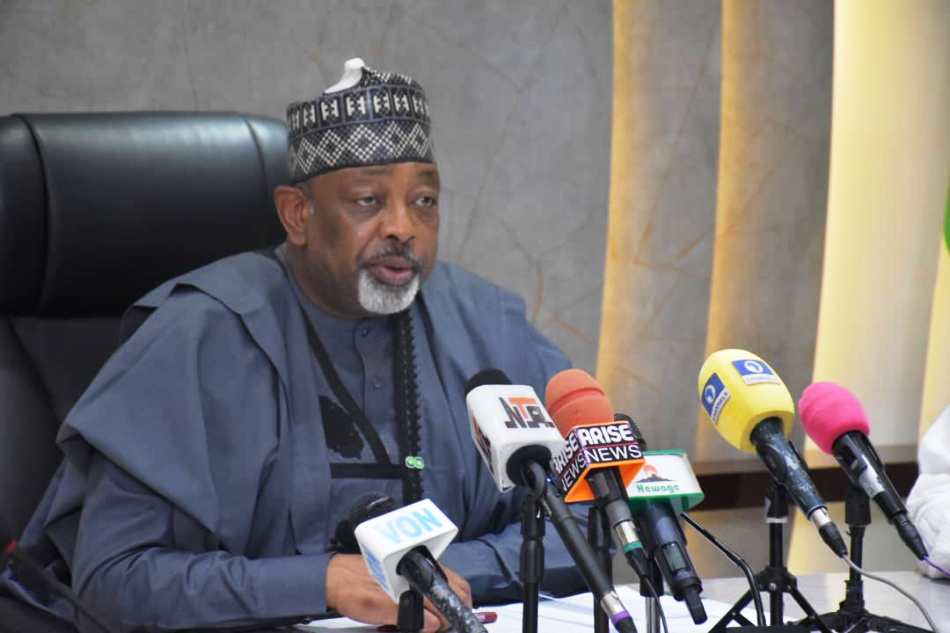
The initiative, launched by Abubakar Kyari, Minister of Agriculture and Food Security, includes the release of a White Paper on Nigeria’s EUDR compliance strategy and the signing of a landmark Memorandum of Understanding (MoU) with the National Space Research and Development Agency (NASRDA) in Abuja on Wednesday.
Kyari said the move marked a “new era where data, science and trust will shape the competitiveness of agricultural economies,” stressing that the EU will only recognise a single national traceability system—not fragmented state-level efforts.
“Nigeria faces the risk of losing over $1 billion in direct export earnings and $3 billion in total economic value annually if we fail to adapt,” the minister warned. “This system ensures that our commodities are traceable, legally produced, and verifiably deforestation-free.”

Under the MoU, NASRDA will provide satellite imagery, real-time monitoring, geospatial mapping, and technical leadership, while the Ministry will coordinate farmer registration, policy integration, and nationwide adoption.
In his remarks, Matthew Adepoju, Director-General/ Chief Executive Officer NASRDA, said that President Bola Tinubu had approved four new satellites—three optical and one synthetic aperture radar (SAR)—to strengthen Nigeria’s geospatial capability for agriculture, security and infrastructure.
Adepoju noted that NASRDA had already used space technology to identify fake beneficiaries in agriculture financing schemes, map schools nationwide, and monitor crop health under the ongoing CropWatch Nigeria project.
“Most terrestrial problems have solutions in space. With this partnership, Nigeria can deploy precision agriculture, nationwide geospatial mapping and real-time verification of farmlands,” he said.
He added that the agency would immediately begin implementing the MoU and would brief the President through the National Space Council, where the Minister sits as a Council member.

Giving the welcome remarks, Marcus Ogunbiyi, Permanent Secretary, Ministry of Agriculture and Food Security, described the White Paper as a “critical economic safeguard,” noting that global markets no longer tolerate weak environmental compliance.
He said the framework would provide a unified national database for farm mapping, Satellite-supported monitoring of land-use and forests, a traceability system for exporters, processors and aggregators and standards to guarantee Nigeria’s produce meets global sustainability criteria
“Compliance is no longer optional. This system ensures that Nigeria’s agricultural products remain trusted, traceable and competitive in global markets,” he said.
Kyari emphasised that although some States had begun their own mapping exercises, all data must feed into a central national platform—the only system recognised by the EU and global buyers.
He assured that the system prioritises smallholder farmers, offering simplified onboarding and tools designed to reduce compliance burdens while expanding access to premium export markets.
The initiative is expected to protect Nigeria’s export access to the EU market, enhance investor confidence in the agricultural value chain, modernise land-use monitoring and combat deforestation, improve income and opportunities for millions of farmers and position Nigeria as a competitive supplier in high-value global markets
Kyari concluded that the Government is determined to build a “technologically driven, globally respected, economically vibrant agricultural sector.”