To get a better sense of the poor state of finances and corruption in Nigeria’s oil producing regions, consider places like Aviara in Isoko South LGA of Delta State, where the former governor, budgeted N56.5 million to re-activate a fish farm in 2013.
When the Niger Delta Citizens and Budget Platform (NDCBP) an NGO, visited the site of the project, it reported a “farm that had no fishes and was desolate and enmeshed in a bush.”
The NDCBP estimated that the value of work done on the site was only N4.83 million.
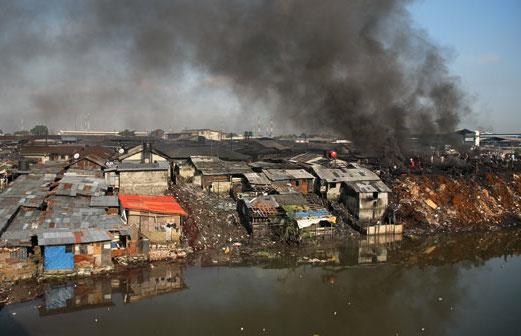
Residents of Nigeria’s oil regions are enmeshed in a vicious circle of poverty, unemployment and environmental degradation, as state governors in the area fail to impact on most of the communities despite having huge budgets.

The five major oil producing states of the Niger – Delta had a combined budget of N1.93 trillion ($11.6 billion) in 2013 comprising: Akwa Ibom (N540.1 billion), Bayelsa (N285.9 billion), Delta (N472 billion), Edo (N149.4 billion), and Rivers (N490.3 billion).
The combined budget of the five states was equivalent to the 2014 Federal budget of the West African country of Ghana, which spent 36 billion cedis ($11.61 billion) that fiscal year.
This spending by the governors is usually crafted to be siphoned off by corrupt practices.
“Edo State allocated N4 billion to security vote in 2013, which was more than double the capital allocations to food sufficiency, community development, commerce and industry, transport and public utilities and youth and sports combined,” the NDCBP said in a report.

Of the state’s N63.3 billion recurrent expenditure bill for 2013, N16.2 billion was allocated to overhead costs and 50 percent (N8 billion) of this was spent directly by the Governor’s office and agencies embedded in it.
In Akwa Ibom, most of the budgetary allocation has been embedded under the large budget grouping simply tagged “General Administration”. The state allocated N10 billion to ‘security expenses’ and N2.5 billion for ‘consultancy payments.’
In Bayelsa N500 million was budgeted for the construction of an abattoir at the capital, Yenagoa with no traces of any construction of such a project according to NDCBP.
In Rivers the share of the overhead costs allocated to Government House increased to N5.29 billion in 2013 from N4.7 billion in 2012.
Governors in the five states of the oil region racked up external debt of $285 million as at December 2014, according to data from the Debt Management Office (DMO).
Now, with the 50 percent sell-off in oil prices, most governors in Nigeria’s Niger Delta, who get a special 13 percent derivation proceed of all resources from petroleum sales are increasingly unable to pay salaries or borrow money, having already racked up huge debts.
Oil was trading at $54.94 for Brent as of 2:22 p.m. in London on Friday.
Inhabitants of the Niger Delta, feeling abandoned by the government at the centre and the state governors have resorted to siphoning oil from pipelines to sell to illegal oil traders and refineries.
Oil spills, gas-flaring and illegal refineries are ruining Niger delta waters with oil and cancer-causing chemicals, according to a study in the Journal of the Nigerian Medical Association.
Shell estimates oil leaks due to theft and sabotage in its Nigeria operations have increased from about half in 2008 to at least 80 percent.
“Two hundred and fifty thousand barrels per day of Nigerian crude are being stolen and people sell and put the money into individual accounts,” Nigerian president Muhammadu Buhari told members of Nigerians In Diaspora Organisation, in the United States last week.
PATRICK ATUANYA