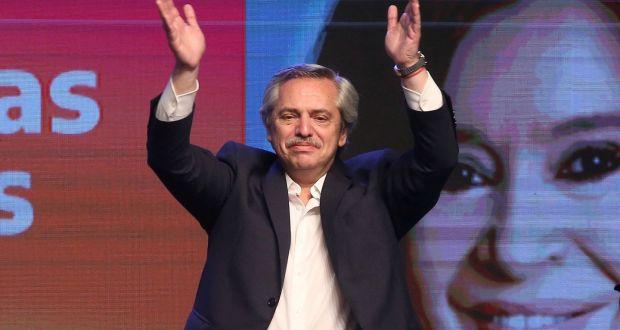
Argentina’s populist Peronists have swept back to power in Sunday’s presidential elections, with former cabinet chief Alberto Fernández winning a clear victory over pro-market incumbent Mauricio Macri amid a deep economic crisis.
Mr Fernández, 60, triumphed with 48 per cent of the vote, three percentage points above the margin needed for a firstround victory, while Mr Macri’s centre-right coalition received 40.4 per cent, with 96 per cent of the ballots counted.
The win was smaller than Mr Fernández had hoped for, suggesting unease among some voters at a return to power by his running mate, former president Cristina Fernández de Kirchner, who governed from 2007-15. The Peronist party, which generally favours interventionist and pro-worker policies, has ruled Argentina for all but six of the past 30 years.
The Peronist victory is further evidence that Latin America’s left is regaining force after several years of conservative gains. Populist left-winger Evo Morales claimed victory for a fourth term in Bolivia last week amid opposition accusations of electoral fraud. And mass protests in Chile demanding higher wages and pensions have forced the resignation of the entire centre-right cabinet.

“The times ahead will not be easy,” Mr Fernández told rapturous supporters who waved Argentine flags and chanted “we are coming back”.
In a stark reminder of the difficulties facing the Argentine economy, the central bank announced overnight a dramatic tightening of restrictions on foreign exchange purchases. Argentines will now be limited to buying just $200 a month, down from $10,000 a month before the election, in an effort to conserve scarce reserves.
Read also: Will Argentina be safe in the Peronists’ hands?
Mr Fernández said he would meet Mr Macri on Monday to discuss what is likely to be a difficult transition before he takes power in December.
“I hope that those who will now be our opponents are aware of the situation they have left us and that they help us to rebuild the country from the ashes,” said the president-elect.

Argentina’s economy is shrinking, inflation is running at more than 50 per cent a year, unemployment is over 10 per cent and more than one-third of the population lives in poverty. The country is on the brink of its ninth debt default, struggling to pay more than $100bn of foreign debt, much of it run up under a record $57bn IMF bailout handed to Mr Macri’s administration.
One of Mr Fernández’s first tasks will be to renegotiate Argentina’s debt. He named a transition team of four to handle economic issues, which includes former finance minister Guillermo Nielsen, as well as Matias Kulfas and Cecilia Todesca, who was an official at the central bank under Ms Fernández’s government.
Investors fear Argentina will demand that they take a loss on the face value of their debt, though the size of that “haircut” remains in doubt. The benchmark Argentina 2028 dollar bond fell 1.3 cents in early trading on Monday to 39.33 cents, Reuters reported.
Mr Macri conceded defeat in an emotional address to supporters and vowed to “continue working for Argentines through a healthy, constructive and responsible opposition”.