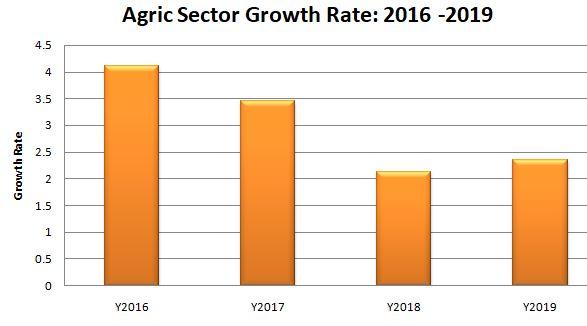
For the first time in four years since Muhammadu Buhari assumed the presidency, an analysis of Nigeria’s GDP report for 2019 has revealed the agric sector recording a growth rate higher than a previous year. Until last year, agriculture growth rate had been declining in the two previous years, which bad as it was, deviated from an irregular growth pattern, where every year of growth was followed by a decline as captured in an eight-year analysis by BusinessDay.
At the end of 2016, the first full calendar year of Buhari’s presidency, data from the National Bureau of Statics (NBS) showed the agric sector grew by 4.11 percent, but the following year, 2017, growth rate slowed to 3.45 percent, and in 2018, slowed even further to 2.12 percent. In 2019, the agric sector finally grew by 2.36 percent, an increase of 0.24 percentage points and the first such growth to be recorded under Buhari’s presidency. Yet, the current growth rate is still lower than what was recorded in 2016 and even 2017.
In some quarters, border closure, FX restrictions and some other factors may have been said to be responsible for this sudden growth, but for border closure in particular, analysis of data from the NBS does not support its contribution to growth in the agric sector.


The border was closed in August 2019 and if its effects were to be felt in the fourth quarter of the year, this does not appear to be the case. In the fourth quarter of 2019, the agric sector grew by 2.31 percent, a decline of 0.15 percentage points from 2.46 percent that was recorded in 2018 when the border was not closed.
Going by the GDP data released by the NBS, as there was no increase in growth rate of the fourth quarter of 2019, compared with the same period of 2018, the border closure cannot be said to have been one of the factors leading to the sudden growth in the sector.
In fact, the growth rates from the first to third quarters were higher in 2019 than 2018, except for the fourth quarter where the perceived gains of border closure should have been realised.
Nigeria’s economy may have recorded a 2.27 percent growth that exceeded projections of for instance the International Monetary Fund (IMF) at 2.1 percent, however; growth in the agricultural sector is failing to track the rhetoric of economic diversification through the sector. Not just by the incumbent administration but others before it, agricultural growth rate remains unimpressive and for most of the last nine years, has been abysmal.
In an earlier eight-year analysis by BusinessDay, between 2011 and 2018, for every year the agric sector recorded a growth, it would decline the following year, and as abysmal as this was, it became an established pattern for six years between 2011 and 2016. In 2017, however, the sector declined in growth rate (as expected going by this pattern), and this decline continued in 2018.


BusinessDay analysis of NBS data showed that in 2011 the Agric Sector recorded a GDP growth rate of 2.92 percent in real terms. In 2012 the sector improved, recording 6.7 percent, but the following year, 2013, declined to 2.94 percent. It again rose in 2014 to 4.27 percent, and going by the now established pattern, declined yet again in 2015 to 3.72 percent. It increased in 2016 to 4.11 percent, and as now established to be the pattern, declined to 3.45 percent in 2017. The sector however failed to grow the following year, 2018, when it was expected to grow again, going by the pattern established over time, instead further declining to 2.12 percent.
There may be some question as to why the current four-year analysis for the Buhari government is for 2016 to 2019. Considering Buhari came to power on May 29, 2015, effectively starting governance middle of the year, with cabinet appointment taking another five months, for the sake of balance, 2016 was adjudged the first full year he got to run the country; with the full complement of a cabinet and an agriculture policy that was also unveiled that year. Even if this appears unsatisfactory, the 2019 growth rate would still be the first being recorded after two years (2017 and 2018) of declining growth rate in the agric sector. Either way, the sector is just recording some measure of growth following years of expectations.
CALEB OJEWALE