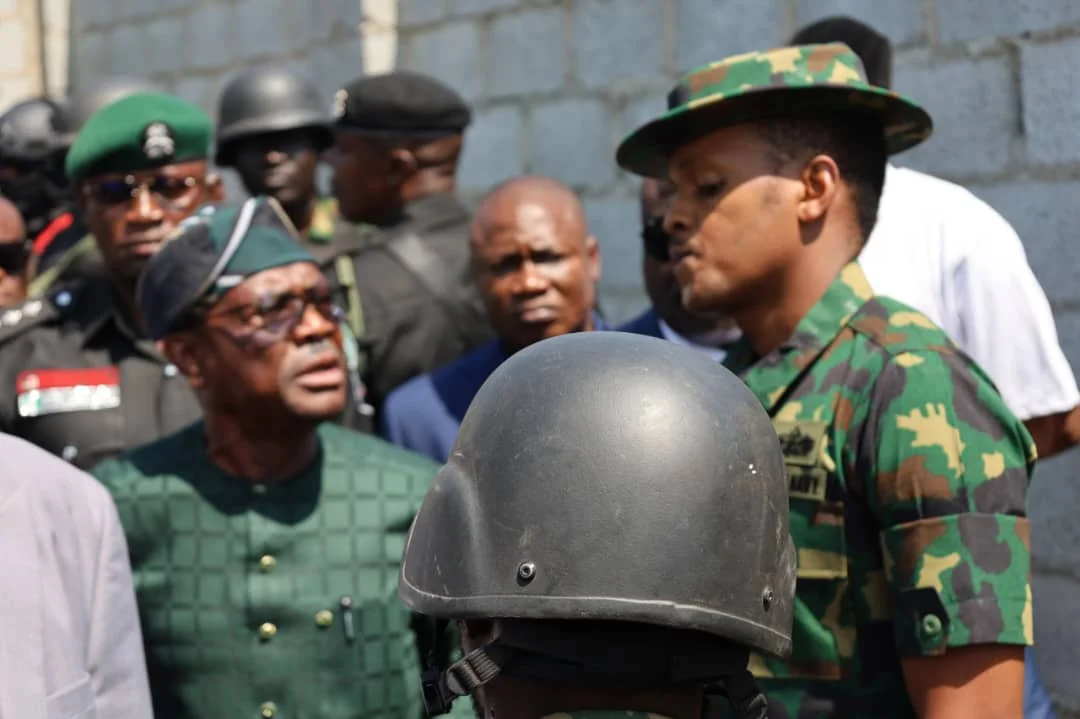
Sabastine Hon, a Professor of Law and Senior Advocate of Nigeria (SAN), has strongly condemned the actions of A.M Yerima, a young naval officer who obstructed the Minister of the Federal Capital Territory (FCT), Nyesom Wike, from gaining access to a parcel of land in Abuja.
In a statement titled “My Brief Opinion on the Faceoff Between Nyesom Wike and the Young Naval Officer, A.M. Yerima,” made available to BusinessDay via WhatsApp on Wednesday in Jos, Hon described the officer’s conduct as “totally condemnable,” stressing that obedience to superior orders has clear constitutional and judicial limits in Nigeria’s military structure.
The senior lawyer cited the recent Supreme Court decision in Onunze vs. State (2023) 8 NWLR (Pt. 1885) 61, where Justice Ogunwunmiju held that the obligation to obey superior orders does not extend to “palpably illegal or manifestly unjust” commands.
He emphasised that every officer’s oath is to defend the Constitution, not to execute illegal instructions.

Quoting further from the apex court’s ruling, the professor of law reminded military personnel that they could be held personally liable for illegal actions carried out in obedience to such orders, adding that this principle had been consistently affirmed by the courts.
Read also: No soldier on lawful duty will be punished over Wike clash , says Defence Minister
He also referenced Nigeria Air Force vs. James (2002) 18 NWLR (Pt. 798) 295, in which the Supreme Court made it clear that soldiers and officers are subject to both military and civil law, and cannot hide under illegal directives. According to Hon, “it is monstrous to suppose that a soldier could be protected when the order is grossly and manifestly illegal.”
The constitutional lawyer argued that no service law in Nigeria authorises a serving officer to mount guard at a private construction site of his superior, calling the action “an aberration and a serious breach of service discipline.” He maintained that the officer should have engaged the civil police if he suspected any threat or criminal activity.
The Senior Advocate further explained that the FCT Minister, by virtue of sections 297(2) and 302 of the 1999 Constitution (as amended), exercises delegated powers of the President of Nigeria concerning land administration in the Federal Capital Territory. “Therefore, Wike’s authority in Abuja is constitutionally equivalent to that of a state governor”; he said.

He noted that obstructing Wike from entering the land amounted to obstructing the President’s representative and, by extension, the Commander-in-Chief of the Armed Forces. He warned that such insubordination undermines the civil authority of the President and breaches both constitutional and military regulations.
Citing section 114 of the Armed Forces Act, Hon stated that military officers are criminally liable for civil offences and that Yerima could face court martial or prosecution for obstructing a public officer in the performance of his duties.
The legal luminary warned against celebrating the humiliation of public officials, arguing that condoning such actions could embolden military personnel to act with impunity against civilians. “If this conduct is left unpunished, it may unleash a reign of terror by men in khaki against hapless civilians. This is not Nigeria of our dream,” he declared.