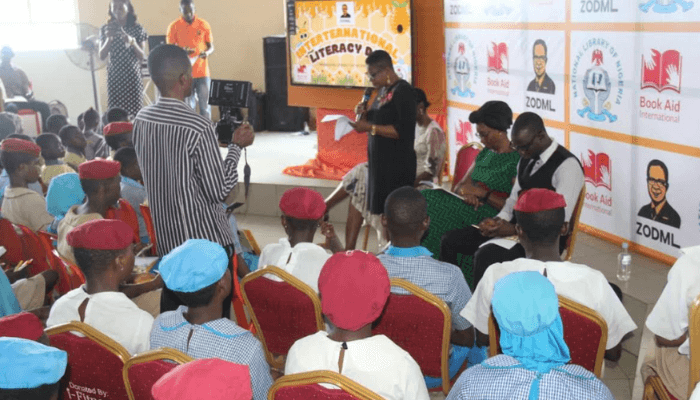
…as the National Library, ZODML commemorates International Literacy Day
As digital technology becomes increasingly central to education and daily life, experts have called for the responsible adoption of digital literacy in Nigerian schools to curb students’ abuse of technology integration in learning across the country.
They emphasise that beyond access to devices and the internet, students must be equipped with the skills to navigate the digital world safely, ethically, and effectively.
Obianuju Onuorah, deputy director at the National Library of Nigeria, speaking at the commemoration of International Literacy Day organised by the National Library of Nigeria and the Zacchaeus Onumba Dibiaezue Memorial Library on Tuesday, September 30, said that in today’s digital world, literacy encompasses not only traditional reading and writing skills but also digital literacy.

“It is essential to equip everyone, including students, with the skills to navigate, evaluate, and create digital content,” she said.
Onuorah, who is also the head of the National Library of Nigeria, Lagos branch, said their institutions serve as a hub for knowledge innovation and community engagement.
“We are committed to supplying literacy initiatives and providing resources that empower Nigerians to achieve their full potential in the digital era,” she noted.
She emphasised that the International Literacy Day is observed annually on September 8, and that it was first held in 1967 by UNESCO to remind the world that literacy is a foundational human right and a pathway to dignity, opportunity, and equality.
Literacy, she explained, opens the door to education, creativity, and lifelong learning for children and lays the foundation for inclusion, sustainability, and progress.

The theme for 2025 International Literacy Day (ILD) is ‘Promoting Literacy in the Digital Era’, which highlights the importance of literacy in the digital age and the need to harness technology to promote education and socio-economic development.
Ifeoma Esiri, chairperson at Zacchaeus Onumba Dibiaezue Memorial Library, said that digital learning is something that has come to stay, and that Nigerians must embrace the truth of modern education, which is digital.
Esiri emphasised there is no two ways about the exposure a child can have, but by sensibly using the internet to gather information about all sorts of things, stressing that AI is a tool that, when used responsibly, is empowering.
“Technology has taken over the way people learn, and it has come to stay. So it’s for us to understand it and empower our children to know how to use it responsibly.
“If they use it responsibly, they will be able to acquire the knowledge and learn from it,” she said.
She applauded the collaborations with Book Aid International, a UK-based charity organisation that works with UK publishers to supply brand-new books to libraries and communities in need, primarily in sub-Saharan Africa.
She said collaborations with Book Aid International and the National Library of Nigeria have been very impactful in her organisation’s literacy drive.
Agbaje Daniels, a staff member of the Mainland Local Government Education Authority, urged the students not to use digital tools in negative ways. “The one thing that I love about this digital literacy is the fact that it augments our learning.
“Digital tools expand our knowledge and add more speed to our learning. But I implore you as a student, make use of those tech tools wisely,” he said.
Olatunbosun Taofeek anchored the panel discussion session on ‘Blending Books and Digital Tools: How Technology is Transforming Learning.’ He told the students that their ability to blend books and digital tools will distinguish them.
“Strive to always read from both sides, read your books, and at the same time use your digital devices,” he emphasised.
Bisola Bilewu, head of catalogue at the National Library of Nigeria, took the students through a digital treasure hunt session.
The event had over 100 students from different primary and secondary schools across Lagos State in attendance.