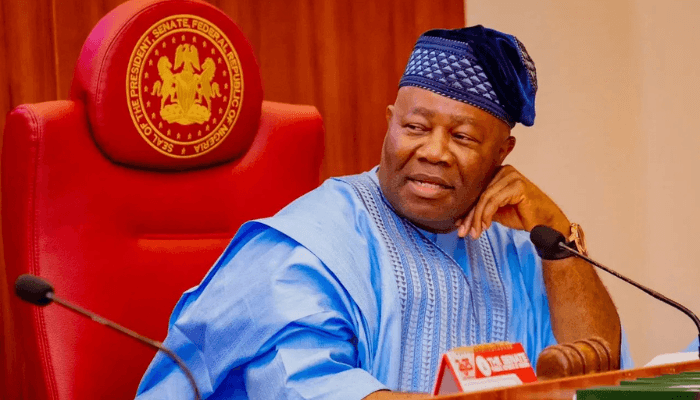
Godswill Akpabio, the Senate President, on Wednesday, declared that banditry would come to an end in 2026.
Akpabio gave the assurance while lawmakers raised the alarm over worsening insecurity in Katsina State following fresh attacks that left at least 35 persons dead within 24 hours.
The Senate also resolved to press for urgent military and humanitarian intervention in the affected areas.
The resolutions followed the adoption of a motion of urgent public importance on the recent ambush of operatives of the Nigeria Police Mobile Force in Bakori Local Government Area of Katsina State, where three policemen were killed and two others critically injured in broad daylight.

Leading the debate, the sponsor of the motion, Senator Mohammed Dandutse, said the Senate was “deeply disturbed by the scale and frequency of attacks across communities in Katsina State.”
He disclosed that “as of Tuesday, February 3, 2026, no fewer than 35 people were killed in coordinated attacks across several local government areas within a 24-hour period.”
Breaking down the figures, Dandutse said, “Twenty-four persons were killed in Faskari Local Government Area, eight in Dandume, two in Funtua and one in Kankara.”
He warned that sustained attacks on rural communities were already crippling agricultural activities in the State.
“Over 50,000 farmlands have reportedly been abandoned due to insecurity, thereby threatening food security and the livelihoods of the people,” he said.

The senator recalled that Governor Dikko Radda of Katsina State had earlier led a delegation of elders from the Funtua Zone to President Bola Ahmed Tinubu to brief him on the deteriorating security situation.
“During that visit, the President pledged to establish a military barracks in the zone, particularly around Malumfashi, to stem the tide of banditry,” Dandutse said.
Read also: Senate’s rejection of electronic transmission of results may increase apathy, PDP warns
He expressed concern that criminal gangs continued to exploit porous corridors linking Katsina with parts of Kaduna and Zamfara states, including forest routes around Machika and Kankara, stressing the need for stronger interstate security coordination.
He warned that continued inaction could lead to “mass displacement, the collapse of rural livelihoods and long-term psychological trauma for vulnerable populations.”
Contributing to the debate, the Deputy Senate President, Barau Jibrin, said while the military and security agencies were making efforts, more decisive action was required.
“The determination of these bandits shows that we need to do more. We need to add more force, deploy more technology and rely on stronger intelligence-driven operations,” he said.
Several senators described the affected areas as Nigeria’s agricultural heartland, warning that persistent insecurity there posed a serious national economic threat.
Senator Ahmed Aliyu Wadada cautioned strongly against negotiating with bandits.
“Negotiating with bandits only emboldens them. It does not bring lasting peace,” he said, insisting that intelligence-led operations must remain the first line of action.
Following deliberations, the Senate unanimously adopted the motion and urged President Bola Ahmed Tinubu to immediately fulfil his pledge to establish a new military barracks in the affected zone of Katsina State.
The resolutions also included a directive to the Inspector-General of Police to equip the newly established police squadron in the area.
“The Inspector-General of Police should ensure the provision of at least three Armoured Personnel Carriers to boost intelligence-led operations, forest combing, cross-border collaboration and community-based intelligence,” the Senate resolved.
Lawmakers further called on security agencies to sustain coordinated operations “until all criminal elements are flushed out of Katsina State and neighbouring hotspots,” while mandating the Federal Ministry of Humanitarian Affairs and the National Emergency Management Agency (NEMA) to provide immediate relief to affected and traumatised families.
Residents of the affected communities were also urged to remain united, vigilant and supportive of security efforts, while resisting internal collaborators who undermine national security.
In his remarks, Senate President Godswill Akpabio assured lawmakers of the Senate’s resolve to end banditry, declaring that 2026 would mark a turning point.
“I want to thank you, Senator Maidoki, for your very strong stance and to say that we in the Senate are with you. We share the same opinion,” Akpabio said.
“We are of the opinion that this banditry should end. In fact, on the 1st of January, my prayer to God, which I also shared with the nation, was that banditry and insurgency should end this year,” he added.
Striking a note of optimism, the Senate President said, “By the grace of God, in 2026, we will not see our end, but rather we shall see the end of 2026 and the end of banditry. That is our prayer.”
Akpabio acknowledged the anger and frustration expressed by senators but cautioned that the challenge was complex.
“They go for soft targets. We cannot have military barracks in every village in Nigeria. The country is very vast,” he said.
“When they strike, they cause massive damage, and by the time we move there, it becomes reactionary,” he added, advocating the deployment of technology.
“I advise that we explore the use of very sophisticated drones in vast areas that cannot be effectively manned,” Akpabio said.
He assured lawmakers that the National Assembly would reflect their concerns in the 2026 budget.
“I assure you that the National Assembly will take cognisance of your plea and look at the 2026 budget in a way that will favour the military in general,” he said, adding that the National Orientation Agency would also be strengthened “to sensitise the public so that when you see anything, you should report.”
In honour of victims of the attacks, the Senate observed a one-minute silence.