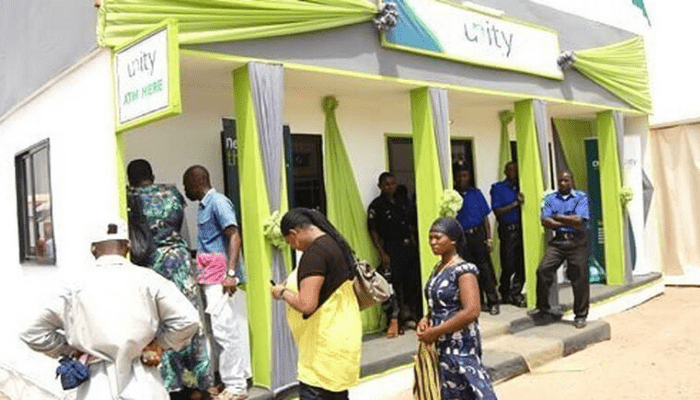
Shareholders of Unity Bank Plc heaved a sigh of relief last week when the board of the second tier bank announced its performance for 2019. The bank announced a profit after tax of N3.38 billion for the financial year 2019 last week. The performance, when compared with the year before, was a milestone in view of the fact that about the same time in 2018, the bank posted a loss after tax of N7.7 billion.
The transformation agenda the bank’s board and management have pursued in the last few months has started to pay off. Gross earnings for the year rose by 29 percent to N43.59 billion in 2019 up from N34.65 billion in the previous year. Interest income rose by 22 percent to N35.95 billion from N29,51 billion in 2018.
Interest income came mainly from loans and advances to customers which earned the bank N21.89 billion in 2019, and thus accounted for 61 percent of the bank’s interest income. In 2018, Unity Bank realised N17.64 billion as interest income from loans and advances extended to customers, accounting for the same weight of that year’s total interest income.
Other sources of interest income were treasury bills where the bank made N9.53 billion in 2019 as against N8.52 billion in 2018; and bonds, bonds (amortised cost) which generated N3.9 billion last year compared with N2.99 billion in the previous year.

Unity Bank did not earn much from interbank transactions as its interest income from placement with banks amounted to just N632 million in 2019, as against N361 million in 2019. Nevertheless, the interest payment to banks constituted the bulk of its interest expense. This is because out of the N19.45 billion interest expenses it paid in 2019, the expense due to banks was N10.12 billion, representing 52 percent of the total interest expense.
Net operating income was N23.2 billion in 2019 compared with N13.16 billion in the previous year. The total operating expenses fell to N19.6 billion down from N20.7 billion in 2018. Two segments of its expenses were responsible for this decline. Personnel expenses were reduced to N9.4 billion last year in contrast to N10 billion in the previous year. Admin expenses fell to N5.2 billion down from N5.9 billion during the reference period.
The reduction in personnel cost implied that 156 workers exited the bank in 2019 when the bank’s total workforce was 1,578 as against 1,734 in 2018. Employees mostly affected earned between N2.8 million and N3.5 million annually.
The level of employees had 547 in 2019 whereas in 2018 there were 656 of them in the employ of Unity Bank, meaning that the bank axed 109 of its staff within this cadre. Thirty eight staff of the bank who earned between N5.5 to N6.5 million annually also left the system in 2019, just as 6 among those who earned N3.6 to N4 million left the system last year.
The north central and north east accounted for the bulk of its risk. With N73 billion in north central and N16.77 billion in north east, those two geopolitical zones held N89.8 billion, or 84 percent of its risk assets out of N106.9 billion total risk assets the bank had in 2019.

During the year under review, risk assets allocated to the north east increased by 1,408 percent while those allocated to north central rose by 140 percent when compared with their levels in 2018.
The news of its return to profitability was immediately noticed by investors as its share price gained 9.62 percent last week to close at N0.57 per share as against N0.52 per share, and thus emerged as one of the top performing stocks last week.
The bank donated N39.16 million to the needy through its CSR activities in 2019, far higher than N13.4 million it donated in 2018. Among the beneficiaries of its CSR projects were the Osun State Millennium Development Goals Programme, Local Government Staff Pension Board Training, ASSIFFI Local Intervention Program, Cash Management Accident Victims Support, and Almighty God Compassion Care Home.