The United Children’s Fund (UNICEF) in collaboration with the Federal Ministry of Budget and National Planning, Nigerian Guild of Editors (NGE) and the Diamond Award for Media Excellence (DAME) to host a symposium aimed at raising awareness on the role of child reporting in accelerating progress on child related issues in Nigeria.
The event which held at Radisson Blu Hotel, Lagos, with the theme; “Reinforcing the Role of the Media in Mainstreaming Child Rights,’ touched on the need to amplify the issues affected children as well as possible solutions.
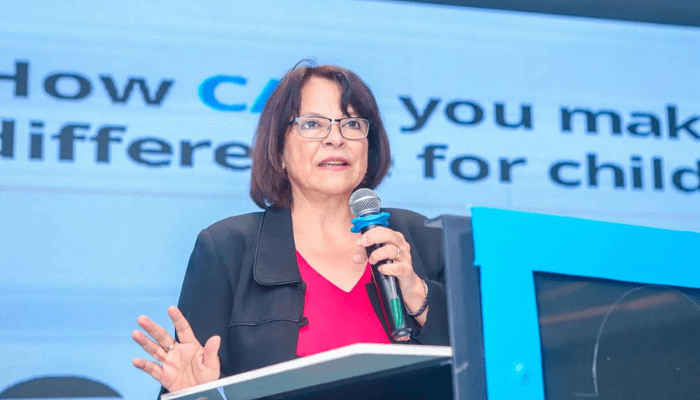
Christian Mundute, UNICEF Country Representative, in her paper titled, ‘The State of Nigeria’s Children: summary of the 2024 situational Analysis of Children and Adolescents in Nigeria,’ noted that the challenges which confront Nigerian children cover a broad range category.
According to her, the challenges range from increasing rate of maternal and child mortality as a result of poor access to healthcare, lack of access to sanitation facilities, violence against children and abuse of children, poverty and malnutrition and lack of access to vaccination services, amongst others.

She said: “2.1 million children in the country still have no dose of any vaccine and these children are at high risk to get any preventable disease. Almost 10 million children at primary school age who are not attending school due to different factors like services and security. We know that parents want to protect their child, so they prefer not to send them to school.
“Also, poverty plays a critical role. 10 million children in primary school, more or less 8 million plus in junior high school. Need to have access and need to have the opportunity to be educated. It is important to create awareness through stories and to show more of what is happening, ” said Mundute.
Read also: UNICEF deepens healthcare in Bauchi with oxygen plant, baby care facility
Mundute emphasized that it is also important to inform about the good things that are happening although they are still on a small scale.
“The more you inform the public on the successes made, the more opportunities there are to scale them up.

“If open defecation ends in Nigeria, there will be a dramatic change in the health status of children around the country. It would culminate in the end of polio, cholera, diarrhea, diphtheria and a lot of other illnesses.
“Right now, as you saw, the challenge is huge so we hope to accelerate progress by leveraging on stronger partnership with the media,” she advised.
Also speaking, Eze Anaba, president, Nigerian Guild of Editors, stressed the importance of such collaborations to strengthen public knowledge on the existing challenges which affects children.
While charging journalists to rise to their responsibilities, Anaba explained that the media remains a dominant force in shaping public opinions and as such must actively engage existing social issues to proffer solutions through data driven journalism focused on positively impacting society.
“As journalists, we are confronted daily by existential issues. The media is not just a passive observer of society. It is an active participant in shaping societal norms and influencing policies. Our role in mainstreaming child rights is as important as any other stakeholder.
“We must uncover and amplify the voices of the voiceless by highlighting the challenges children face. The narrative we create can inspire, mobilize, and drive change. Today, I urge us all to channel this power towards a cause that demands our collective attention. The rights and well-being of Nigerian children,” he said.
On his part, Tunde Onakoya, founder, Chess in Slums Africa, giving a presentation on the ‘urgency of the situation,’ stated that nearly half of 7 million Nigerian children live in abject poverty. With Nigeria being one of the countries with the youngest population in the world. He warned that if deliberate measures are not taken to invest in the capacity of Nigerian children, they will have no part to play in the world’s future.
He said: “Every time and we talk about the children that are going to be custodians of that future but the real nigerian challenge is the struggle of the nigerian child. Nigeria is going to be the future workforce in the world in the next 50 years as europe. If we have 20 million children out of school that do not have any skill, any education, how would they participate in that future?
“There really would be no place for them in the world if they don’t have the education to contribute meaningfully to global markets. So what happens is that they will become liabilities to the future because they have no value to give. The world wants assets and it desires their educated workforce to come build economies.
“Nigeria and Africa generally focus on the minerals that we have, the crude oil and other raw materials but the world doesn’t want to have finished our products. However, our finished products which is the world wants is our children and the human capital that we have but it rejects the unfinished ones that are uneducated.
“This is the real nigerian challenge that we invest more in our children and we export less raw materials. This is the greatest investment that we ever make in the future of the children and this is the real crisis that we need to tackle. The second thing is our role as storytellers now that we understand the problem and we understand the complexity of the problem.”