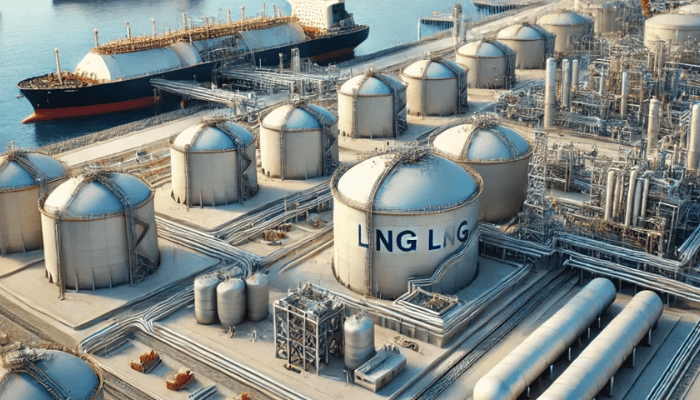
The article examines the rapid transformation of the United States (U.S.) from a net importer of liquefied natural gas (LNG) for decades to a net exporter of LNG in 2017-2018; and to the leading global LNG exporter since 2022. The U.S. began its foray into LNG exports with 0.5 billion cubic feet per year (bcf/y) in 2016 reaching an estimated average of14.6 bcf/y in 2025, with total shipments growing significantly in the first ten months of the year. According to the United States’ Energy Information Administration (EIA), exports could rise to 18.1 billion cubic feet per year by 2027, which is about 137.54 million tonnes per annum (mtpa). The U.S. has not only outpaced Australia and Qatar as the leading exporter of LNG globally, but its operational capacity grew by 24 mtpa to a total of 116 mtpa in 2025. Exports grew by 25% year-on-year in 2025. The U.S. exports LNG to 48 countries, Europe is its major export region and South Korea is the single largest export market. There are currently eight LNG export terminals (LNG liquefaction plant, plus storage tanks and jetties or shipping infrastructure and administrative facilities). By the time current construction of additional export terminals are completed by the end of the decade, the total LNG export capacity of the U.S. is expected to increase to 26 billion cubic feet per day or 266 billion cubic meters per annum – approximately 197.6 million tonnes per annum (mtpa).
The United States achieved LNG export dominance within six years (2016-2022). The following are the reasons for this stellar performance:
• The Shale Revolution, which started in the early 2000s but gathered momentum with significant shale gas production between 20205 and 2008. The Shale Revolution, also known as the Shale Boom or Fracking Revolution unlocked tremendous amounts of gas in the United States and some other jurisdictions, but principally in the U.S. “The Shale Revolution, also known as the Shale Boom or Fracking Revolution, refers to the significant increase in oil and natural gas production due to the application of hydraulic fracturing (fracking) and horizontal drilling technologies for the extraction of oil and gas from previously in-accessible shale formations. The technological advancements and economies of scale achieved through the Shale Revolution have made the United States one of the world’s largest oil and gas producers. The Shale Revolution has had a profound impact on the US energy market, leading to a significant increase in domestic oil and gas production.” The low cost of production of shale gas in U.S. reduced the price of gas to as low as between 20% to 25%, which gave American gas exports a strong competitive edge.
• The conversion in 2016 of the Sabine Pass LNG terminal in Louisiana from an LNG import terminal to an LNG export terminal in the wake of the Shale Revolution. “Since its inception, it has become a pivotal player in the U.S. LNG export market, increasing exports from 0.5 billion cubic feet per day (Bcf/d) in 2016 to 15.0 Bcf/d in 2025. The terminal has shipped over 3,300 cargoes worldwide, accounting for 39% of all U.S. export cargoes through November 2025.”

• Technological advancements and strategic infrastructure investments which resulted in the conversion of existing LNG import terminals (plus LNG regasification plants) into LNG export terminals (plus LNG liquefaction plants), including improved transport networks and export logistics transformations, which enabled the rapid expansion of U.S. LNG exports to markets around the world, allowing the U.S. become the dominant global LNG exporter within a short period of six years.
• Flexible contracting and pricing have given U.S. LNG competitive advantage further enhanced by shale gas production cost advantage. While other LNG-exporting countries used rigid long-term contracts tied to Brent crude oil prices, American LNG exporters allow for flexible destinations and re-routing of shipments to various export markets. The result is that LNG from U.S exporters is often cheaper compared to their competitors’.
• There are currently eight industrial-scale LNG export terminals in the United States with a total capacity to produce close to 15 bcf/d (114 mtpa) of LNG per annum. Current construction projects in the sector will significantly increase that capacity by 2030.
• Needless to say, U.S. LNG exporters are backed by the most advanced oil and gas technologies, the largest and most sophisticated financial system and infrastructure and the largest economy ($31.8 trillion) in the world with a plethora of financial and technological options for project finance and some of the richest and largest institutional investors in the world. Besides, it is an entirely private sector driven system, with government only concerned with providing an enabling business environment. So, decision-making is fast without political interference or midstream abandonment of sound business case projects; and successful projects are easily scalable and replicable.
The United States LNG scenario is far and ahead of other competitors for thereasons given above, which are by no means exhaustive. But we live in a world of possibilities; and from a strictly entrepreneurial point of view, a world in which we create our own possibilities and opportunities. As it is for individuals, so it is for nations. Nigerai must pick up the gauntlet of leveraging on its huge proven gas reserves, which is the 10th largest in the world to embark on an extraordinary mission to reposition its LNG exports by doubling its liquefaction capacity in the next five years from 30 mtpa in 2026 to 60 mtpa, in line with what is currently happening in the U.S. and Qatar.. This is achievable if Nigeria LNG Ltd can embark on a 10 mtpa capacity Train 8 project, deliverable by 2030; if we can find local and international investors to revive Brass LNG and Olokola LNG, each with two trains of 7 mtpa per train, making a total of 28 mtpa; and if we can find local and international investors who can invest in additional four floating LNG (FLNG) projects of 3 mtpa each – in addition to the ongoing UTM FLNG project.. These projects have a total additional capacity of 50 mtpa. This is the kind of mindset that has positioned Qatar, a Gulf state of 3.2 million people as one of the top three LNG exporting countries in the world.

Nigeria’s gross domestic product GDP has experienced some improvements in the last month or so, according to the International Monetary Fund (IMF), but even then, at $334.4 billion and with a population of 242.4 million, compared to Singapore, $606.2 billion GDP (with a population of 5.9 million) and United Arab Emirates, $601.2 billion GDP (with a population of 11.6 million), it is obvious Nigeria has a great deal of work to do to upscale its GDP. That is where the $1 trillion aspiration of President Bola Ahmed Tinubu becomes relevant and urgent. However, it will remain an aspiration unless Nigeria leverages on some sectors to give the economy a push. The power sector is one such sector. Unless the power sector is privatised, there is very little hope no matter what government does, (including setting up a power sector asset management company) of its turnaround and its contribution to the turnaround of the economy at large. Another critical sector is gas. Apart from the Decades of Gas (DoG) initiative’s global objectives, leveraging specifically on an ambitious transformation of Nigeria’s LNG exports along with other gas sector objectives is one sure way to turn the Nigerian economy around and bring it closer to $1 trillion in the shortest possible time.
• Mr. Igbinoba is Team Lead/CEO at ProServe Options Consulting, Lagos