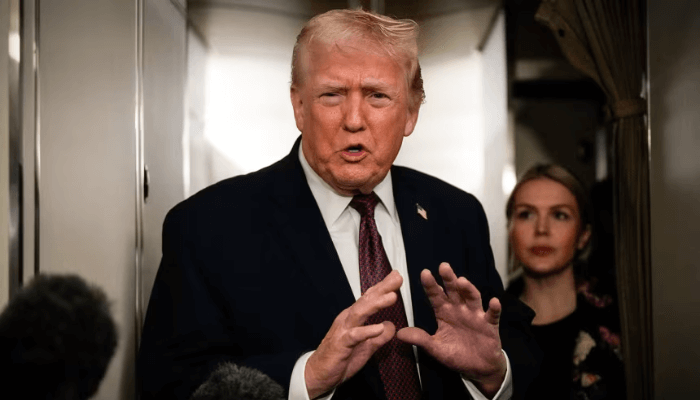
Committees of the United States House of Representatives have formally presented a report on Nigeria’s security and religious freedom situation to Donald Trump.
The report, compiled by members of the House Committees on Appropriations and Foreign Affairs, followed months of investigations, expert testimonies and on-the-ground assessments.
It outlines findings on alleged persecution of Christians, extremist violence and broader insecurity across parts of Nigeria.
The submission comes on the heels of President Trump’s decision to redesignate Nigeria as a Country of Particular Concern (CPC) under the US International Religious Freedom Act.
The designation places Nigeria back on Washington’s formal religious watchlist and triggered a congressional probe into claims of religious persecution and terrorism-related violence.
Trump had directed Riley Moore,
Congressman and Tom Cole, House Appropriations Committee Chairman to spearhead the investigation.
Moore confirmed the report’s submission in a statement posted on his official X account, describing a White House meeting as the culmination of extensive bipartisan work.
According to him, the findings were drawn from congressional hearings, closed-door roundtables, expert testimonies and two separate bipartisan fact-finding visits to Nigeria.
During one of the visits, the US delegation toured Internally Displaced Persons camps in Benue State, met victims of attacks and held consultations with senior Nigerian officials, including the National Security Adviser, Nuhu Ribadu.
Moore said the engagements offered what he described as a clearer understanding of the scale of insecurity and the challenges facing Christian communities in parts of the country.
“I travelled on a bipartisan delegation to Nigeria and saw with my own eyes the atrocities Christians face and the instability the Nigerian government must combat,” he stated.
The report proposes a bilateral security agreement between the United States and Nigeria aimed at protecting vulnerable communities and dismantling extremist networks.
It also recommends withholding certain US funds pending measurable action by the Nigerian government to curb violence.
Among other measures outlined are sanctions and visa restrictions against individuals or groups found complicit in religious persecution.
The document further calls for technical assistance to help Nigerian authorities address violence attributed to armed Fulani militias.
Lawmakers additionally urged a review and repeal of Sharia and blasphemy laws they consider discriminatory, while advocating coordinated diplomatic action with international partners including France, Hungary and the United Kingdom.
Moore described the White House engagement as productive and commended Trump for redesignating Nigeria as a CPC, arguing that deeper cooperation between Washington and Abuja would serve the interests of both nations.
“Together, we must address these pressing security challenges and bring an end to violence against Christians,” he said.
Nigeria’s religious freedom record has long been a recurring point of friction in US–Nigeria relations.
Read also:
During Trump’s first term, Nigeria was designated a Country of Particular Concern in 2020.
The designation was removed in 2021 under Joe Biden, a move that drew criticism from some American lawmakers, including Chris Smith, who argued that violence against Christians remained severe.
Trump’s recent redesignation reinstated Nigeria on Washington’s religious watchlist and formally set in motion the congressional investigation led by Moore and Cole.
On it’s part, the Federal Government has consistently maintained that the violence is rooted in terrorism, criminality and communal conflicts, not state-sponsored religious persecution.