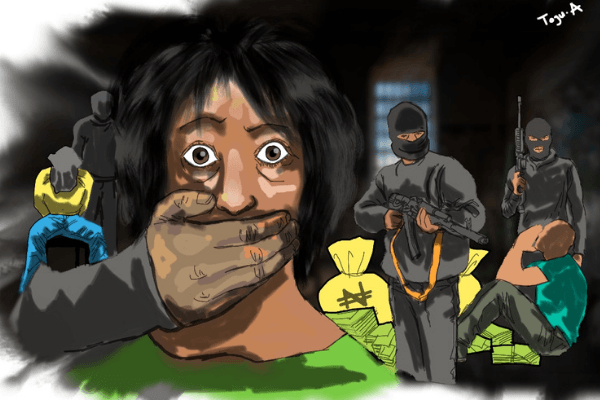
The average Nigerian is no longer safe. To make matters worse, BusinessDay investigation through interactions with victims of Kidnap, suggests some officers of the Nigerian Police Force are actively conniving with gangs of kidnappers across the country.
Gangs of mostly young men have taken to bush paths, not for farming or to hunt games, rather, hunting for their fellow human beings to maim, rob, and kidnap for ransom. For those who cannot afford to take flights, every road trip is fast becoming a one-way ticket with a possibility of no return.
From Aba in the southeast, to Oyo in the South West, Zamfara in the northwest, and even the FCT, Abuja and the now notorious expressway linking it with Kaduna, millions of Nigerians commute daily in fear of not returning home safely.
As some accounts indicate in interviews conducted by this reporter, even when kidnappers drove through police checkpoints, and victims thought they were about to regain freedom, just like a suspense-filled horror-movie, the kidnappers would only extend some cash to the uniformed men at the checkpoint, and proceed on their journey with the victims.

No attention is paid to those held in the vehicle against their will, perhaps, if they did, they would notice their distraught countenance, and even the gun pressed against their body to keep them silent. The police is usually not involved in the rescue process, mostly based on the instruction of the kidnappers, and also in part, due to a lack of faith and confidence in the Nigerian Police Force.
A kidnap victim interviewed by BusinessDay recalled when the ransom was to be paid for someone else being held hostage, and there was a suggestion to inform the police.
The ransom was N10 million and while at the police station, the person received a call from the kidnappers that as punishment for going to the police, ransom had been increased by N2 million.
“By bringing the police into your case, you are compounding it. Don’t dare call them at all,” said Jonathan Ebiye, who is recovering from the inhumane treatment he was subjected to in the kidnapper’s den.
The Kidnappers have become more daring; waylaying every vehicle they perceive could be conveying suitable targets, perhaps, their confidence bolstered because they have ‘insurance against arrest or prosecution’. Every Nigerian is now a target, rich or poor. This month (June) Governor Rotimi Akeredolu of Ondo state revealed his convoy was attacked along the Akure-Ibadan road, a major transit hub into may southwest states.

“I have encountered them (kidnappers) before; so security issue is not limited to the masses alone,” Governor Akeredolu was quoted to have said.
“If the convoy of a governor can be attacked, who else is spared?” stated a newspaper report quoting Gani Adams, a leader of the Odua People’s Congress.
BusinessDay findings have also revealed that in many cases, the kidnappers have a well-organised supply chain that ensures they get enough supplies. In an alarming instance, one kidnap victim recalled being kept in a building where relatives (mothers and siblings) of the abductors also lived. In fact, the younger ones were often sent on errands to purchase noodles, which they were fed with, after their mothers and sisters prepared the meals.
“Kidnapping is now a normal thing in Aba,” said Ada Onuoha (not her real name) who was recently abducted, and this week, her domestic staff was almost kidnapped again, as well.
Ada, a 39-yeard old who has been a medical practitioner for about 15 years, was kidnapped in Aba, Abia state on her way home from work. Narrating her ordeal to BusinessDay, Ada said she closed from work on the fateful day but her car wouldn’t start so she left the hospital where she works using public transport, specifically the tricycles popularly referred to as ‘Keke’. When she got to the Umuimo road, which leads to her residence, she boarded another ‘Keke’ but unknown to her it was that of kidnappers.
She was the only passenger at first, when it moved a little bit, two guys entered. As they got in, “the next thing I saw was a gun by my side,” she said. “I gave them my bag thinking that was all they needed,” but she was wrong.
They drove to a point where a four-runner vehicle was parked, in it was another female kidnap victim. Coincidentally, she knew this other person, who was lucky to get released before Ada as her family paid a N10 million ransom.
From this point where she joined the vehicle, which according to her was snatched from its owner, they drove to a point where what she described as a rickety Volkswagen Golf Car was parked. When they got to Saint Paul’s road instead of taking the Aba Owerri road they made a turn into the streets, presumably by Ada, to avoid crowded areas that may have helped them attract attention.
The kidnappers opted for a lonely road, then met the checkpoint at Okigwe road by rail, from that place to Port Harcourt road, from there to Alogi then connecting the expressway at Ohukpa.
After driving for an hour and half, on high speed and on a free expressway, her abductors finally arrived at a village settlement,
“The one I couldn’t understand, when we got to a place they call railway, there is a police checkpoint and they saw us. But you can’t talk because someone is pressing a gun against your body, so you are scared,” she said.
Speaking further, she said, “We felt, ‘thank God’, we will get rescued. But can you believe that when we got to that point, they gave the policemen at the checkpoint a bundle of money.” According to her, it couldn’t have been less than N100, 000. After the transaction, the car zoomed off and headed towards Alogi, from where they entered the Ohukpa expressway to Port Harcourt, at a point they veered off the main road and “I couldn’t tell where we were again, as the journey continued inside bush paths,” she said.
The mother of six children; the youngest 8 and the oldest 18 years old, Ada was held in captivity for two days, until a N1.2 million ransom was paid to secure her release.
The kidnappers, not satisfied, withdrew N600,000 from her account using her ATM card. Despite security claims by banks, particularly by having cameras installed around ATM points, she says they were unable to help in tracking the criminals.
While Ada was fortunate to have left the kidnappers’ den alive, another young man kidnapped and taken to the same place was not. He bled to death from the wounds sustained from a gunshot, presumably due to a scuffle when he was being abducted.
“Detained for three days of inhumanity,” as described by Jonathan Ebiye (not his real name), his abduction along with six other people would not have happened without the complicity of at least a certain officer of the Nigerian Police Force they encountered on a trip.
On May 15, Jonathan along with four others were heading to delta state from Lagos. As they passed from one police checkpoint to the other, they were delayed because of the vehicle’s tinted glass. This repeated itself at another checkpoint at Okada where one of the police officers was making a phone call, going round the vehicle, and speaking Fufude (the Fulani language) to describe the vehicle and its occupants, according to Jonathan.
They left the checkpoint and after about seven minutes’ drive from Okada, they heard gunshots, but thought it was happening behind at the last checkpoint. Unknown to them, it was coming towards them, and the assailants were the kidnappers.
Five masked armed men dressed in army fatigues, who according to him in subsequent dialogues were identified as Fulani, rounded them up. A car had rammed into theirs from behind when the shooting started, and two of the occupants in that car were abducted along with them.
Altogether, seven of them were marched into the forest where they were subject to series of beatings and inhumane treatment. His driver and and lady were released.
Ransom was placed at N50 million for the remaining five captives, and as they called the relative of each person, they were flogged to ensure they were wailing loudly to the hearing of their family members. This was to ensure they cooperated, and promptly too.
The ransom was gradually reduced from N50 million, to N30 million, then N10 million, and finally N5million, which he said appeared to be the benchmark. In the end, their families could only raise a total sum of Two million, three hundred and fifty thousand naira (N2.35 million), with the support of church members and friends.
The ransom was delivered not far from the last police checkpoint in Okada before they were attacked. Packed in a sack, the money was buried inside a heap of ‘Garri’, to ensure that while in transit, other police officers, to avoid complicating issues, would not sight it.
After their release, they went to Okada police station where Jonathan’s SUV had been taken to, and from there taken to the State Command in Benin. While writing his statement, “one of the women in the station whispered to my ears, some of our officers are with them (the kidnappers).” The day their ransom was paid, another passenger vehicle was attacked, during which one of the passengers died, with the kidnappers taking a new set of hostages. “It is like a daily occurrence,” he said.
This week, Dayo a son of the immediate past Minister of Health, Isaac Adewole was abducted before his release was secured. However, for those who may think poverty confers immunity from abduction, this is fast becoming a thing of the past, as those not ‘financially useful’ are likely to meet their untimely death.
Femi Adeniyi (not his real name), a 200-level undergraduate of the Osun State University was abducted on his way back to school from Lagos. Along with five others, they were asked to insert their debit cards into a POS device, from which withdrawals were made from their bank accounts.
His aunt, who spoke with BusinessDay, would not allow further communication with the family as she says it would remind them of the traumatizing experience all over again. “We don’t want any more trouble from those people,” she said, despite reassurances of complete anonymity.
The daring act is not the first account of abductors and robbers, using POS to get payments from their victims. This, despite the appearance of banking regulations in place before POS devices are issued, and even the BVN process that was touted as the end to escaping financial crimes.
Some Nigerians who have been victims of kidnapping (directly or either indirectly as a close relation was affected), are dealing with the traumatizing experience in their own way; mostly through silence. They are reluctant to talk about it, for fear repeated attacks, but mostly because they have lost faith in law enforcement getting them justice.
While Ada was in captivity, two other men were brought in alive, while a third was brought in dead, having bled to death from a gunshot wound. “We don’t know what happened to the corpse, if it was buried or not,” she said.
According to Jonathan, “Police officers told us it is happening every day, but what are they doing about it?”
CALEB OJEWALE