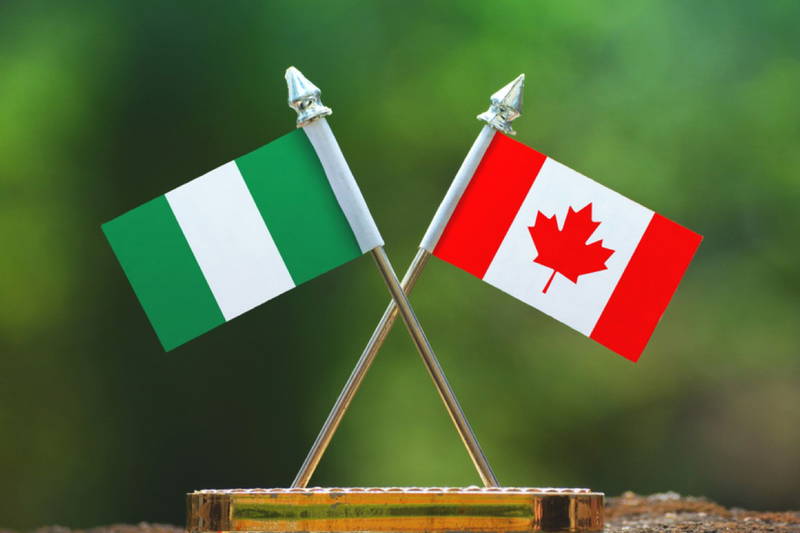
For many Nigerians, Canada is often painted as a land of many opportunities and a sanctuary from domestic challenges.
Rehrah, a Nigerian migrant to Canada, has revealed in a video the lived experiences of immigrants with a more nuanced truth: “Canada is a land that ‘humbles’ even the most ambitious.”
Read also: Nigeria among 10 countries that allow dual citizenship with Canada
Social capital matters

One of the most significant realisations for newcomers is that the Canadian job market relies heavily on social capital. While often contrasted with the “who you know” culture of Nigeria, the reality in Canada is surprisingly similar.
Networking and referrals, often referred to as the “hidden job market”, are the primary engines of career success. “It is actually about who you know,” she explains. “The moment someone refers you, that’s when all the ‘We’d like to invite you for an interview’ may start popping up.”
Without this guidance, many professionals find themselves trapped in “survival jobs” far below their qualification levels.
Read also: Canada prioritises jobs in the transportation sector for permanent residency
Rehrah also highlighted the story of a trained nurse who had to start over as a caregiver and pharmacy assistant while navigating the re-certification process.

Her advice to others is, “Don’t drive Uber. Stay in the system while you upgrade… You see that kind of honesty? It saves people time.”
Bankole, another contributor, reinforced this by stating, “Most times you need somebody that is in the system to hold your hands and guide you because it’s a new system.”
The housing hurdle and emotional toll
Beyond employment, the housing crisis remains a daunting barrier. Newcomers frequently face a cycle of instability, with some families moving up to five times in four years due to soaring rents, basement flooding, or landlords reclaiming properties for relatives.
“Packing up with kids asleep on the couch… starting over and over and over again, especially when children are involved, it’s even harder on the whole family”, Rehrah said.
Read also:FIFA World Cup: How to apply to Canada as a footbal fan, volunteer, media personnel, others
This constant upheaval underscores the fact that migration is not just a change of address, but a total reconstruction of one’s life. As she said, “People don’t realise that moving to a new country is basically starting over. We’re not just relocating. We are rebuilding emotionally, mentally, financially.”
This sentiment is a necessary reality check for those arriving with “rose-coloured glasses,” expecting an easy transition.
Strategy for the strategic immigrant
Succeeding in this environment, Rehrah advises that newcomers must pivot from passive observation to active strategy.
This begins with seeking out mentors and prioritising professional networking over cold applications to bypass the “hidden” barriers of the job market.
Furthermore, intending immigrants must prepare for potential short-term housing instability by researching school zones thoroughly and budgeting for the high cost of rent. Above all, success requires a shift in mindset; one must accept that relocation is an emotional and financial “rebuild” rather than a simple plug-and-play move.
As she warns, “My people perish for lack of knowledge… some people’s whole immigration experience gets sour because of lack of knowledge.”
Read also: PGWP freeze brings certainty for international students in Canada
Canada: Destination or transit point?
Rehrah reflects on her own journey: “When we were in the UK, we knew UK was not the destination. We always knew Canada was the destination… We lived our life like that”.
Interestingly, many regard it as not a final destination but a strategic stepping stone. In 2022 alone, over 67,000 people left Canada, many of whom were naturalised citizens moving to the United States for better economic prospects, highlighting the growing trend in onward migration.
This approach highlights that for many, the move is about the process rather than the place. “It’s not always because Canada failed them,” she clarifies. “It’s just that Canada was never the goal. It was the process.”