By Josephine Oshiafi, Business Development and Investor Relations Manager, Amber Hospitality Services Ltd.
What would it look like to tell Nigeria’s tourism story from the inside looking out rather than the outside looking in? A tourism industry in which Nigerians are the market makers coming together to develop the products, people and processes for a strong tourism economy.
I went on a family trip to Owu Waterfalls near my mother’s hometown in Kwara state last November, and what a gorgeous sight it was! To think that such natural beauty was so close to home, but we never knew until we stumbled upon it on Youtube. In my typical explorer fashion, I got relatives’ contacts in the village from my mum and coordinated the family excursion. We hiked a wonderful but dangerous path for an hour accompanied by local guides on bikes until we reached the foot of the waterfall and stared up 330 feet into the sky, feeling the fresh spray of water on our faces. It was worth every second!
As Paul Kagame, the President of Rwanda, said, “Africa’s story has been written by others; we need to own our problems and solutions and write our story.” For too long, Nigeria’s tourism industry has been described as one with “potential”, “underleveraged”, “promising”, “emerging” and other synonyms that describe something waiting to happen in the future rather than something in the here and now. Well, we must wake up. The time to elevate Nigeria’s tourism economy is now and the Nigerian people are our competitive advantage.

While it is true that our challenges of national insecurity, banditry, poor infrastructure and unreliable or expensive power supply are limiting factors in the success of our tourism industry, we do not often speak about our people problem. By this I mean, human capital development in the hospitality and tourism sector has been lacking for a long time and it is a critical need if we are to compete globally with other well-developed tourism economies. This is what the foreign brands have done; they have invested in their people, and while we use their models of hospitality and tourism management today, we have not yet developed our own unique people-centric approaches to hospitality and tourism.
“African hospitality” is a catch phrase used to refer to the warmth and authenticity of African cultures, the tasty and spicy foods, the gorgeous landscapes and the rich cultural displays. These all centre around people but we have not leveraged the collective power of our strengths as a nation. The international brands such as Radisson, Marriott, Hilton, Accor and IHG in the Nigerian hotel industry; for example, know that investing in people is a game-changing strategy. Any successful business in the hospitality and tourism industry must focus on developing the capacity and modern skillset of their people. Gone are the days where an employee can put on a uniform, clock-in, serve coffee and clock out without knowing the product they sell, the vision and mission of the brand, their unique selling point or the pain point they are solving for the customer. Every employee who interfaces with a customer must be trained as a brand ambassador, the beginning of the customer’s experience with the brand. This is what the international brands teach their employees and managers, and this is how they create successful products and processes that work anywhere in the world, in spite of the peculiar odds of that market.
As Nigerians, we must begin to question the fragmentation and lack of coordination of efforts between participants in the Nigerian hospitality and tourism industry. Business Day aptly proposed this in the theme of their most recent Tourism Conference 2025: People, Culture and Infrastructure: Building Inclusive Models for Tourism Growth in Nigeria. Inclusive models for tourism growth require that all stakeholders in the tourism industry collaborate on developing people to design, package and market products that will be attractive to the increasingly savvy and sophisticated consumer, particularly the youth who post everything on social media. Social media is a powerful tool that can amplify the growth story of Nigeria’s tourism sector.
Let us give deeper consideration to the hospitality skills gap for workers in the tourism economy. Nigeria’s tourism economy is worth approximately NGN 3.9 billion USD (NGN6.6 trillion) and according to the World Travel and Tourism Council is expected to grow by 5.4% annually for the next seven years. Currently there are about 2.4 million jobs in the tourism economy which represents an 11.3% rise from pandemic levels but more than half of these jobs are in the gig economy made up of transient and lowly educated workers who do not have income stability. The rate of attrition is high because the workers’ skills are perceived as easily replaceable and the level of burnout is high. The World Travel & Tourism Council revealed that Nigeria is expected to create 2.6 million new jobs in tourism over the next decade but in my opinion this optimism report is fuelled by the post-pandemic boost in business for the hospitality and tourism industry and not by the realities of job security and a living wage expected by these workers. If the Nigerian tourism economy grows by 5.4% annually, the question is, do we have a labour force specialized enough to handle the increased volume of customers without damaging our reputation for service delivery globally? Many of us in Nigeria can attest to a bad experience with customer service either at a restaurant where the waiter cannot explain the options on the menu, or with the front office clerk of a hotel that cannot explain the room features, amenities available or restaurant meal times, or perhaps, you booked a tour from the diaspora with a local tour operator via Trip Advisor only for the tour to be cancelled at short notice or the security measures seem sketchy. These gaps or lack of minimum standards in service delivery might be the reason a customers will choose not to patronize a brand. Often times, so-called “soft skills” such as communication, active listening, maintaining a positive attitude while multitasking, emotional intelligence and paying attention to details are what separate successful businesses from failed businesses. Business owners must take the time to create on-the-job training programs because the employees do not come pre-programmed with these skills from the plethora of vocational training institutes. Private sector participants should also team up with universities and vocational schools which have pools of talent. While operational skills are being taught, it is even more important to impart business and managerial education to the students to raise the standards of service delivery for the businesses into which they are hired. The combined mind and job enrichment will help reduce the high turnover rates in the industry
Finally, we need to reimagine the labour model by upskilling employees and encouraging more full-time career paths in hospitality and tourism.
Traditionally, however, the wages in the industry have not been encouraging and are a stumbling block to attracting the right kind of talent. Business owners need to think actively about how to use technology to reduce costs and increase available top line profits to pay staff better wages. With a modern blend of upskilled labour and technology, tourism which does not yet contribute up to 5% of Nigeria’s GDP, can double in the next decade. We can join the ranks of our sister African countries such as Egypt, Morrocco, Ethiopia, Kenya, South Africa, Tanzania, Zanzibar, Ghana and Cape Verde which enjoy a range between 7%-40% contribution from the tourism industry to their GDPs.
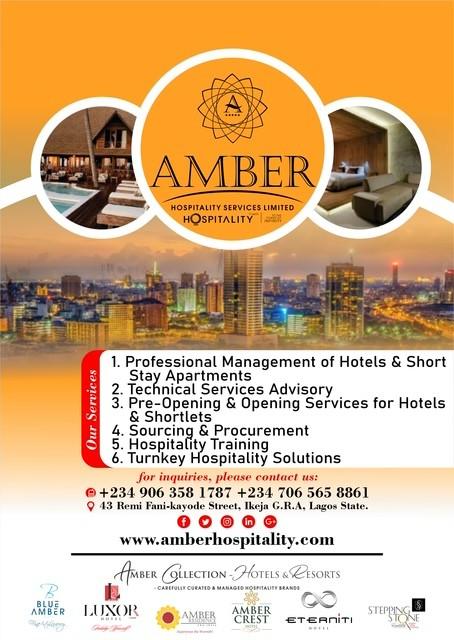
At Amber Hospitality Services Limited, we are an indigenous hospitality management company that designs, operates and manages hotels and extended stay apartments for our portfolio and for other owners and investors across Africa. We see ourselves as specialists in hosting curious minds in curated spaces, whether they are traveling for leisure, business, education or whatever their objective may be in Africa. Inclusivity in our business model means we collaborate with local communities who are our employees, suppliers, and taste makers; investors who make it possible for us to grow in the global marketplace; and you, the individuals, groups and corporates who are our guests. We have learned as Reid Hoffman, the founder of LinkedIn stated, that “no matter how brilliant the mind or strategy, if you are playing a solo game, you will always lose out to a team.” We must therefore invest in our people and in leading them correctly towards the standard we want as a nation for the tourism industry. This will make all the difference in the 21st century story of Nigeria’s tourism growth.