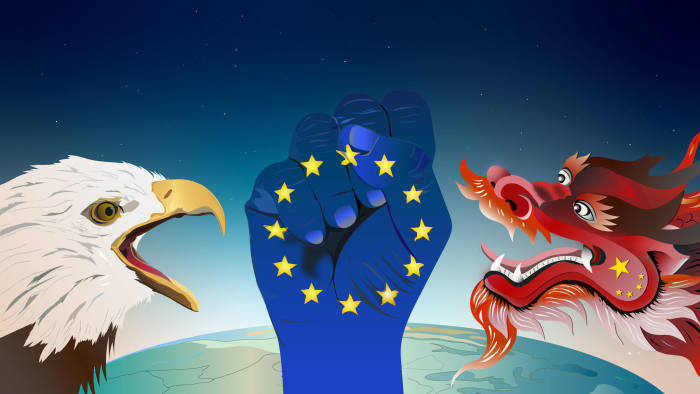
In Britain and the US, the idea that the EU could aspire to be a superpower is usually treated as either ludicrous or sinister. So when Guy Verhofstadt, a prominent member of the European Parliament, recently made the case for the EU to be part of an emerging “world order that is based on empires”, there was a predictable backlash. At the Conservative party conference a few days ago, his words, taken from a speech to their anti-brexit enemies the Liberal Democrats, were cited as evidence of the dangerous imperial ambitions of the EU — and proof that leaving the bloc is the UK’S only safe option.
Mr Verhofstadt can be arrogant. But, in this case, he also happens to be right. The rise of China and India, and the America First policies of Donald Trump’s US, makes it more important than ever that European countries defend their interests collectively.
Read also: EU allies urge US to avoid tit-for-tat trade spat over WTO
The EU once dreamt that the whole world would move towards a law-based system, similar to the EU method. But a world order, shaped by Xi Jinping’s China and Trump’s America, will be based on power rather than rules. The outbreak of a global trade war underlines that small European countries can no longer rely on international rules to protect them. They need the bulk and heft that the EU provides.

The former Belgian prime minister’s choice of the word “empire” — with its connotations of conquest — was unfortunate. The EU is an empire by invitation. Nobody is forced to join. And, despite the difficulties of Brexit, any member is free to leave. It would be more accurate to say that the EU can and should aspire to be a superpower — one of four or five major global powers, capable of shaping the world order.
That aspiration is eminently achievable. Indeed, in important respects, it has already been achieved. Last week provided an interesting illustration when the European Court of Justice ruled that individual countries can demand that Facebook take down defamatory content, on a global basis.
The ECJ ruling was made in response to a complaint from an Austrian politician — and prompted an immediate and concerned response from Facebook. If this had just been a ruling by an Austrian court, the Californian internet giant would have been able to brush it off. But the ECJ has sway over a market of more than 500m people — compared with the 9m in Austria. Facebook’s ambitions for Libra, a digital currency, will also be shaped by rulings made in Brussels. The EU’S decisions — good or bad — change the behaviour of the world’s largest firms, from Silicon Valley to southern China.