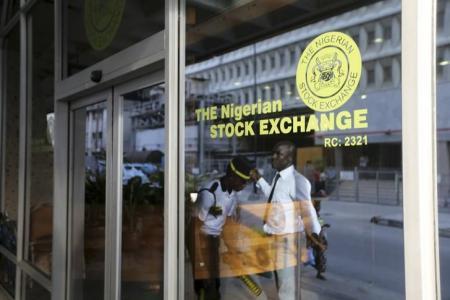
Stock investors at the Nigerian bourse have chosen to remain on the sideline following unclear policy direction that has bedeviled the over six weeks old government of President Muhammadu Buhari.
This is coupled with investors’ scepticism over the outcome of ongoing Monetary Policy Committee (MPC) meeting.
Though, there is room for bargain hunting activities at the nation’s bourse following downbeat value stocks, but some analysts expect the stock market activities to remain dampened due to worries of investors over the nation’s economic uncertainties.
Currently, policy vacuum from Nigeria’s central government seems to be affecting investors’ confidence, foreign exchange (FX) rates and capital market valuations.

On a weekly valuation, the Nigerian bourse sustained its bearish run last week losing 2.1percent week-on-week (wow) and pushed the YtD return to a new low of minus 10.4percent.
“It is evident from both exchange rates and capital market performance that the economic costs of government static are not theoretical, but real and substantial! After the elections, capital markets rallied with a correction to claw back discounts due to elevated political risk,” according to economic analysts at RTC Advisory Services Limited.
These analysts noted that, “in the foreign exchange markets, rates fell from over N227/$ to as low as N203/$ after the presidential elections. Both indices have now reversed with capital markets falling again and non-interbank rates now above N235/$”.
The bears were unable to relinquish their positions last week at the Nigerian Stock Exchange (NSE) All Share Index (ASI) depreciated by 2.15% to close at 31,047.99.
Also, the equities market capitalisation depreciated by 1.92% to close at N10.628 trillion. All the sectoral indices finished lower during the week in review, with the exception of NSE ASeM Index that closed flat.

“The policy outcome of the Central Bank of Nigeria MPC meeting scheduled for this week will give further direction to the market,” according to team of economic intelligence at Access Bank plc.
The stock market opened for four trading sessions last week as the Federal Government of Nigeria declared Friday July 17 and Monday July 20, 2015 as public holidays to observe the end of Ramadan and Idel-Fitr celebrations.
Thirteen (13) equities appreciated in price, lower than nineteen (19) equities in the preceding week. Fifty-seven (57) equities depreciated in price, higher than fifty (50) equities in the preceding week, while one hundred and twenty (120) equities remained unchanged, lower than one hundred and twenty-four (124) equities recorded in the preceding week.
According to research analysts at Meristem Securities, “the prolonged dampened mood in the equities market is due to dearth of policy direction by the current government coupled with investors’ scepticism ahead of the MPC meeting scheduled for 23rd and 24th of July 2015.”
“We expect the outcome of the MPC meeting, inflow of H1:2015 results as well as policy actions or pronouncements from the government to dictate the direction of trade in the coming week,” they said in their recent investment guide.
In their view, research analysts at Lagos-based United Capital said FX uncertainty and the gloomy terrain of Nigeria’s economy and financial markets will keep investors on the side-line in the short term.
“However, domestic institutional investors are expected to key-in to Treasury Bills (TBills) and Bonds as yields are attractive at the moment. This said, we look to see a relatively calm market on the side of the bears as investors await the outcome of the MPC meeting for possible outlook on FX,” said United Capital analysts.
Iheanyi Nwachukwu