A record-setting sukuk auction has pushed Nigeria’s Islamic finance market into the national conversation, offering a rare moment of excitement in an otherwise traditional bond-dominated debt market. Investors are no longer treating Sharia-compliant instruments as a niche category.
Instead, sukuk has become one of the fastest-growing segments of Nigeria’s fixed-income market, drawing interest from pension funds, ethical investors and domestic institutions looking for alternatives to interest-based debt.
“Nigeria’s non-interest capital market has expanded significantly and now exceeds N1.6 trillion, reflecting stronger participation and improving market infrastructure that supports sukuk and related instruments.” Securities and Exchange Commission Director-General said in November 2025, acknowledging how quickly the market has matured.
In late May 2025, the Debt Management Office offered N300 billion in sovereign sukuk under its Series VII programme. By the time the auction closed, investors had submitted about N2.205 trillion in subscriptions, roughly 7.35 times the amount offered.

Analysts and market participants widely interpret this as around 735 percent oversubscription, one of the most striking demand ratios recorded in a domestic debt sale this year.
The reason the number matters is simple. It shows that even in a market where investors already have options like treasury bills and conventional government bonds, a growing segment is deliberately choosing financing structures linked to real assets instead of fixed interest.
Nigeria’s leadership has also openly championed the economic role of non-interest finance. “Our sukuk issuances, now in their seventh cycle, have funded more than 120 major road projects covering nearly 6,000 kilometres.
“Each bond represents a covenant between government and citizens, proof that finance can build rather than burden.” Vice President Kashim Shettima said at a public forum in 2025, reinforcing the narrative that Islamic finance is no longer abstract but visibly tied to development.
Corporate sukuk is arriving, and investors are following

The sukuk story is no longer only about government borrowing. Nigerian corporates and non-interest banks are now stepping into the issuance pipeline. In October 2025, TAJBank brought its N20 billion Mudarabah sukuk to the market.
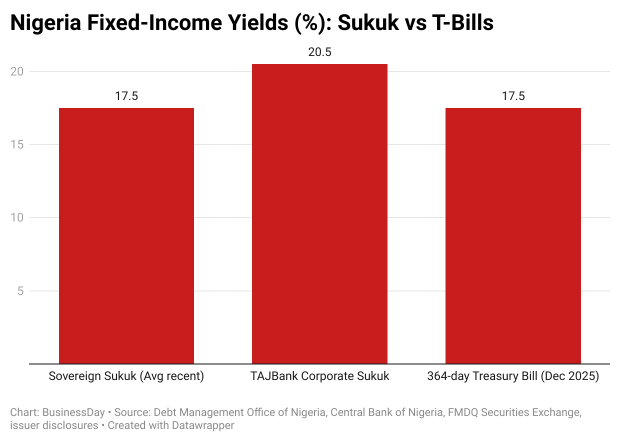
Demand once again exceeded supply, with subscriptions reported at about 185.15 percent oversubscription, and allotments estimated around N57 billion, delivered at an annual profit rate of 20.5 percent, evidence of how fast books are built when investors believe in the structure.
Corporate sukuk matters for market depth. It adds issuer variety, creates a credit curve beyond the sovereign, and offers investors more instruments to spread risk while staying within non-interest mandates.
Fitch says the runway is long
Nigeria’s Islamic finance market is still small when measured against the global sukuk universe but growth forecasts are strong. According to a Fitch-referenced industry outlook, Nigeria’s Islamic finance industry is expected to continue expanding due to increasing sovereign issuances, regulatory upgrades, and broader participation from domestic institutions.
“The sector is benefiting from new liquidity tools and renewed regulatory scaffolding, giving it a stronger second-phase growth profile compared to conventional debt segments.” Fitch Ratings commentary noted in 2025, pointing to structural momentum rather than short-term spikes.
International sukuk is now on the table
The next frontier is global issuance. Official approval records show that in October 2025, Nigeria’s parliament authorised a $500 million debut sovereign sukuk as part of a broader $2.85 billion external borrowing plan designed to support budget financing and refinance maturing Eurobonds.
If executed, a foreign-currency sukuk would achieve two things at once. It would broaden Nigeria’s investor base to include deeper Islamic capital pools from the Middle East and Asia, and it would give the country another funding channel when Eurobond pricing is under pressure from volatile global yields.
Risks investors should understand
Sukuk is not risk-free. The risks are practical rather than ideological. Secondary market liquidity is still developing. If an investor needs to sell quickly, pricing can be less predictable than the most actively traded conventional instruments.
And structure matters. Sukuk instruments differ widely in asset composition, legal protections and distribution mechanics. Investors must read offering documents carefully, because risk varies by design.
Macroeconomic conditions also influence pricing. Inflation, liquidity tightening, and regulatory shifts can move sukuk markets the same way they move traditional bonds.
What this means for Nigeria’s bond market
The 2025 subscription numbers are the signal. Sukuk has become a serious funding channel with measurable, repeatable demand. For government, it is a proven way to mobilise domestic capital for infrastructure without relying only on interest-based bonds.
For corporates, it is emerging as a viable alternative source of large-ticket naira funding. And for investors, it is now a mainstream diversification tool inside Nigeria’s fixed-income universe not a specialised corner reserved only for faith-based buyers.