Mobile money is not just changing the economic and social fabric of the world; it is also affecting the dynamics of payments in African countries.
However for Nigeria, which still runs a bank led mobile money model that has made limited progress over the years in financially including its citizens, concerns over potential dominance by Telco’s may be giving regulators and other stakeholders cause for pause.
Sources tell BusinessDay that the country’s financial institutions, telecommunication companies, Central Bank of Nigeria (CBN), Nigerian Communications Commission (NCC) and the Vice President, Yemi Osinbajo, held a meeting recently which was aimed at finding common ground in bridging the nation’s financial exclusion gap.
The source however disclosed that the Vice President promised that efforts will continue at ensuring the Telco’s have opportunity to drive financial inclusion in a country that has about 40 percent exclusion rate.
“Stakeholders may be afraid that the Telco’s who are dominating the market share in their telecommunications industry will also begin to make more profit and generate more revenue in mobile money functions,” a financial inclusion analyst who pleaded anonymity said.
Dolapo Ashiru, a Lagos-based stock broker said with the right regulation Nigeria can attain and overtake the heights of Safaricom with M-Pesa in Kenya, or in Ghana noting that the mentioned countries have structural and efficient institutions that allows Telco’s to drive financial inclusion, unlike Nigeria where the reverse is the case.
Responding to stakeholder’s fear of Telco’s dominating the fintech space through mobile money, Ashiru said “a communication company like MTN Nigeria is already bigger than most banks in terms of turnover and profitability.
“There is also an argument for rural telephoning but a combination of MTN, Airtel,9mobile and GLO already rakes up about 140 million subscribers and they have the capacity to do more, so there is reason for concern,” Ashiru said by Phone.
BusinessDay’s analysis of Nigeria’s peers who are driving financial inclusion through the Telco led model shows that the telecommunication company with the largest customer base and infrastructure also generates the highest revenue while also having dominance of the industry.
Kenya’s mobile money market for example has five players among which are; M-Pesa, Airtel Money, T-Kash, Equitel Money and Mobile Pay. Safaricom controls the lion’s share with 83.08 per cent of the market, Equitel 16.36 per cent and Airtel 0.56 per cent.
Telkom Kenya has 1,581 base stations, some of which are leased, while Airtel has 1,548. Combined, however they are not close to Safaricom which has 4,000 base stations.
East Africa’s biggest mobile-network operator, Safaricom Plc, developed one of the world’s first mobile phone-based money transfer services, and says 88 percent of its almost 30 million customers now use it.
This is not different in Ghana, as figures from the country’s National Communications Authority (NCA), revealed that between 2012 and 2017, MTN Ghana has been the consistent market leader by number of subscriptions.
Across the five-year period, the company’s market share rose to 47.5percent in 2017; Vodafone Ghana’s market share also rose from 21 percent in 2012 to 24.1 percent in 2017. While Airtel Ghana and Tigo Ghana experienced marginal changes in market share, falling 0.37 percent and rising 0.71 percent respectively.
This also rubbed off on the mobile money market share of the country, as MTN Ghana has the highest percentage, followed by Vodafone, Tigo and Airtel.
Yewande Adewusi a Lagos-based financial inclusion consultant said there are different schools of thought on how mobile money should work in Nigeria due to its peculiar challenges but if the country is looking at how to maintain monetary system stability or still maintain financial inclusion with the right oversight then the banks and Telco’s should work together to drive it.
“A lot of factors make mobile money difficult to work in Nigeria, for example there are some rural areas that don’t have gsm network so even if Telco’s drive mobile money there will still be problem of availability,” Adewusi told BusinessDay.
Adewusi noted that Nigeria is a huge market and it is very obvious that what the country has been doing previously is not working. “However, moving forward it should be a combination of Telco’s working together with banks or we should allow the Telco’s have their own licenses which will be regulated through Special Purpose Vehicle (SPV) by the CBN.”
The recent meeting by the government, telecom companies and the financial institutions came after the country’s mobile operators; MTN, Airtel, Globacom and 9mobile announced their commitment towards deepening of financial inclusion to at least 90 million customers in the next 30 months on the condition that they are given a level playing ground to perform mobile money functions.
At the meeting which was held on September 4 2018, the Telco’s said it is overly possible to significantly reduce Nigeria’s financial exclusion rates by 50 percent if the telecommunication operators with a wider subscriber base than the total banked population are allowed to drive mobile money penetration.
However some other analyst said financial inclusion can only grow if driven by Telco operators who have large numbers of subscribers on their networks.
A survey by BusinessDay showed that the Telco led model in African countries reported tremendous progress owing to the already existing large customer base of the Telco’s.
Kenya has about 60 percent mobile money service penetration, while Ghana has about 40 percent service penetration, and Nigeria with a lot more population numbers, remains at 1 percent, largely due to its bank-led model.
Ghana’s decision to have a Telco led model resulted in a 73 percent increase in registered mobile money customers in just one year, according to World bank data, and has helped lift financial inclusion rates in Ghana to 58 percent in 2017 from 41 percent in 2014.
This was not different for Ivory Coast which has experienced a mobile money revolution. As a result, there are now more adults with mobile money accounts of 24.3 percent than with bank accounts of 15 percent.
In fact, Ivory Coast has the fifth highest rate of mobile money accounts in the world behind Kenya (58 percent), Somalia (37 percent), Uganda (35 percent), and Tanzania (32 percent), according to Brookings Institute, a highly regarded, non-profit public policy organization based in Washington, DC.
Kenya also improved to 81.6 percent financial inclusion rate in 2017 from 74.7 percent in 2014, Ivory Coast improved to 41.3 percent from 34.3 percent and South Africa increased marginally to 69.2 percent from 70.3 percent.
“It is safe to say that Nigeria is playing catch-up when it comes to achieving inclusion and must look to learn from success stories like Ghana and Kenya if we are to achieve our goal of 80 percent inclusion by 2020,” said Gbenga Adebayo, Chairman of the Association of Licensed Telecom Operators of Nigeria (ALTON) centered on Financial Inclusion.
Umar Garbar Danbatta, Executive Vice Chairman of NCC in May this year told BusinessDay that security challenges on the telecommunications infrastructure in Nigeria is a contributing factor in holding back the licensing of Telco’s for mobile money services.
Ayo Akinwunmi, Head of Research, FSDH Merchant Bank said that the issue of the insecurity and the high unemployment rate in Nigeria are factors contributing to the slow progress of financial inclusion in the country.
“A lot of banks that are located in these areas where there are high levels of insecurity are already shutting down. If there is peace there will be more bankable adults,” Akinwunmi said.
According to figures by Nigerian Communications Commission (NCC), the country’s telecommunications industry has a reach of 86 percent of the country, with 162.3 million customers (the single largest customer base of any industry in Nigeria).
This makes the industry till date, one of the most thriving sectors in the country and analysts say it has the capabilities to drive inclusion, including technology, infrastructure, and distribution network and subscriber base.
Meanwhile, Nigeria’s Telco’s industry players have a combined presence in 773 local government areas across the country further emphasizing their ability to reach especially hard to reach areas of the country.
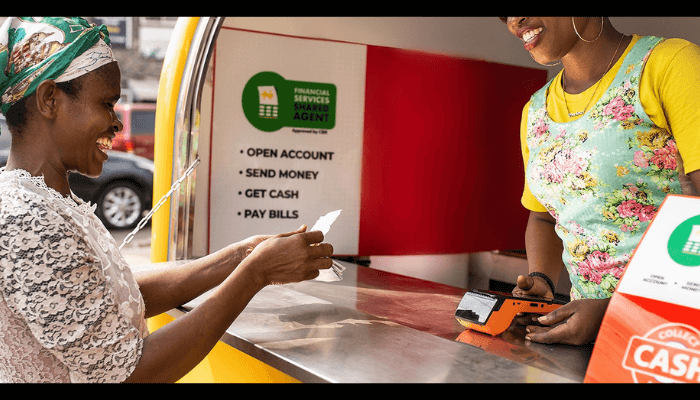
The communication service providing companies in Nigeria also have about 1,000,000 unique agents already in place selling airtime across the country, and analysts say this can quickly be converted to establish mobile money agent networks which can help reach out to the unbanked Nigerians especially those in the rural areas.
According to London based Group Special Mobile Association (GSMA), “from a regulatory perspective, one basic requirement for mobile money to succeed is to create an open and level playing field that includes non-bank mobile money providers such as Mobile Network Operators (MNOs).”
ENDURANCE OKAFOR & DIPO OLADEHINDE