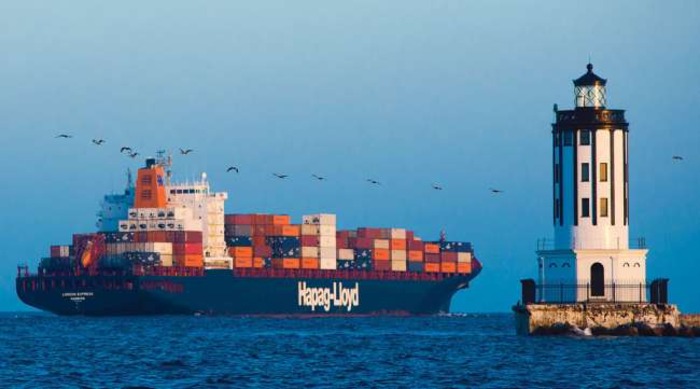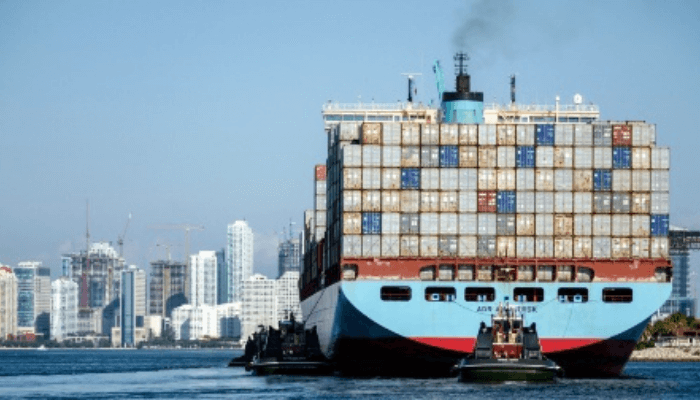
The world’s biggest shipping lines have made disruptive changes to their operations in Nigeria as the deadly war in the Middle East reaches a fever pitch.
In a customer advisory on Monday, Hapag-Lloyd, the world’s 5th largest shipping company, announced a suspension of bookings for cargo of all types from all African countries, including Nigeria, to the Upper Gulf region, including the United Arab Emirates (UAE), Iraq, Kuwait, Qatar, and the Eastern Province of Saudi Arabia.
“Due to the current operational and security constraints in the Upper Gulf region, a decision has been made,” it said, describing its decision as “necessary to maintain cargo safety, secure equipment placement, and uphold operational standards.” The directive was enforced “with immediate effect and until further notice.”
The Upper Gulf receives primarily crude oil, Liquefied Natural Gas (LNG), sesame seeds, gold, and agricultural commodities from Nigeria, with the UAE, being the biggest trading partner in the region, often acting as a re-export and commodity trading hub for onward distribution. The suspension inherently cuts off supply.

“This is a major supply chain disruption,” said Muda Yusuf, director of the Centre For The Promotion Of Private Enterprise. “Almost 90 percent of our trade is via maritime. If you cannot export, how do you generate foreign exchange and Customs duties?”
On the same day, the Mediterranean Shipping Company (MSC), the world’s biggest shipping line, announced new freight rates for cargo heading from all Far East ports, including ports in Japan, Korea and Southeast Asia, to Sub-Saharan African and Indian Ocean ports.
From March 10, imports into Nigeria’s ports 20-foot dry van containers with $4,600, while 40-foot containers now carry a $5,600 freight bill.
The company said it is “to support the continued provision of reliable and efficient services across its network.” The new rates will remain “until further notice but not beyond 21 March 2026.”
Key imports from these parts include machinery and industrial equipment used in factories and construction, as well as vehicle parts and fully assembled vehicles, especially from Japan and South Korea.

Some electronics like televisions, air conditioners, generators and household appliances also make up a significant portion of cargo from the region.
Analysts warn the disruptions could push up an already-slowing inflation in Nigeria, where most trade moves by sea and higher logistics costs are quickly passed on to consumers.
“We don’t produce everything. When you have a situation like this, the transmission effect on the economy is inflationary because costs begin to rise,” Yusuf said.
As of 2026, MSC remains one of the largest carriers operating in Nigeria, primarily serving the ports of Lagos (Apapa and Tin Can) and Onne (Port Harcourt). According to its website, MSC Nigeria officially moves “more than 200,000 Twenty-foot Equivalent Units (TEUs) per year.”
It had earlier announced the suspension of worldwide cargo bookings to the Middle East region “until further notice,” while it “closely monitors developments.” The company’s standard terms, including its Bill of Lading, still apply.
BusinessDay learned that clearing agents and freight forwarders had stormed the MSC local offices to protest the hikes, claiming the company’s decisions came earlier than expected.
“Apart from the cost implication, it will hamper trade facilitation and affect our maritime operations and security,” Sulaiman Ayokunle, a senior special adviser to the president of the Association of Nigeria Licensed Customs Agents (ANLCA), told BusinessDay. “Even raw materials that will come in to make finished goods will become too expensive,” he said.
Nigerian shippers had braced for a rise in freight costs and delays at sea and air following the rerouting of vessels away from the Red Sea and Suez Canal, the major routes for cargo to and from Nigerian ports to Asia, amid escalating attacks in the Middle East.
Read also: Nigerian shippers brace for rate hikes as Middle East conflicts force shipping giants’ reroutes
Just days after CMA CGM announced plans to resume full Suez Canal operations in Q2 2026, the world’s third-largest container ship operator abruptly reversed course, pulling major Asia-Europe services back around Africa through the Cape of Good Hope.
“The complex and uncertain international context” is why CMA CGM said it abandoned the shorter route, offering no timeline for when it might reconsider. It also implemented an Emergency Conflict Surcharge of up to $3000 per 40ft container for some regions and cancelled reefer bookings.
Meanwhile, Maersk, the world’s third-largest container ship, despite confirming its structural return to the Red Sea route weeks earlier, has now withdrawn from that decision and has again suspended transits through the Red Sea/Bab el-Mandeb Strait, rerouting vessels around Cape Town, citing “deteriorating security situation” and “unforeseen constraints” in the region. Many ships have stayed trapped at sea as operators find alternative, safer areas to dock.
The traditional Suez Canal-Red Sea route to Asia is the shortest at 30 to 35 days transit time, saving roughly two weeks of fuel and operational costs compared to the alternative. The alternative route around Africa’s Cape of Good Hope adds weeks to the calendar, along with thousands of dollars in fuel and handling costs per shipment.
“I pray that war is going to end very soon,” Bunmi Olumekun, an exporter to Asia told BusinessDay. “Before shipments spent a month and a half at sea. With all this, we expect at least 60 days, if we’re lucky, to find ships.”
Sea Empowerment and Research Centre (SEREC), a maritime research organisation in Nigeria, in a communique warned that global freight rates could surge as much as 40 percent and marine war-risk insurance may spike by as high as 400 percent in high-risk corridors if the situation persists.
The oil situation
Very large crude carriers have seen freight rates “skyrocket” as route disruptions tighten vessel supply and push oil prices higher, industry leaders said. Prices had already been climbing before the conflict began and continued their upward trend on Tuesday.
By Tuesday morning trading, Brent crude was up about 3.2 percent, hovering above $80 a barrel.
But analysts warn that Nigeria, a major oil exporter, has little reason to celebrate.
At least 150 tankers are anchored in open Gulf waters beyond the Strait of Hormuz, with only a handful of Iranian and Chinese vessels still moving through, according to ship-tracking platform Kpler.
Aminu Umar, president of the Nigerian Chamber of Shipping, said the shortage of available vessels for Nigerian exports is proving costly, as ships trapped in the Gulf are unable to load or discharge cargo elsewhere.
“There are ships that are trapped in the Gulf and are unable to come out now. If the route is blocked, many ships inside, dry cargo, wet cargo and gas, that should be loading or discharging, cannot move. Those ships cannot come out to service others,” he said.
With Nigeria owning no national carrier to ship out its resources, Muda Yusuf, chief executive of the Centre for the Promotion of Private Enterprise, said higher oil prices mean little if shipments cannot move. “If the crude cannot move, we make nothing, then what are we celebrating?” he said.