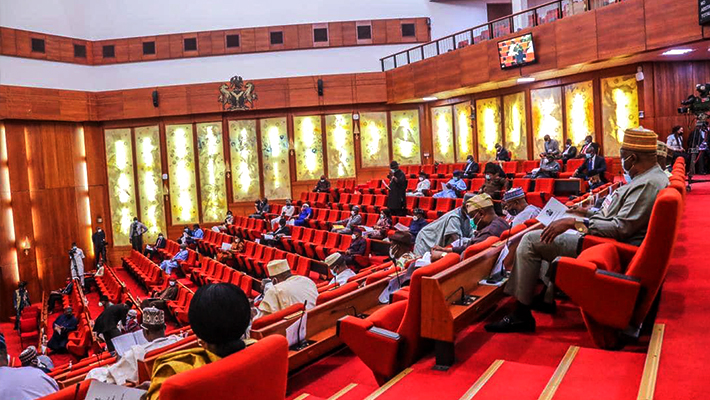
The Nigerian Senate on Wednesday began moves to classify kidnapping as a terrorism offence, proposing the death penalty for perpetrators as abductions surge across several states.
Lawmakers said the measure would be written into the Terrorism (Prevention) Act, mandating Senate Leader Opeyemi Bamidele to work the resolution into forthcoming amendments.
The decision followed a motion by Deputy Senate Leader Lola Ashiru, who cited recent mass abductions in Kwara, Kebbi and Niger states.
During debate, senators warned that the frequency and scale of kidnappings had become a national emergency.

Abdul Ningi (Bauchi Central) said the chamber must impose the harshest possible punishment. “Kidnapping must be branded a terrorist act and must carry the death penalty. Let’s look inwards and get it right,” he said.
Read Also: Tinubu declares national security emergency as lawmakers reject bandit negotiations
Sadiq Umar (Kwara North) described the crisis as an “existential threat,” urging the government to escalate its response. “It is time for us to declare that we are at war,” he said.
Bamidele said both the executive and legislature “inherited this problem,” but cautioned that “should not be an excuse,” calling for urgent, coordinated action.
The Senate urged communities across Kwara, Kebbi, Niger and the wider country to remain vigilant and support security operations while resisting internal collaborators who aid criminal networks.

Lawmakers commended President Bola Tinubu and security agencies for what they described as “rapid” responses to recent abductions, urging sustained operations to free all victims and arrest perpetrators.
They also directed the Ministry of Works to immediately rehabilitate federal roads in insecurity-prone areas to improve military mobility and emergency response.
In a raft of additional measures, senators mandated the army, police, DSS and Defence Intelligence Bureau to intensify intelligence-driven operations — including aerial surveillance, forest combing and cross-state collaboration — across Kwara, Kogi, Kebbi, Niger and other high-risk zones.
They also called for the creation of a Joint Task Force covering the Kwara–Kogi corridor, with forward operating bases in Eruku, Babanla, Oke-Ero and Isanlu in Kwara, and Wasagu in Kebbi.
The Ministry of Humanitarian Affairs and NEMA were instructed to provide immediate relief to affected communities.
Lawmakers further asked the federal government to strengthen local vigilante groups and review national firearms laws, noting that more than 175 countries allow responsible civilian gun ownership.
All security-related committees were directed to investigate the withdrawal of military personnel from a Kebbi school hours before a bandit attack, as well as the killing of Brig. Gen. Musa Uba, and report back within two weeks.
The Senate also resolved to seek enhanced counterterrorism cooperation with the United States and other partners, reconstitute the committees on Air Force and National Security and Intelligence, and require weekly briefings from committees on the army, navy, defence, interior and police affairs.
It reaffirmed its support for Tinubu’s efforts to tackle insecurity but urged him to “rejig” the security architecture to confront evolving threats.