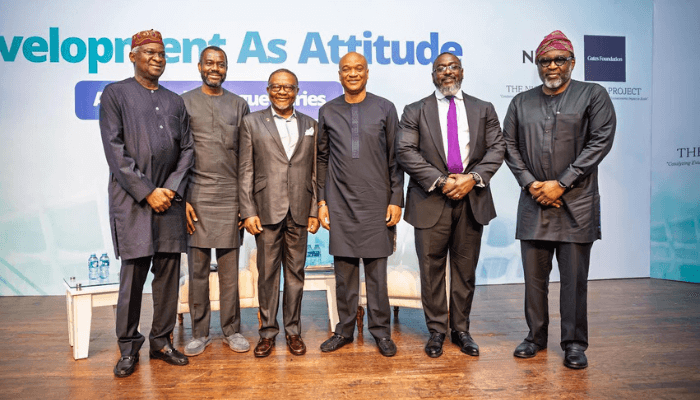
Babajide Sanwo-Olu, the governor of Lagos State, and Babatunde Fashola, former minister of works and housing, have called for a systemic change in Nigeria’s leadership culture and citizen engagement, saying both are critical to unlocking the country’s growth potential.
Speaking at the Lagos edition of the Nigerian Hamilton Project National Dialogue Series, the two leaders called for a shift toward service-oriented governance, alongside a reorientation of citizens toward national unity and accountability. They said the combination is essential for sustaining economic expansion and improving social cohesion in Africa’s most populous nation.
Sanwo-Olu, represented by Ope George, commissioner for Economic Planning and Budget, Lagos, reaffirms his administration’s commitment to providing essential services that cater to the well-being of the citizenry in the state, emphasising that “the true strength of any nation is not in the buildings or budget but in its people.”
Read also: Nigeria can generate $1bn from leather sector, says NESG’s report

“We can lay the foundation, but it’s in the actions and attitudes of a shared culture and responsibility that projects will last. True development comes when both leaders and citizens play their parts,” Sanwo-Olu said Thursday at the event anchored on a book reading authored by Osita Ogbu, a professor of development economics, titled “Development as Attitude: How National Progress is Shaped by Leadership Philosophy and Citizens’ Orientation.”
In a panel session, Fashola, who was the governor of Lagos between 2007 and 2015, argued that development can only exist if a nation agrees and keeps to laws, knowing that there would be consequences if broken. For the former minister, that’s the best “selling point for us as a nation.”
“The idea of a nation of laws is one that easily appeals to me,” Fashola said at the event powered by the Nigerian Economic Summit Group (NESG). “I think that’s the idea around which we can take our first steps into a national development before we start going into developing people.”
Read also: Power shortage, FX instability impeding businesses in Nigeria – NESG
The former governor called for a change in philosophy, stating that most of the programs Nigerians benefited from could have been more appreciated if the underlying ideas were made known.

Citing the Universal Primary Education initiated by Obafemi Awolowo, then premier of the Western Region, Fashola said, “I became a very free-willed adult to appreciate that free education was not just about being nice to Westerners, but that it was profoundly about attacking very, very endemic and insidious illiteracy.”
“Nations are built when people are educated, united, and driven towards a common purpose, not by where they come from, but by what they stand for,” Fashola said.
Other members of the panel included Olu Ajakaiye, a professor and executive chairman of the African Centre for Shared Development Capacity Building; Adenike Adeyemi, executive director of FATE Foundation; and Abiodun Oladipo, who represented Seye Oyeleye, the director general of the DAWN Commission.
Read also: How FG can ramp up revenue to implement 2025 budget – NESG
Also on the panel was Abubakar Suleiman, CEO of Sterling Bank and a member of the NESG Board. Osasuyi Dirisu, executive director of the Policy Innovation Centre (PIC), moderated the conversation.
The panelists all examined the urgent need to foster leadership philosophies rooted in national service while exploring how mindset, civic engagement, and institutional reform can drive Nigeria’s developmental progress.