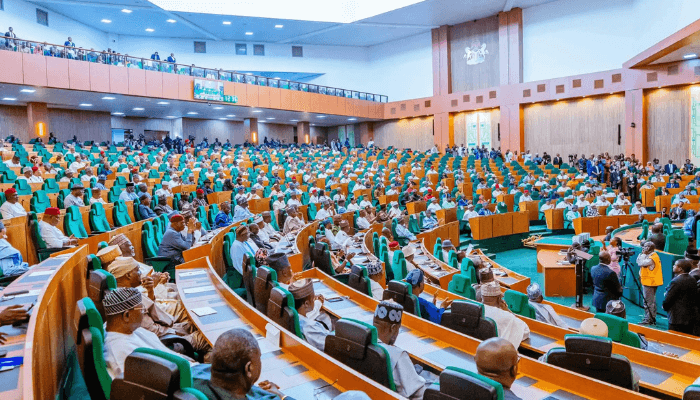
The House of Representatives has rejected seven constitutional amendment bills, including a bill to allow for the rotation of the Offices of the President and the Vice President among the six geopolitical zones of the country.
The six other bills include bill to strip the Independent National Electoral Commission, the powers of registration and regulation of political Parties in Nigeria and transfer same to the Office of the Registrar General of Political Parties sponored by Abbas Tajudeen, Speaker of the Hosue; Bill to create Office of the State Auditors-General for Local Governments and the Federal Capital Territory Area Councils; Bill to provide for the Number of Judges of the Federal High Court to be not less than one hundred.
Others are Bill to empower the National Judicial Council to Fix and Review, in conjunction with the National Salaries, Incomes and Wages Commission, the Salaries, Allowances, and other Emoluments of Judicial Officers and staff of the judiciary; and a Bill to create Ughelli East Local Government Area in Delta State.
Among the bills, only the bill on zoning sponsored by Benjamin Kalu, the deputy speaker, was debated. The proposed law is titled, A Bill for an Act to Alter the Constitution of the Federal Republic of Nigeria, Cap. C23, Laws of the Federation of Nigeria, 2004 to Provide for the Principle of Rotation of the Offices of the President and the Vice President of the Federal Republic of Nigeria among the Six Geopolitical Zones of the Country, Namely: North Central, North East, North West, South East, South South, and South West and for Related Matters (HB. 2291).

Read also: Reps pass bill to amend requirements for election as president, governor
In his lead debate, Kalu argued that the proposed law would enhance inclusivity and foster unity across the federation.
“This will enable every part of this country to contribute to the national leadership of this country. There is no region that does not have capable people who can lead. It would increase national cohesion and national unity. What is good for the goose is also good for the gander,” he said.
However, the proposal drew mixed reactions from lawmakers. Sani Madaki, who represents Dala Federal Constituency, opposed the bill, stating: “We should not put this in our Constitution, we should allow it as it is, there is already something where political parties decide to zone.”
In contrast, Ali Isa, Minority Whip of the House, supported the bill, arguing: “We should support it, we should even extend it to governors. Some states are marginalised and need to be given fair treatment. It would promote fairness.”

Clement Jimbo, representing Abak/Etim Ekpo/Ika, also backed the proposal. “It will cure an age-long injustice in our land, especially minority zones, that would naturally not have a chance to rule,” he said.
But Mohammed El-Rufai, representing Kaduna North, opposed the proposal, warning that it could violate the constitutional rights of eligible Nigerians. He argued that every citizen has the right to contest for office, regardless of region.
Read also: Reps’ U-turn on immunity bill sparks public outrage
He also questioned the practicality of the zoning arrangement, asking how a consensus would be reached within a zone like the North Central. According to him, “the real reason for the feeling of injustice is just failure of government”.
“We should not set a dangerous precedent”, he warned.
Following the debate, the deputy speaker, who presided over the plenary, called for a voice vote. The majority voted ‘nay’, effectively killing the bill at second reading, along with the other six proposals.
However, after the House reached a decision, Francis Waive, the chairman of the House Committee on Rules and Business, raised a point of order that the decision to take all the constitutional amendment bills together should be rescinded and the bills should be treated individually.
However, to revisit the matter, a substantive motion, filed on notice and listed on the order paper, would be required. The House resolved to address the matter in the next sitting. For now, all seven bills remain rejected.