…another bill empowers NJC to decide Judges removal
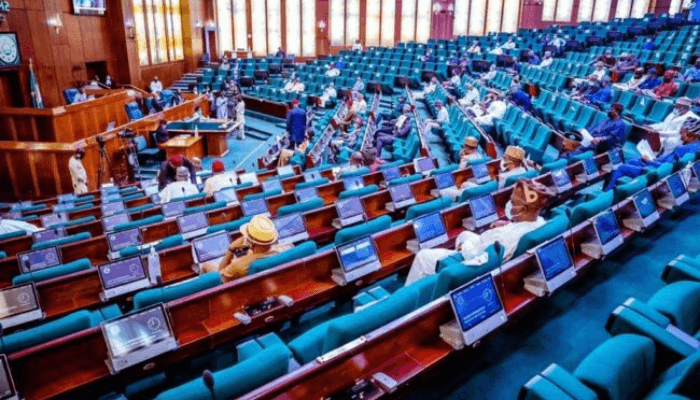
The House of Representatives on Tuesday passed a bill for second reading, seeking to amend the Constitution to allow the Nigerian Bar Association (NBA) to receive petitions against corrupt judicial officers and assess their defence before making a decision.
Titled “A Bill for an Act to Provide for the Presumed Resignation from Office of the Chief Justice of Nigeria, Justices and Judges of Certain Courts in Nigeria and for Related Matters,” the proposed legislation was sponsored by Afam Ogene, who represents Ogbaru Federal Constituency, Anambra State.
The bill, which was among 39 passed for second reading during plenary on Tuesday, aims to amend the 1999 Constitution by introducing provisions for the removal of corrupt justices and judges from office.

Read also: Reps pass 42 constitutional amendment bills for second reading
It proposes a new subsection 6 to sections 231, 238, 250, 256, and 271 of the 1999 Constitution to enable the removal of a corrupt Chief Justice of Nigeria, President and Justices of the Court of Appeal, Chief Judge and Judges of the Federal High Court, Chief Judge and Judges of the High Court of the Federal Capital Territory, as well as Chief Judge and Judges of State High Courts.
Thr bill confers powers on the Nigerian Bar Association to receive petitions against any erring judicial officer, assess the defence of the petitioned officer, and if unsatisfied, conduct a vote of no confidence.
It proposes that if two-thirds of the members of the NBA at its Annual General Meeting or Conference pass a vote of no confidence against the petitioned officer, then their continuation in office shall be effectively terminated. This termination implies that the judicial officer is presumed, in the eyes of the law, to have resigned from service.
Explaining the essence of the bill, the sponsor argued that it seeks to introduce an alternative constitutional mechanism for disciplining erring and corrupt judicial officers, beyond the “mundane role” of the National Judicial Council (NJC), which, according to him, has become ineffective in addressing the decline in the judiciary.

In a related development, the House also passed another bill seeking to make the NJC’s recommendation a mandatory requirement for the removal of heads of Nigerian courts.
Sponsored by Abbass Tajudeen, Speaker of the House, the bill also scaled second reading on Tuesday.
Currently, heads of courts can be removed by the President with the backing of a two-thirds majority in the Senate or by a Governor with the support of a two-thirds majority in the State House of Assembly. However, the proposed law seeks to make their removal subject to a recommendation by the NJC.
The bill aims to amend Section 292(1)(a)(i) and (ii) of the 1999 Constitution, stipulating that heads of courts—including the Chief Justice of Nigeria, President of the Court of Appeal, Chief Judge of the Federal High Court, President of the National Industrial Court, Chief Judge of the High Court of the Federal Capital Territory, Abuja, Grand Kadi of the Sharia Court of Appeal of the Federal Capital Territory, and President of the Customary Court of Appeal of the Federal Capital Territory—shall only be removed from office following a prior investigation by the NJC.
Read also: Bills on state/LG police, others scale 2nd reading in House of Reps
Similarly, state judicial heads such as the Chief Judge of a State, Grand Kadi of a State Sharia Court of Appeal, or President of a State Customary Court of Appeal, can only be removed after the NJC has conducted and concluded an investigation within six weeks, in line with the Supreme Court’s ruling in Elelu-Habeeb & Anor. v. A-G of the Federation & 2 Ors. (2012) 13 N.W.L.R. (Pt. 1318) 423.
Speaker Tajudeen argued that the existing constitutional provisions leave heads of courts at the mercy of the President, Governors, and the respective legislatures without NJC involvement.
“This situation undermines the doctrine of separation of powers and the checks and balances enshrined in the Constitution. More fundamentally, it threatens the independence of the Nigerian judiciary, as it allows for the removal of heads of courts by other arms of government without charge, trial, or proof of culpability,” he stated.