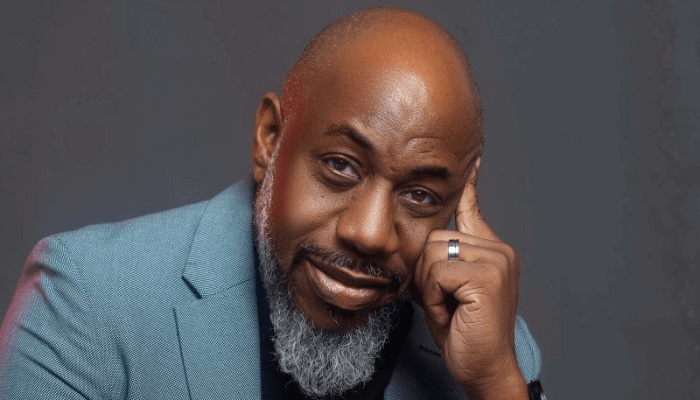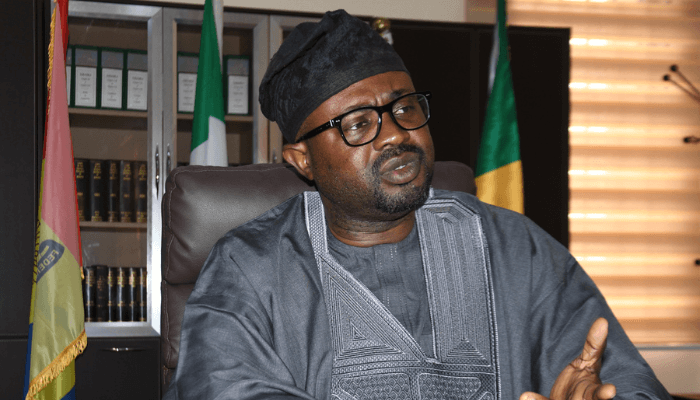
Olubunmi Tunji-Ojo, Nigeria’s Minister of Interior, is a trained engineer, tech entrepreneur, and former legislator known for championing transparency and accountability. Appointed in August 2023 by President Bola Tinubu, the London-educated ICT expert brings deep technical expertise and reformist energy to the ministry which, according to stakeholders, are yielding the desired impactful result. In this exclusive interview with BusinessDay’s General Manager, Bashir Ibrahim Hassan, he outlines his digitisation agenda, from prison decongestion and identity management to passport reforms and border security, all aimed at building a smarter, more secure Nigeria. Excerpt…
“What this all means is that we’re automating processes to ensure the system is efficient and self-sustaining. It’s no longer about building institutions around strong individuals.”
There’s a big signboard just at the entrance to the premises with the inscription: “Ministry of Interior is going digital.” And then beneath it is “ECMS goes live September 2025.” What is so special about these?
Let me say clearly that what we’re trying to do in the Ministry of Interior is to optimise all our processes, automate our solutions, and make sure that we give people the best experience. That’s what the “Renewed Hope Agenda” of the president is all about.
Beyond all the services that we render to the public, we also think that our internal operations need to be fully automated. That’s what ECMS is all about—the Enterprise Case Management System. It’s to make sure that, in accordance with the instruction of Mr. President, before the end of the year, we want to go totally paperless and create an efficient system of excellence, where all the trails will be at the tip of the finger.

Tell us where we’re coming from and how far we’ve gone.
As you can see, we still work with files. What we want to do is to fully conclude our ECMS to be able to deal with our internal operations end-to-end. We want to make this ministry as paperless as we can, and we know that that is achievable, and we’ll definitely achieve it by the grace of God.
“We’re also looking to explore innovative ways, including private sector funding, to further improve the welfare of these people.”
How much have you done in reforming our correctional centres? How much better is it now, compared to what you met on the ground?
Overall, I would say it’s not about me; it’s about the government under President Tinubu. It’s about the implementation of the national agenda.
Many of our correctional centres are currently undergoing a significant facelift. You can visit Kuje and several other centres across the country, there’s a great deal of physical work going on. Just a couple of weeks ago, a major surgical procedure was carried out efficiently and successfully at the Kuje Correctional Centre. That was possible because we’ve upgraded their medical facilities, among other improvements.

Beyond the physical upgrades, there are two key issues that matter deeply to me.
The first is overcrowding. We’ve managed to reduce the number of inmates by about 5 percent, that’s over 4,000 individuals, and we did so efficiently without relying on public funds. We’re now working closely with the Office of the Attorney General of the Federation, as well as with various state governments, because the majority, about two-thirds of inmates in our correctional centres, are state offenders, not federal. That makes it difficult for the federal government to release them without the involvement of the states. We don’t have that jurisdiction. So, we’re engaging the states and the Attorney General’s office to further decongest our prisons.
The second, and to me the most important, is the rehabilitation, transformation, and correction of these inmates. Correctional centres should not be places of punishment alone; they must also be places of transformation. In the last six months of last year alone, about 10,000 inmates were rehabilitated. We are working towards achieving a zero rate of recidivism. When people come into correctional centres, they should leave as better citizens, empowered with skills, more useful to society and to themselves.
We want to help them build livelihoods, not return to crime. It’s disheartening when someone is released only to return after two or three months. We want to end that cycle and truly clear the space.
Let me also emphasise that identity and information management in correctional centres are crucial. For example, when there was a jailbreak in Niger State last year caused by severe weather, it took us far too long to identify the escapees because we didn’t have comprehensive records. But rather than complain, we acted. Today, unlike in the past—like during the Maiduguri flood incident—every inmate’s information is captured on our Correctional Information Management System. In less than 12 hours after a recent escape attempt, we had all the necessary data available.
Before now, such systems were poorly executed, if at all. That’s what led to the challenges we faced in Suleja, Niger State. The same happened in Borno, but within days, we had tracked many of the escapees.
What this all means is that we’re automating processes to ensure the system is efficient and self-sustaining. It’s no longer about building institutions around strong individuals. No. It’s about building strong systems: systems that will endure and operate independently over time.
Read also: Nigeria to establish centralised system for verifying travel documents – Tunji-Ojo
There have been allegations of corruption in the system. What are you doing to reduce bribery and corruption in the correctional system?
Well, for me, it’s not about what we say; it’s about what people can see. I don’t want to score myself—you, as an investigative journalist, are in a better position to assess that.
We’re on top of this. Once we apprehend anyone involved, we discipline them. I’ll give you an example: when we had issues last year, several controllers were suspended indefinitely and are currently undergoing disciplinary procedures. Those being sanctioned include an Assistant Comptroller-General.
We have built a system where nobody is above the law—everyone is equal.
Evidence of progress is that complaints have reduced. I’m not saying we’ve arrived; we’re not yet where we want to be. But the good news is that we’re no longer where we used to be. So, there’s clear progress, and we’ll continue to give our best to ensure we build a system that can sustain itself.
Still on the correctional centres, you seem to be passionate about the welfare of the inmates. How much have you done so far, and what should we be looking out to see you do in the next couple of months and years regarding the welfare of inmates?
While welfare has improved, there is still a long way to go. You are aware that Mr. The president graciously increased the feeding allowance by 50 percent, taking into consideration the cost of commodities. Mr. President also approved for us to recruit about 50 doctors and 100 nurses to our correctional centres. We’re also looking to explore innovative ways, including private sector funding, to further improve the welfare of these people. So, as I said, a detention centre or a correctional centre is a place of transformation, and you cannot transform people when you don’t pay attention to their well-being.
Beyond the significant improvement in passport administration, how much more should we expect to see in reforming the immigration system generally?
We’ll continue to innovate. The day we stop innovating is the day we die. Innovation is life. To me, innovation is as important as the oxygen we breathe. That’s my belief. It’s about constantly seeking new and better ways of doing things.
You can see this clearly in the improvements we’ve made to passport administration and other innovations we’ve introduced. It’s no longer business as usual—especially for Nigerians in the diaspora, who previously had to travel long distances just to renew their passports. That era is over. People can now complete the process from the comfort of their homes.
In terms of border control, immigration has also made significant strides. This government has successfully implemented the Advanced Passenger Information System, a vital border control solution. We have also deployed E-Gates to enhance security and efficiency. Additionally, we have digitised the SEPAC scheme and improved the Temporary Work Permit (TWP) process, making the work permit environment more transparent and accessible, giving more opportunities to Nigerians to thrive.
So yes, immigration has improved significantly.
Let’s also not forget that this government has acquired around 50 Hilux vehicles for border protection. As I speak to you, a number of forward operating bases are being constructed at our borders. We’re placing a high priority on our borders, understanding that immigration is responsible for patrol, surveillance, and management.
As I always say, a safe border is a safe nation. When your borders are secure, your nation is more secure. That’s why we are fully focused, and the reforms are already yielding results, even in migration management.
What I’m saying is this: when you look at the end-to-end responsibilities of the Nigerian Immigration Service, many of them had never been innovatively addressed—until now. And as I keep saying, we must keep innovating. The United States, China, and the UAE, all leading nations, are in a constant state of innovation. What keeps you in the game, what keeps you ahead, is your level of innovation. That’s something this government takes very seriously.
As an expert, generally, how much have you done to really make our Identity Management Commission as efficient as it should be so that it can discharge its constitutional mandate as it should?
I think the NIMC is doing well when you look at the number of people they’ve been able to enroll. But it’s not just about the quantity of enrolment but the quality of enrolment and cleaning up the database. And, of course, there are still one or two issues. On Friday, the DG was with me with his team, and we have so many areas we’re still working on, including NIN, whose integrity determines the integrity of all other social services of the government. So we’re working on that, and I can tell you that NIMC is doing very well. More agencies are keying into the NIMC scheme because it’s not optional; it is mandatory.
Reflecting your target-driven style, what is your target for NIMC?
I want to assure you that within the next year, NIMC will have been completely repositioned to function as a truly modern, digital-first identity management institution. Our target is not just mass enrolment but quality enrolment—ensuring that every Nigerian’s data is captured accurately, securely, and efficiently. We are working closely with the leadership of NIMC to clean up the existing database, strengthen the integrity of the National Identification Number (NIN), and ensure interoperability across key government services. The goal is to make NIN the bedrock of all public service delivery so that identity becomes the foundation for access to education, healthcare, banking, and social protection. Nigerians will begin to feel the real value of a seamless, secure, and dependable digital identity system, backed by innovation and accountability.
Read also: A breakthrough: Tunji-Ojo gifts Nigeria e-Visa and digital security leap
As Honourable Minister of the Interior of the Federal Republic of Nigeria—the most populous Black nation in the world—how much have you been able to achieve in securing Nigeria internally? Looking at our borders, there are still complaints. Up till now, our borders are porous. So, how much have you been able to do, Honourable Minister, in dealing with our internal security challenges so far?
A lot has been done, and we’re working very closely under the supervision of the President and, of course, very closely with the Office of the National Security Adviser. A lot has been done, but I wouldn’t want to discuss the details. These are security issues. But I tell you that most of the concerns that Nigerians have today are concerns that we’re working very hard on. The NSA is coordinating the security architecture, and I can tell you that the government is on top of a lot of these things, and Nigerians can be rest assured that we will not sleep until they can close their two eyes.
What about the issue of overlap between the police and the Nigerian Security and Civil Defence Corps?
No, there’s no overlap. You can go through the laws; there’s no overlap.
How efficient are they in working together?
There’s efficiency. You can see what’s happening in our minefields. The NSCDC is responsible for the protection of critical national assets.
How much better are they now at doing that compared to what they were doing before?
We’re providing specialised training to protect mineral sites, which is quite different from the training required to protect farmland. The threats are not the same, and therefore, the methodology cannot be the same.
That’s why you must sectorise your security architecture. It is only when you sectorise that you can build efficient systems tailored to each sector.
That’s exactly what we did with the solid minerals sector. You’ll notice that the noise around terrorism and insecurity at mineral sites has significantly reduced. This is because the NSCDC introduced a specialised unit called the Mine Marshals. They work closely with the Ministry of Solid Minerals. I don’t give them instructions—the directives come directly from the ministry.
We’re also developing a similar strategy for power infrastructure, because every sector faces unique threats.
If you apply a one-size-fits-all approach, you’ll merely scratch the surface of the problem. But when you sectorise and provide targeted training for each specific threat, the personnel will be far better equipped to respond effectively.
What are your top priorities in the next three years?
In the first place, never put yourself under pressure. That’s the first thing. Because pressure kills innovation. That’s number one. It’s philosophical.
Number two is that innovation is a growing concern. It will always continue. It’s about you having your targets and having milestones to achieve as much as you can.
How are you dealing with funding challenges?
That’s not something I would like to talk about. We’re partnering a lot with the private sector and making sure that we create funding outside of the system. We want to collaborate and create private sector funding to be able to make an addition to what the system has to offer.
Security is everybody’s responsibility. So, the responsibility of solution delivery has to be collective.
Generally, what should Nigerians expect to see in relation to your key priorities in the next two years and in line with your legacy? Also, what type of support do you require of Nigerians?
For me, I think what Nigerians should expect is a more detailed, effective, and efficient delivery of the Renewed Hope Agenda of Mr. President, making life easier for them and creating long-term solutions to long-term problems. That’s something I think Nigerians should expect.
And for the support, what I would like to ask for is basically that we should be patriotic and not always pray or look forward to the failure of our leaders.
We should endeavour to build a country we can all call home and not to celebrate the failures of leaders. Rather, let’s support the government to succeed. Because I have realised that a lot of people, with due respect, are more interested in the endless pursuit of the discovery of mistakes, not success.
So let’s pray for the success of the government and support the government, knowing fully well that we are all Nigerians and this is the only place we can call home.
Finally, in the last interview I had with you, you said for you, it’s “Nigeria first, Nigeria second, and Nigeria always.” Do you still stand by this statement?
Definitely. Nigeria always. That’s the simple truth. Nigeria is not just a country. Nigeria is not just a nation. Nigeria is us. We are Nigeria. I didn’t say we are Nigerians; we are Nigeria!