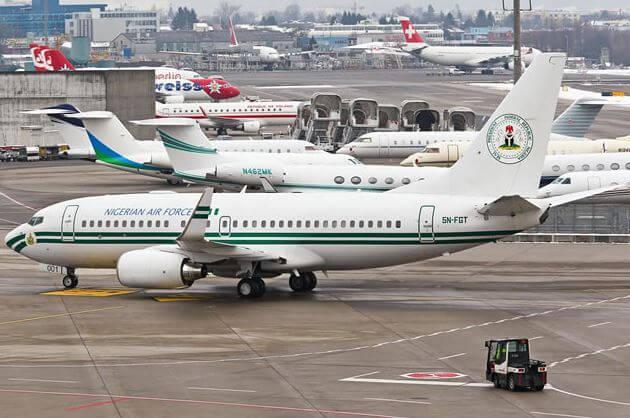
The Office of the National Security Adviser (ONSA) has told the Senate that spending on the Presidential Air Fleet has surged, largely due to overseas maintenance arrangements.
Mohammed Sanusi, permanent secretary at ONSA, disclosed this during a budget defence session before the Senate Committee on National Security and Intelligence, where the agency presented its 2026 estimates.
Sanusi attributed the rising costs to the continued servicing of the Presidential Air Fleet outside Nigeria, a development he said has significantly increased maintenance expenditure.
The 2026 proposal covers ONSA and its specialised units, including the National Counterterrorism Centre, the National Cybersecurity Coordination Centre, the National Centre for the Control of Small Arms and Light Weapons, and the Presidential Amnesty Programme.

Read also: FG launches insurance regulation for leased aircraft to boost aviation sector
However, Sanusi did not provide details of total spending on the fleet in 2025 or cumulative costs since the current administration assumed office.
Beyond aircraft maintenance, he outlined broader operational constraints confronting the intelligence community.
These include a shortage of operational vehicles for covert assignments, irregular disbursement of overhead allocations, failure to implement the 2025 capital budget, funding gaps for foreign-based personnel, and exchange rate volatility affecting service-level agreements.
Yahaya Abdullahi, chairman of the committee, said the National Assembly leadership would review the submissions and determine appropriate interventions.

“After receiving reports from the various committees, the National Assembly leadership will sit down to review the issues and work out appropriate solutions, particularly those that have arisen in the current financial year.
“We also discussed the recent declaration by the president of a national emergency on security. If such an emergency has been declared, there must be adequate funding to support it,” Abdullahi said.
He added that lawmakers may seek direct engagement with President Bola Tinubu to relay the concerns of security and intelligence agencies.
“As a result, we will develop a strategy to ensure that the president’s declaration does not become merely symbolic. If necessary, we will engage the leadership of the National Assembly to seek a meeting with the president.
“We intend to present the concerns of the security and intelligence agencies directly to him so that appropriate steps can be taken to provide them with sufficient funds to carry out their constitutional responsibilities,” he said.
Read also: NAF engineers reactivate DO-228 Aircraft grounded for 23 years
Abdullahi described 2026 as a pivotal year for Nigeria’s democratic stability, warning that inadequate funding could undermine preparations ahead of another election cycle.
According to him, the committee has concluded its budget defence exercise and is compiling its report for submission to the Appropriations Committee and the National Assembly leadership. Further engagement with the executive arm is expected once legislative reviews are completed.
“We also emphasised that 2026 is a very critical year for the survival of the nation’s democracy. Given the current security situation, failure to adequately fund these agencies could create serious challenges as we approach next year’s elections.
“For now, the committee has concluded its work and is preparing its report for submission to the Appropriation Committee and to the leadership of the National Assembly. The National Assembly, in collaboration with the House of Representatives and the relevant Senate committee, will then approach the president with concrete suggestions on how to address the challenges confronting these institutions,” Abdullahi said.