|
Getting your Trinity Audio player ready...
|
…As apprehension envelops zone
…Stakeholders rule-out violence
…Not yet goodnight for Kanu as appeal windows give hope
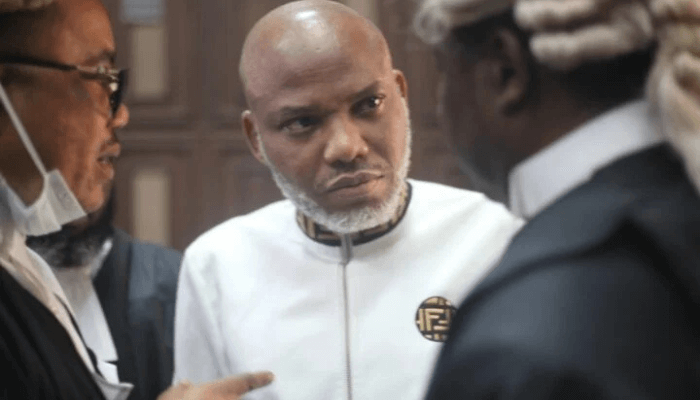
The sentencing to life imprisonment on Thursday of Nnamdi Kanu, leader of the proscribed Indigenous People of Biafra (IPOB), has continued to generate debate in the South East geo-political zone, BusinessDaySunday can authoritatively report.

The development has also ushered in fear of the unknown, as people in the zone are apprehensive over what could be the reaction of Kanu’s followers.
Top on the guess list of many people is whether or not IPOB would respond violently in the days ahead and whether or not the imposed sit-at-home across the zone would continue.
While majority of Igbos see his conviction as injustice against the Igboman, those who lost their loved ones, people whose communities were ravaged, by the activities of the Eastern Security Network, (ESN), other militarized groups, and criminal elements, who took advantage of the situation to cause mayhem in Igboland, see it as justice well served.
Read also: Ohanaeze condemns life sentence on Nnamdi Kanu, calls for calm
For many, his conviction represents selective justice, given the activities going on in different parts of the country and how the Federal Government engaged, and has continued to engage those involved in some kinds of agitations.

In a country where Boko Haram terrorists are captured and enlisted in the army, while the group is still terrorizing the country, people see Kanu’s life imprisonment as high-handed and selective judgment.
“In the case of Nnamdi Kanu and IPOB, we did not see the carrot-and-stick approach; all we saw was the use of force by the Federal Government, probably to put agitation for Biafra to rest for good,”
Obinna Nwagbara, executive director, Youth and Students Advocates for Development (YSAD) observed.
He said that the only thing that can make people from the South-East of Nigeria to forget Biafra is good governance and giving the people a sense of belonging.
“Nnamdi Kanu and other agitators were not wrong to agitate for Biafra; it’s within their fundamental human rights to do so,” he said.
He however, noted that he was not comfortable with the strategy they adopted. “The strategy was counterproductive. One of such tactics was the sit-at-home order, which led to the deaths of many Igbos and it was also one of the things used against him.
“I saw his conviction coming. Not convicting him would have been further ridiculing the already messy judiciary in the country, given his conduct in court.”
As for whether his conviction would increase violence in the South-East, Nwagbara said that he did not think so.
According to him, Ekpa’s arrest and conviction in Finland reduced the tension in Igboland. The prolonged sit-at-home order demoralised the people, which explains why major cities in the South-East were active on November 20, the day that Kanu’s judgment was delivered.
He noted that dialogue was what can grant Kanu freedom at this point, if he appeals his conviction and fails to get it upturned.
Okoye Chuka Peter of the Civil Rights Actor and Advocate for Democratic Justice, described Kanu’s conviction, as a verdict delivered with theatrical bravado, but rooted in selective justice. He noted that the judgement was likely to widen the rift it purports to heal.
He argued that Kanu was not extradited from Kenya, by legal means, but apparently abducted.
He recalled that a Kenyan High Court judgement declared his rendition unlawful, condemned the violation of his rights, and underscored the illegality of the entire process, yet, just months later, a Nigerian court pronounced him guilty on terrorism charges under a statute many argue was already repealed.
“Through a satirical lens, this is not a courtroom proceeding, but a tragicomedy: Justice, blindfolded, somehow still peeks at political instructions; the judge plays prosecutor; the gavel doubles as a weapon. The real casualty, however, is public trust.”
Okoye further argued that the ruling would almost certainly generate more sympathisers for Kanu and IPOB, instead of shrinking his influence.
He observed that the decision would only deepen disillusionment for many in the South-East, already nursing historical grievances, adding that the fragile faith some still hold in the Nigerian project grows thinner by the day.
Suleiman Anyalewechi, a public relations expert, said that he was not expecting any violent reaction from any quarter, especially his supporters for now.
“Although, most of them may be feeling disappointed with the court’s verdict, it will be premature to indulge in any act of violence and or protestation.
“Nnamdi Kanu still has two other judicial layers to explore- the Court of Appeal and the Supreme Court in a bid to extricate himself.
Read also: Nnamdi Kanu sentenced to life imprisonment
“Though tension and anxiety are mostly likely to pervade the South East region, till when the Court of Appeal and probably the Supreme Court will rule on the matter.
“Besides, his supporters are unlikely to embark on any exercise that may jeopardise the likelihood of political solution,” Anyalewechi stated.
Emeka Nwankpa, national convener of the South East Mandate for Good Governance, appealed to Igbo youths across the South-East to remain calm and refrain from violence.
Nwankpa in a statement issued Thursday evening, noted that while the development has generated widespread anger, any resort to violent protest, would only worsen the already-fragile security and economic situation in the zone.
He described violence as “a path that has yielded nothing but bloodshed, economic losses and fear in the past,” stressing that the South-East has already suffered massive financial setbacks, disrupted academic activities, business closures, and loss of lives due to unrest and protest-related conflicts.
“The South-East cannot afford another round of violence. Our markets have suffered, our youths have suffered, and our people have lost much already. Let us not destroy our future out of anger,” he stated.
While calling for restraint, Nwankpa also urged President Bola Ahmed Tinubu to exercise executive clemency and grant Nnamdi Kanu a presidential pardon.
He explained that such a gesture, would help calm tension, restore confidence in national unity, and open a path to meaningful dialogue.
“A presidential pardon at this moment would be a historic act of statesmanship. It will demonstrate inclusiveness and reaffirm that national leadership embraces every part of the country,” he said.
Nwankpa, a bishop, further emphasised that resolving the issue through peaceful and political means would not only deepen the message of “Renewed Hope” championed by the Tinubu administration, but also signal a commitment to reconciliation and lasting peace in the region.
He called on youth leaders, civil society organisations, traditional rulers, and political stakeholders in the South-East to join hands in discouraging retaliation and promoting dialogue.
Enyinnaya Abaribe, former Senate minority leader, bemoaned the conviction and sentencing of Nnamdi Kanu for terrorism, saying however, that the outcome was foretold and not surprising.
Reacting through a statement in Abuja by Uchenna Awom, his media adviser, the Senator said that the life jail handed down to Kanu was a preconceived plot that is not surprising to the Igbo nation and other right-thinking Nigerians.
Abaribe said that at the time the Federal Government refused to factor in pleadings to extend the amnesty to Nnamdi Kanu as it did to others “we knew that today’s outcome was imminent.”
He wondered: “Is it not an irony that negotiations and peace deals with rampaging terrorists in the North East, North West, were gleefully initiated by the local government, states and Federal Government, just like the amnesty to ex-militants in the South-South, who were also rewarded with lucrative oil pipeline contracts. That is to say that justice in Nigeria is not for South East.
“So, we are not surprised- our people can only endure and hope for a time justice in Nigeria would become the Sina qua non. We have done our best, we have variously made the case for the authorities to be circumspect and at least accede to pardon for the sake of unity and inclusiveness,” Abaribe said.
Abaribe declared that the Igbo nation was now left with no other option than to place her fate in this matter squarely on the desk of President Tinubu.
“We must remain calm and pray. May Nigeria succeed, thrive and advance in justice, equity and fairness,” Abaribe added.
Alex Ikwechegh, member representing Aba North/Aba South federal constituency in an open letter to the President said that this is a time to unite the country.
He appealed to President Tinubu, to grant pardon to Nnamdi Kanu. “Clemency at this moment will not only quell the security tension in the country, particularly in the South-East, but will also draw his supporters closer to the President, the father of this great nation.
Read also: Nnamdi Kanu moved to Sokoto prison after life sentence for terrorism
Kanu’s kinsmen react
Meanwhile, Ibeku community in Umuahia North Local Government Area of Abia State, has been gripped by outrage following Thursday’s development.
The judgement against Kanu, a crowned prince of Isiama Afara Ibeku, has left the community deeply worried and unsettled.
Uche Akwukwaegbu, the traditional prime minister of Ibeku Ancient Kingdom, in an interaction with newsmen, expressed deep dissatisfaction over Nnamdi Kanu’s sentencing, describing the ruling as one that has left the Ibeku community in a sad mood.
Akwukwaegbu, who also serves as the President of the Traditional Prime Ministers Council, said that the sentencing of Kanu amounted to an indictment of the entire Igbo race.
Speaking at his residence in Umuahia, shortly after the meeting of Council of Traditional Prime Ministers, Akwukwaegbu lamented that while various acts of terrorism continue across other parts of the country, perpetrators, including notorious bandits, still move freely without confrontation from authorities.
He referenced the recent attack on worshippers at the Christ Apostolic Church in Kwara State as an example of violent crimes that have gone unpunished, insisting that the disparity in the treatment of offenders is troubling.
“Nnamdi Kanu is our brother, and we are not happy about the judgment,” he said.
Akwukwaegbu disclosed that the council of traditional prime ministers had convened for the first time in months to discuss welfare issues and future plans, only to have their deliberations overshadowed by the news of Kanu’s conviction.
“We had already fixed this meeting as our end of the year meeting, but due to the judgement, we couldn’t do much. The judgement affected us,” he said, noting that their end-of-year meeting was held in a low-key manner out of concern and disappointment.
He stressed that the ruling was not final and that there were legal steps available, including advancing the case to the Appeal Court and drawing the attention of international communities to the matter.
He however, noted that banditry continues to be shielded across the country despite the alarming rate of killings, while Nnamdi Kanu is being handed a life sentence merely for leading the Biafra struggle.
He described the judgement as a calculated attempt to indict the Igbo race.
In reaction to what could be considered a positive way forward, Akwukwaegbu explained that the Federal High Court was not the last court.
“Before seeking political solutions, we must go to the Appeal Court, and even appeal to international communities. When all these avenues are exhausted, we will know how to cross the other bridge,” he said.
Akwukwaegbu maintained that as a Nigerian and an Ibeku son, he remains unhappy with the judgement and the broader implications it carries for the Igbo people.
Read also: FG seeks death sentence for Nnamdi Kanu after terrorism conviction
Imo
A prominent businessman in Owerri, Imo State, who spoke to our correspondent on condition of anonymity said: “Mazi Nnamdi Kanu’s conviction will not stop the Igbo people or IPOB from agitating for self-actualization; it is going to fuel the agitation. In fact, it is going to cause a lot of problems in the South East.
“I must also add that it will unfortunately affect the economy of the South East. Mazi Nnamdi Kanu did not commit any crime to warrant his conviction.”
Anthony Nkwazema, one of the community leaders in Aboh Mbaise Local Government Area, said: “We are sad; we are crying. Looking at the faces of people, you will understand that the conviction of Mazi Nnamdi Kanu has added more sorrow to them- sorrow caused by the hardship that is prevailing in the country. Very soon, very soon, you will hear that somebody somewhere will rise up and start from where Nnamdi Kanu has stopped. When Ralph Uwazuruike’s MASSOB went under, Nnamdi Kanu’s IPOB unknowingly to many people sprang up.”
Enugu
In his reaction, Ogbonma Chukwunwike, a businessman in Enugu said that jailing Kanu would increase violence in Nigeria. He believed that the development would further tear the country further apart.
For John Ndubueze a resident of Enugu, “what has happened will increase agitation because people are now seeing it that they are marginalised, because last time, the President released some people up to 185 criminals from prison; people who are known criminals, kidnappers, Boko Haram people; people expected that Kanu who did nothing, except his voice to free his people, could have been released. But he wasn’t, only for Omotosho, sponsored by the Federal Government to pronounce such judgement on him; how can an Igbo man be happy? Let me tell you, every real Igbo man and woman is angry.
“Let me tell you something now, there is no time secession agitation will stop. Kanu came to meet secession and joined because of this kind of judgement. With this, do you think it will end?”
Bianca Odumegwu-Ojukwu’s measured response
Reacting to the judgment, Minister of State, Foreign Affairs, Bianca Odumegwu-Ojukwu called for caution and restraint. Expressing deep pain over the turn of events, she urged Kanu’s supporters to avoid escalation in response to the verdict. Below are her words:
I have just returned from Zanzibar, Tanzania, where I have been for the past five days on NTAC monitoring exercise to the sad news of the conviction and sentencing of Mazi Nnamdi Kanu on terrorism charges. This is not the outcome we prayed for, but it is a reality that is now upon us.
There comes a time in the history of a people when there is need for calm.
I therefore advise Ndigbo, and Nigerians as a whole, that such a period is now! There is utmost need to exercise restraint in response to this situation.
All actions which could be deemed incendiary, and which might escalate the situation at home or in the diaspora should be curtailed. A word is enough for the wise.
Read also: Decade after arrest, court sentences Nnamdi Kanu to life imprisonment over terrorism
This situation requires careful reflection and constructive dialogue involving all Igbo stakeholders, Governors, senators, Members of the House of Representatives, clergy, traditional rulers, politicians and business people to engage with government authorities collectively. Beating the drums of fury and sabre rattling will only generate diminishing returns, and in the worst-case scenario, yet another wasteland.
The most effective path toward resolution of this crisis is dialogue. The quest for mutual coexistence of Ndigbo in Nigeria with justice, equity and dignity is a commitment which requires our collective resolve, and maintaining peace and order is essential to ensuring the security of all citizens, regardless of tribe or creed.
I would like to reassure Ndigbo, Nigerians and our foreign partners that there are still prospects of resolving this impasse in a manner that reduces national anxiety and societal trauma. I oblige everyone to remain calm and patient. Over the years I have continued to engage on these issues with several stakeholders. Now is the time for us all in Ala Igbo to put all hands on deck, and to have a joint engagement, sincerely, involving all the South Eastern States, to seek a political resolution to this matter.