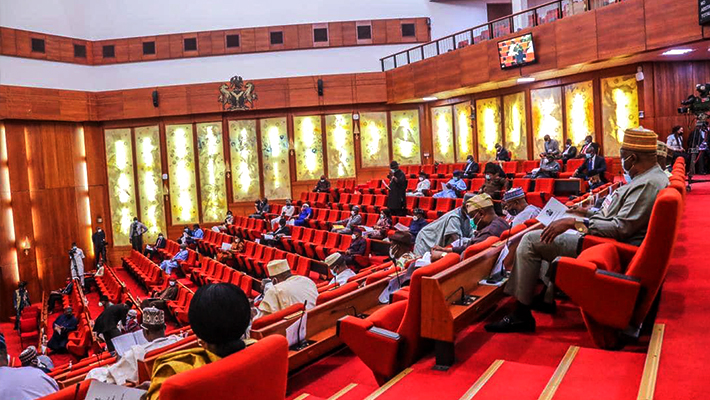
Nigeria is burning, but its lawmakers are on retreat.
Across the country, both the Senate and House of Representatives have dispatched into regional “security retreats” and strategic meetings held inside exquisite hotels, air-conditioned halls, buffet tables, estacodes, and flight-funded movements, while Nigerians remain exposed to violence that grows more horrifying by the day.
Earlier in the week, twenty-five schoolgirls were abducted in Kebbi State.
Also, in a Church programme in Kwara on Tuesday, which was streamed online, gunmen reportedly stormed the venue, killing three worshippers and abducting several others, including the pastor.

By Friday morning, reports emerged of about one hundred villagers kidnapped in Niger State. These events are only the latest entries in a long catalogue of daily horrors, yet the Senate continues to operate as though Nigeria is not in a state of national emergency.
Read also: Nigeria cannot lament its way out of terror
The ongoing retreats have raised questions among citizens and they wonder who exactly is being deceived.
The lawmakers claim to be working, deliberating, consulting and brainstorming solutions, but the evidence suggests otherwise.
Despite the rising wave of violence, the Senate’s rhythm remains unchanged: whenever insecurity spikes, Senate committees travel; whenever kidnappings increase, Senate committees meet; whenever killings rise, Senate committees retreat.

Every retreat has a budget line, every committee has allowances, every ticket is paid for, and every hotel costs millions. But no measurable result has emerged from these excursions.
This year, the Senate added another committee to its long list of “interventions.”
On May 15, it announced the constitution of a 20-man planning committee to organise a “high-level National Security Summit.” Senate Leader Opeyemi Bamidele was named Chairman, with Senator Yahaya Abdullahi appointed Deputy Chairman.
Other members include Senators Ireti Kingibe, Idiat Oluranti, Mpigi Barinada, Babangida Hussaini, Jimoh Ibrahim, Isah Jibrin, Osita Ngwu, Tahir Monguno, Titus Zam, Ahmad Lawan, Abdulaziz Yaradua, Gbenga Daniel, Austin Akobundu, Buba Shehu, Abdulhamid Madori, Emmanuel Udende, Adams Oshiomhole and Saliu Afolabi.
The committee was given two weeks to convene the summit and submit a report.
The Senate had initially proposed the national security summit on May 6, following a motion by Senator Jimoh Ibrahim (APC, Ondo South), who warned that insecurity “has become pervasive, impacting both urban and rural areas, where banditry, ransom kidnappings, terrorism, and other violent crimes are pressing issues.”
Read also: Attacks in Nigeria: What’s behind the latest kidnappings, church raid?
At plenary that day, senators agreed that no part of the country could be regarded as safe and stressed the urgent need for broad-based collaboration.
Yet despite this sense of urgency, the proposed summit has not been held.
No date has been announced, no findings have been presented, and no preliminary documentation has been shared publicly. Nigerians have instead watched their lawmakers embark on a carousel of regional retreats while communities bury their dead.
Even before the committee was set up, some senators openly questioned the usefulness of another summit.
Senator Abdul Ningi warned that past security summits had yielded no real change, arguing that what Nigeria needs is direct interrogation of security chiefs, not another round of conferences. “What we have to do urgently, in my opinion, is to sit with our security chiefs,” he said during the May 6 plenary.
“Let our security committees interrogate them; what have they been doing? What are their challenges? These are not questions that a security summit can answer.”
Senator Enyinnaya Abaribe also expressed concern, noting that previous summits dating back to the 7th Assembly had simply produced reports that were never implemented.
“We cannot continue like this,” Abaribe said. “We can’t pretend that people are not being killed every day. Let us tell ourselves the truth.”
Senator Adamu Aliero agreed, adding that without political will, another summit would be meaningless.
Despite these reservations, Senate President Godswill Akpabio insisted that the summit would provide an opportunity for “broad-based suggestions from stakeholders,” including state governors, security chiefs and experts.
He maintained that the Senate must explore every available avenue to seek solutions.
However, the question now is whether the Senate is truly interested in solutions or merely maintaining the ritual of committees, summits and retreats.
Over the past decade, the Senate has convened security summits during the 7th, 8th, and 9th Assemblies.
Read also: Insecurity: Closure of schools in North raises fresh concerns in Nigeria
Reports were drafted, communiqués issued, and recommendations announced, yet Nigeria continues to witness escalating kidnappings, terrorism and banditry.
No publicly available record shows that any of those recommendations were fully implemented or even meaningfully debated afterwards.
The backdrop to this cycle of inaction is particularly striking because the security sector receives more money than any other part of the federal budget.
Defence, police and intelligence agencies consistently receive the largest allocations and routinely benefit from supplementary budgets, emergency interventions and classified expenditures. Yet every year, Nigeria becomes more unsafe.
The paradox has led many to ask what exactly lawmakers do in these retreats.
Do they examine intelligence failures? Do they interrogate why ransom kidnappings thrive? Do they review procurement controversies that plague defence spending? Do they scrutinise the performance of security chiefs who repeatedly receive budget increases without delivering measurable improvements? Or do senators simply sit in plush conference rooms, listen to presentations prepared by consultants and issue predictable resolutions about “multi-stakeholder collaboration” before returning home or they just seek means to enrich their pockets and get their cuts from the various fund allocations to security?
Nigeria today is witnessing an unprecedented collapse of public safety.
In the North-Central, farmers are attacked on their fields. In the North-West, entire communities disappear overnight, bandits kidnapping and demanding ransoms in broad daylight. In the North-East, terrorist groups roam through highways unchecked.
In the South-East, security breakdowns continue to claim lives. In the South-South, illegal arms and organised crime persist. In the South-West, highways remain unsafe for commuters. The violence is nationwide, and citizens have begun losing faith in government institutions, including the Senate.
Read also: When crime becomes a business model: Why kidnapping thrives in Nigeria
The ongoing retreats and the yet-to-hold security summit have become symbols of a broader failure of leadership.
Nigerians are not interested in another committee, another retreat, another communique or another round of allowances disguised as consultations. They want results. They want safety. They want lawmakers who understand that this is not a season for tourism or bureaucracy but a moment of national emergency.
A summit that was supposed to be treated with urgency has not happened since May 8. Meanwhile, more Nigerian families mourn their loved ones.
More communities are displaced. More children are kidnapped. And every day, lawmakers continue to deliberate in comfort while citizens live in fear.
Nigeria does not need another retreat. It needs leadership, courage and concrete action, none of which can emerge from air-conditioned hotel rooms.