In a country where fiscal power has long rested in Abuja, Nigeria’s newly signed value added tax (VAT) reforms could quietly rebalance economic control, handing more revenue to states and easing cost pressures on families and businesses.
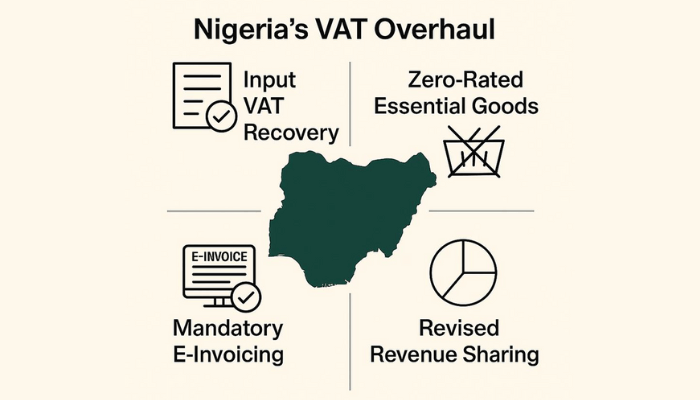
Signed into law on June 26, 2025, by President Bola Tinubu, the new tax reform package introduces sweeping changes to how VAT is applied, recovered, and distributed. Four key shifts, centered on input VAT recovery, zero-rated essential goods, mandatory e-invoicing, and a revised revenue sharing formula, could reshape how Nigerians pay taxes.
“I feel a sense of fulfilment over signing of new tax laws,” said Taiwo Oyedele, chair of the Presidential Tax Reform Committee. “It’s been a very difficult journey. And thanks to all our stakeholders… now that we’re here, I think the foundation has been laid.”
Read also: Nigeria’s VAT overhaul tilts power to states, eases burden on households

For Oyedele, the reforms are not just about plugging revenue gaps, they represent a broader attempt to build a fairer and more sustainable tax system.
VAT just became more business-friendly
Until now, many Nigerian businesses were saddled with VAT charges that they couldn’t recover particularly on office equipment, utilities, or production inputs. The revised VAT framework changes that: companies can now fully reclaim input VAT on all purchases tied to taxable outputs.
It’s a technical adjustment, but one with tangible real-world effects.
“This reduces the cost of doing business,” said Abayomi Fashina, a senior tax consultant in Lagos. “When companies can recover VAT, they don’t need to pass those costs onto consumers.”

For many SMEs operating on razor-thin margins, the change offers a much-needed cushion. It could help stabilise prices in an economy that has battled double-digit inflation for years.
No VAT on food, medicines, books, and more
Another vital change is the expansion of zero-rated goods and services. Basic food items, essential medicines, electricity transmission, tuition, and schoolbooks are now zero-rated, not just VAT-exempt.
Previously, exempt goods meant no VAT was charged, but sellers also couldn’t reclaim VAT on inputs. Now, sellers can claim input VAT credits, avoiding hidden tax costs.
“It’s a win for both sides, producers and consumers,” said Akin Solomon, an economist at a Big Four accounting firm. “Low-income families are protected from indirect taxation, and suppliers maintain margins.”
Additionally, exports, excluding oil and gas, are now zero-rated, enhancing competitiveness for Nigerian manufacturers seeking access to foreign markets.
Read also: Expert advocates grants, tax incentives for interior design industry
Digital receipts and tighter controls
A landmark part of the reform is the mandatory adoption of e-invoicing systems, known as VAT fiscalisation. Businesses are now required to issue digital receipts via FIRS-approved platforms, enabling real-time transaction monitoring.
The aim is clear: enhance compliance, reduce VAT fraud, and plug revenue leakages.
“This will be disruptive initially, especially for small and medium enterprises,” said Nkechi Anozie, a retail operator in Abuja. “But over time, it could simplify our record-keeping and reduce compliance risks.”
Nigeria now joins Kenya, Rwanda, and South Africa among African countries reforming VAT administration through electronic invoicing. Studies from Latin America and other regions have shown that such tools can significantly improve compliance and boost revenue collection efficiency. If Nigeria achieves similar gains, the reform could significantly boost public revenue without raising rates.
Looking Ahead
Nigeria’s VAT reform is bold and overdue. It simplifies tax administration, lightens the burden on low-income families, and empowers states with more fiscal control, say analysts.
But success will depend on execution.
Can the Federal Inland Revenue Service (FIRS) roll out digital invoicing nationwide? Will small businesses receive enough support to comply? And perhaps most importantly, will states use their expanded revenue to improve public services or squander it?
Read also: Nigeria dual tax revolution: Balancing administration reform with pro-poor relief
“The reform is promising,” said Kingsley Ayozie, a partner at an accounting firm based in Lagos. “But implementation is everything. We need systems, not just laws.”
For the first time in decades, VAT may shift from being just a revenue tool to becoming a lever for fairness, transparency, and locally driven development. Whether it delivers on that promise will depend not on legislation but on leadership.