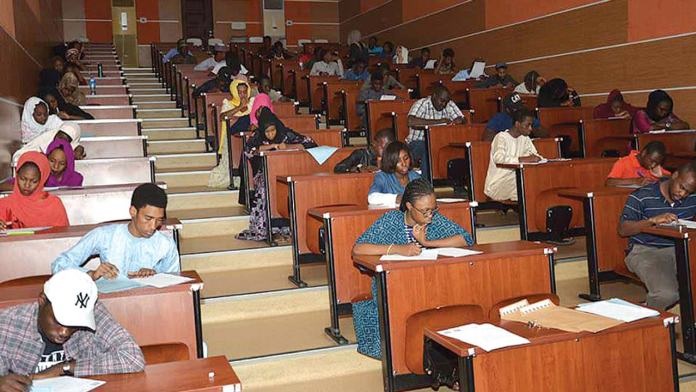
The rapid proliferation of universities across Nigeria, driven by the National Universities Commission’s (NUC) liberal licensing policy, has sparked intense debate among stakeholders in the education sector.
While the expansion aims to improve access to tertiary education and address the growing demand for university admission, it has also raised critical questions about quality, regulation, and equitable distribution of resources.
As new institutions spring up across the country, a closer look reveals a complex landscape of winners and losers, from students and private investors to faculty members and older public institutions, all navigating the changing terrain of higher education in Nigeria.
The rapid increase in the number of universities in the country has become a paradox, even as concerns over quality, funding, and the overall impact on national development arise.

Besides, the unfolding situation poses significant challenges for the labour market and societal attitudes towards education.
As of Q1 of 2025, Nigeria has 270 universities; with 62 federal, 63 states and 149 private tertiary institutions, NUC report indicates.
The 270 universities are reported to have approximately 100, 000 academic staff servicing over 2.1 million students, at a ratio of 1:21, which is above the global benchmark of 1:10.
This glaring gap among other issues of grave concern, are responsible for only a few Nigerian universities being highly ranked globally.
According to the Times Higher Education (THE) World University Rankings 2025, only 21 Nigerian universities are featured, and none are in the global top 500, with the highest-ranked institution being Covenant University, which is placed in the 801–1000 bracket globally.

With the poor showing of Nigerian universities on both the local and international scenes, even if the statistics are not flawless, many stakeholders accuse the NUC of systemic corruption and engaging in underhanded dealings during accreditation exercises.
Abdullahi Ribadu, executive secretary at NUC recently disclosed that to attain full accreditation status, that a programme must score a minimum of 70 percent in each of the four core areas, and an overall score of 70 percent or above in its entirety.
Ribadu emphasised that earning full accreditation status “does not imply that a programme has all the necessary resources in perfect measure,” but is deemed to be an “acceptable standard of performance,” with adequate room for further improvements.
Regrettably, many of these universities produce graduates who lack the skills needed in a competitive job market.
Many stakeholders believe that NUC should enforce stricter criteria before approving new universities to prioritise quality over quantity.
Furthermore, a critical look at the situation in many institutions shows that lecturers manage up to 1,500 students per course, and this severely affects assimilation and dilutes education quality.
In some cases, individual lecturers manage between 1,200 and 1,500 students, which far exceeds the NUC’s recommended lecturer-to-student ratio of 1:30.
When universities proliferate without a substantive focus on quality, public trust in higher education diminishes. Hence, it is time for stringent criteria for university establishment to be put in place to ensure that new institutions meet high academic standards.
Nubi Achebo, director of academic planning at Nigerian University of Technology and Management said the rapid approval and establishment of universities has raised concerns about the impact on learning outcomes.
Achebo disclosed that while increasing access to higher education is crucial, the proliferation of universities may not necessarily translate to improved education standards.
“One of the primary concerns is the potential compromise on quality education. With more universities, there may be a shortage of qualified faculty members, inadequate infrastructure, and insufficient resources, ultimately affecting the quality of education,” he said.
Isaiah Ogundele, an educationist, said Nigeria having many universities is not a crime but what matters is the quality of learning outcomes which translates to human capital development.
“To be sincere, as long as we do not control our birth rate in Nigeria, the population will keep increasing and no provision from the government will be able to cater for such a population.
“We need more private and public universities for the development of our nation but such arrangements should be well tailored to enhance human capital development, producing problem solvers and not graduates who are looking for a white collar job that does not exist,” he said.
The human capital development index of Nigeria is put at 0.32 percent, which simply means that a Nigerian child has only about 30 percent of his/her potential in life to compete at the global level.
Employers of labour have also lamented the dearth of skilled graduates that fit to work amid poor performance of candidates that turn up for job interviews.