Nigeria has been forced to collect and reprogramme nearly 200,000 electronic scanners as it grapples with a one-week delay to its presidential election, a stark reminder of the risks associated with a shift towards digital elections.
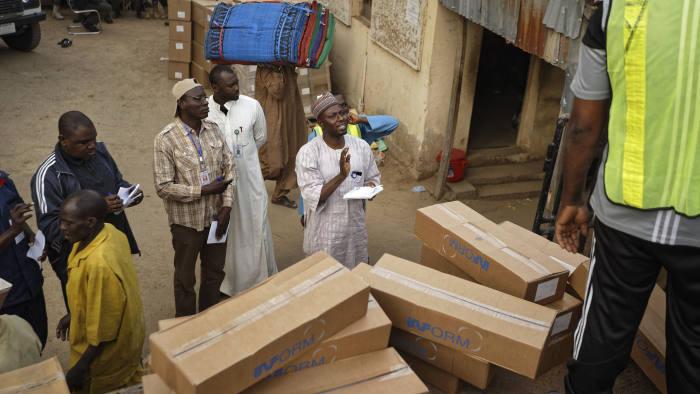
The country’s electoral commission was on Monday collecting and reconfiguring 180,000 scanners deployed to verify voters’ ID cards after it emerged that the seven-day delay had neutralised their anti-fraud measures. The challenge of collecting the machines was a new logistical problem for the Independent Nigerian Electoral Commission (Inec), which announced the delay on Saturday because it had failed to surmount a host of other practical hurdles. “That is a Herculean task,” said one experienced international observer in Nigeria. The adoption of electronic voting has become controversial around the world in an era of digital malfeasance and organised hacking. Nigeria’s travails revived memories of the Democratic Republic of Congo’s December presidential election, which was delayed for seven days after fire destroyed 8,000 electronic voting machines. The use of e-voting eventually created a trail of digital evidence that raised grave doubts about the legitimacy of the final result.
In Nigeria, the shift to new technology has been less ambitious. The scanners will be used to authenticate Nigerians’ voter ID cards, but people will cast their votes with a fingerprint on a paper ballot. Observers have nonetheless praised the safeguards built into the design of the voting machines, which are location sensitive, in order to reduce the likelihood of fraud. Each machine was programmed to operate only in one specific polling place and only in a certain time period around election day. They cannot be reprogrammed from afar because they can only transmit data and are unable to receive it, a set-up that reduces the risk of hacking.
Instead, each machine must be sent back to one of the electoral commission’s main offices to be reprogrammed by hand before being reshipped back to its polling place. The postponement has become a source of embarrassment for Nigeria, which is Africa’s most populous nation and has the continent’s largest economy. The election observer said former senior African officials in Nigeria for polling day were “shaking their heads”. In the election — now due to be held on Saturday — President Muhammadu Buhari is facing a strong challenge from the main opposition candidate Atiku Abubakar, a former vice-president. Both candidates have condemned the delay and fuelled suspicions among some citizens that attempts to manipulate the result are underway in a country with a long history of vote rigging. At a press conference on Monday Mr Buhari, who is running for the All Progressives Congress party, echoed widespread frustrations about the electoral commission’s decision to delay the election. “The reasons why such incompetence manifests itself has to be explained,” he said. He added that anyone who snatched ballot boxes “will do it at the expense of their own life”, and that he had ordered police and security services to be “ruthless” when dealing with those seeking to disrupt or rig the election. In December, Mr Buhari fed criticism that he was not fully committed to free and fair elections when he refused to sign a key electoral reform bill for the fourth time, citing drafting errors and arguing that its enactment just two months from election day would create uncertainty.

The bill had been praised by good governance groups for, among other things, dealing directly with the scourge of vote buying and making elections more transparent. Idayat Hassan, head of the Abuja-based Centre for Democracy and Development, said no electoral bill could have prevented the “sheer incompetence” of the electoral commission. It has had to delay the previous two elections as well, in part because of logistical challenges. “I think they were just overwhelmed,” Ms Hassan said. “They did not realise they were organising the biggest election not just in the history of Nigeria, with 84m voters, but the biggest in the history of the continent.” Mr Abubakar’s party said it would resume campaigning this week despite an INEC prohibition, which the party argues contradicts laws that say campaigning must end 24 hours before election day.