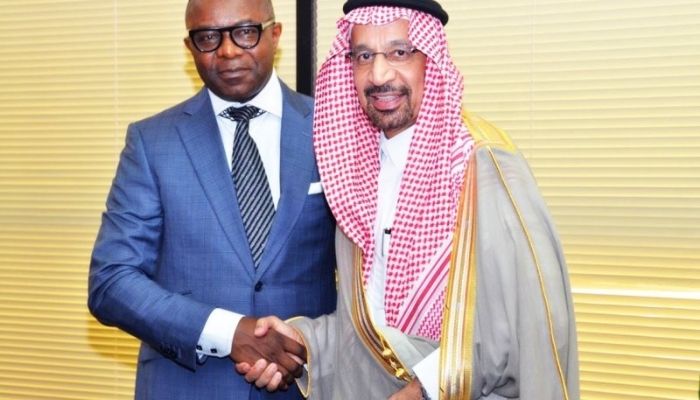
Minister of petroleum, industry and mineral resources of the Kingdom of Saudi Arabia, Khalid Al-Falih, Wednesday held talks with the Federal Government as parts of efforts to bring about stability in the crude oil price and in the international crude oil market.
Speaking at a visit to Ibe Kachikwu, minister of state for petroleum resources, in Abuja, Al-Falih said Saudi Arabia was in consultation with Nigeria and a host of other countries to address the volatility in the global crude oil market.
Al-Falih said the discussions with Nigeria was geared towards ensuring all petroleum producing countries present a common front in the forthcoming meeting of members of the Organisation of Petroleum Exporting Countries (OPEC), scheduled to hold in Vienna next month.
He said, “We are going through a period of volatility. In the last few weeks, we have seen oil market go through great volatility. That has also been amplified by new political tensions and this has brought about speculations, specifically in the activities of international investors resulting in the decline in crude oil price.
“Our consultations today with Nigeria is very important, it would prepare us well for the OPEC meetings. All of the consultations we have had with different countries would lead us to reach a consensus. Once again I am confident that the producers that would be gathering in Vienna would do the right thing in stabilising the market and giving some comfort for 2019.”
Confirming this, Kachikwu said there was an absolute resolve of both nations to ensure that during the meeting in Vienna, they speak with one voice and that whatever action needed to be taken to stabilise the prices would be taken.
READ ALSO: How OPEC seems to be losing control over oil prices
“Obviously, we agree collectively that the interest of the whole is what will guide us when we get to Vienna.
“We are looking forward, not without some level of trepidation, but certainly with a lot of resolve to find a closure to some of the things we see have caused the volatility all over the world,” Kachikwu said.
Furthermore, he disclosed that the Federal Government was seeking ways to collaborate with Saudi Arabia to revamp Nigeria’s refineries and also restructure the downstream sector of the Nigerian petroleum industry.
The Nigerian petroleum minister said during the discussions, he was able to secure an understanding with his counterpart from Saudi Arabia in terms of understudying the Arabian nation’s model in refining and downstream operations.
He said, “You know the refineries are very close to my heart. I did bring up the issues of the experiences we have had so far and he shared his own experiences in terms of the successes they have had and we have got an understanding to come and look deeper into how they did their own trajectory to get where they are today and what experiences we can get from there.
“No formal thing was agreed yet, we need to collaborate and learn from one other. These are usually very strong business decisions and at the appropriate time we would nosedive into the details of that.”
Confirming this, Al-Falih said lessons to be learnt from its downstream policies were reflected in the fact that its national oil company, Saudi Aramco became successful to a large degree, turning deficit in terms of fuel products, to becoming a major exporter by building a number of large refineries through joint venture approach, by attracting investments and finding and attractive financing scheme for foreign direct investments.
He said, “There are technical and financial successes among others, followed by operational success that is needed for Saudi Arabia becoming a major exporter of value added products integrated with petrochemicals which improves the profitability of these manufacturing companies.”
He stated that the company was looking to increase its presence and invest in the West African market and was looking at beginning with Nigeria.
He said, “Saudi Aramco being a global company, the largest upstream company, with a clear approach to be the largest downstream company, that all over the world, we would have playgrounds. Africa is very close to us, it is a very important market going forward and if Saudi Aramco believes it would invest in this market in Western Africa, we welcome this approach. There is no better place to start than Nigeria. There is a huge market and a bridge to other countries.”
In addition to refining and marketing of refined petroleum products and petrochemicals, Al-Falih noted that there was an opportunity for gas and gas to power.
“We have announced recently that Saudi Aramco would march its global skill in oil with a large presence in natural gas.
“The company is looking to invest in gas in every continent of the world including in Africa, and there is a way not only to invest in gas upstream, but to monetise that gas domestically within the continent. Putting gas to power creates investment opportunities, and it is worthwhile for Saudi Aramco to look at it the opportunities,” he said.
HARRISON EDEH, ABUJA