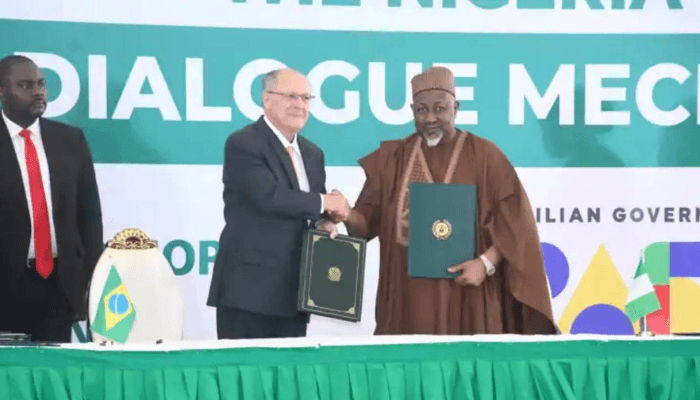
Nigeria has moved to strengthen its defence partnership with Brazil as Mohammed Badaru Abubakar, Minister of Defence, held a bilateral meeting with José Múcio Monteiro Filho, his Brazilian counterpart, in Brasília on Monday.
The meeting was part of President Bola Ahmed Tinubu’s ongoing state visit to Brazil.
Also in attendance was Renato Rodrigues de Aguiar Freire, Chief of the Joint Staff of the Brazilian Armed Forces, as discussions centred on deepening military cooperation, advancing defence-industrial collaboration, and enhancing maritime security in the Gulf of Guinea.
Badaru reaffirmed Nigeria’s commitment to fully implementing the Nigeria-Brazil Defence Agreement signed on 24 June 2025, describing it as a strategic instrument for expanding collaboration, technology transfer, and building industrial partnerships.

He emphasised that the deal is key to developing Nigeria’s indigenous defence production capacity and reducing overreliance on imports.
“Nigeria is determined to build a resilient defence industry that reduces dependence on imports and positions our country as the defence-industrial hub in Africa.
Read also: Nigeria, Brazil ready for direct flights as Tinubu, Keyamo sign BASA
“Brazil’s experience and technological depth make it a trusted partner, but our priority is to move from agreements to action, with clear timelines and measurable results that benefit both nations,” the minister stated.
According to the Ministry, the talks also addressed joint efforts to strengthen maritime domain awareness, enhance interoperability through joint exercises, and secure vital sea lanes in the Gulf of Guinea, which remains critical to Nigeria’s economic survival.

Badaru commended Brazil’s role in regional maritime security and its support in advancing the objectives of the South Atlantic Peace and Cooperation Zone (ZOPACAS).
The minister further noted that Nigeria’s pursuit of stronger defence-industrial ties aligns with Tinubu’s Renewed Hope Agenda, which prioritises national security, industrial self-reliance, and sustainable economic growth.
Both ministers agreed to establish a structured defence dialogue framework to ensure continuity, accountability, and measurable outcomes from the cooperation.