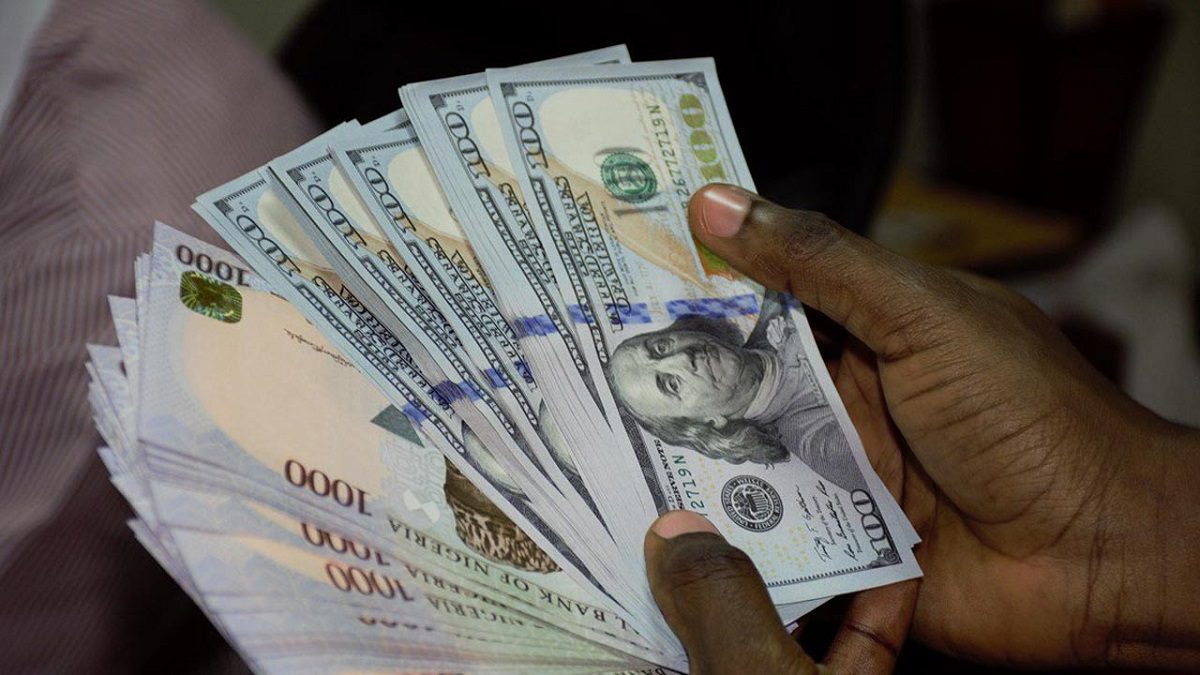
The naira, long considered one of Africa’s petrocurrencies, has depreciated against the US dollar over the last 15 trading sessions, despite rising oil prices fueled by the ongoing conflict between the US, Israel, and Iran. Analysts say this development reflects the gradual erosion of its petrocurrency status, as the currency increasingly reacts to hot money flows rather than oil revenues.
Data from the Central Bank of Nigeria (CBN) showed that the naira weakened by N69.66 over the last two weeks, closing at N1,405.62 on Monday. This marked a 4.96 percent decline from N1,335.96 per dollar quoted on February 17, 2026, at the Nigerian Foreign Exchange Market (NFEM). The naira recovered slightly on Tuesday, trading at N1,401.40, a 0.3 percent gain from the previous day.
Read also: Naira falls to 1,405.62/$ despite rising FX inflows as market gap narrows
In the parallel, or black market, the naira lost N60 over the last 16 sessions, closing at N1,440 per dollar on Tuesday. This represents a 4.17 percent drop from N1,380 recorded on February 17, according to street traders and online data collation platforms.

Before this recent depreciation, the naira had experienced a steady appreciation, supported by inflows from foreign portfolio investors (FPIs).
Globally, certain currencies are recognised as petrocurrencies because their value closely tracks oil prices. These include the Canadian dollar, influenced by Canada’s oil exports; the Norwegian krone, tied to North Sea production; the Russian ruble, heavily dependent on oil and gas revenues; and the Nigerian naira, which relies on crude oil exports for foreign exchange.
Over the past two weeks, the Canadian dollar to US dollar exchange rate fluctuated between roughly 0.727 and 0.741, averaging 0.732, reflecting moderate volatility.
Ayodele Akinwunmi, chief economist at United Capital Plc, said the recent depreciation of the Naira relative to the US dollar was largely driven by concerns over a potential spike in global inflation arising from the ongoing conflict in the Middle East. The conflict, he said, has the potential to disrupt global trade, increase the cost of goods, and restrict the supply of critical raw materials required for production. These developments could trigger a slowdown in global economic activity and potentially lead to a broader economic downturn. Consequently, heightened uncertainty in the global economy has increased fears of an economic crisis, prompting investors to move funds to safer assets, a typical “flight to safety” response, which puts pressure on emerging market currencies, including the Naira.
Akinwunmi, noted that Nigeria has not significantly benefited from the recent rise in crude oil prices because a large portion of the country’s oil exports are sold through forward contracts. As a result, the immediate impact of higher crude prices on government revenue and foreign exchange inflows remains limited. However, recent de-escalation statements from key stakeholders in the conflict offer some optimism that tensions may ease in the near term. “If this trend continues, it could restore some stability in global markets and potentially support an appreciation of the Naira. Importantly, the underlying fundamentals of the Nigerian economy remain resilient. The current administration continues to implement structural reforms aimed at strengthening the economy and improving its capacity to withstand external shocks,” he said.

Ayodeji Ebo, managing director and chief business officer at Optimus by Afrinvest, said that while rising oil revenues could support naira stability by boosting forex inflows, inflationary pressures and global risk aversion could trigger capital outflows, further weakening the currency. He noted that the parallel market’s volatility could widen gaps in remittances and import costs.
“Export-oriented and dollar-earning businesses should strengthen treasury management to mitigate FX volatility and meet hard-currency obligations,” Ebo said. “The Iran war could have a dual effect on Nigeria: it can support oil earnings, reserves, and the naira in the short term, but it can also drive up inflation through higher fuel, logistics, freight, and imported input costs. So while headlines may look positive for an oil-producing country, the lived reality for businesses and households could remain difficult if the conflict persists.”
Read also: CBN’s reforms stabilise external reserves near $51 billion year-end target, lifts naira
In comparison, other African petrocurrencies have exhibited varying degrees of stability over the same period. The Libyan dinar has remained relatively stable against the dollar, fluctuating between 0.156 and 0.158 USD per dinar, closing at approximately 0.1565 USD as of March 10, 2026. The Angolan kwanza traded around 0.0011 USD, with minor fluctuations between 0.00106 and 0.00109, and the US dollar exchanging between 911.97 and 937.30 kwanzas. Analysts describe the kwanza’s short-term trend as a “shock trend,” with potential resistance around 0.001085 USD.
The Algerian dinar also remained steady, with 1 DZD hovering between 0.0076 and 0.0077 USD over the last two weeks. The dollar fluctuated between 130.49 and 131.73 dinars, reflecting low volatility and a slight decrease of approximately 0.9 to 1.3 percent over 7–30 days.
Crude oil, a critical input in refined petroleum production, accounts for the largest share of refinery production costs worldwide. Global crude prices surged from about $65 per barrel to over $100 per barrel in recent weeks, an increase of more than 50 percent. Historically, Nigeria has spent between $10 billion and $15 billion annually on importing refined petroleum products, according to Muda Yusuf, CEO of the Centre for the Promotion of Private Enterprise. He noted that these imports are a major source of foreign exchange demand, placing pressure on external reserves and posing risks to exchange rate stability.