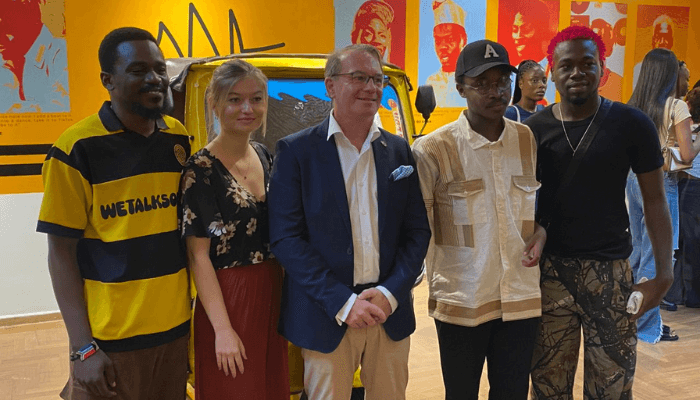
A new exhibition in Lagos is shining a global light on “Mara,” a fast-rising street dance and music movement born in the city’s crowded neighborhoods. The Mara Mania exhibition opened on Saturday at Alliance Française de Lagos in Ikoyi, drawing artists, diplomats and young creators who say the culture deserves national and international respect. The event was free to the public.
French Consul General Laurent Favier told guests that France supported the project because Mara represents “raw artistic energy from the streets of Lagos,” adding that he was surprised to learn the name means “street” and “madness.” He said the high-speed beats and wild dance steps show “a pure artistic language” that should be documented and shared.
“We support the creative industries because they carry talent, identity and exchange,” Favier said. “Nigeria and France share a creative ecosystem, and this exhibition shows what can happen when these worlds meet.”
The exhibition was supported by the France-Nigeria Cultural Exchange Programme and the Creation Africa Fund, which identifies and promotes emerging African talents. The fund recently sponsored Nigerian DJs at the Nyege Nyege Festival in Uganda, where global electronic producer Shree Lex sampled Mara sets on the main stage. Favier said the recognition was “a very exciting moment” for the dancers and young producers pushing the culture.

Curators said the exhibition was built to feel like Lagos itself, loud, honest and full of motion. Visitors stepped into a multi-sensory space with music, documentary screenings, beat-making tools and installations inspired by the streets. There were charging-station displays, TikTok video walls, dance tutorials, graffiti-style sticker boards, and a beat-box station built with sound stems from DJ Khalifa, one of the genre’s leading voices.
Creative director and co-curator Anthony Dike said the goal was to take people inside the world that shaped Mara. “Someone walked in during our setup and said, ‘This is Lagos.’ That was the energy we wanted,” he said. “We wanted something curated, but not detached. Something that feels like the community.”
Dike said the team spent over a year documenting the culture with local artists, dancers and DJs who helped shape the movement. He noted that Mara is more than entertainment. It reflects the environment, the soundscape, the pace, and the daily struggles of people living and working in Lagos.
Dike thanked the production team, acknowledging the long list of collaborators who carried the vision for over a year and a half. He lauded the French Embassy for supporting “emerging cultures” and helping create an archive that lives beyond hype. “For people who don’t know this community, I want them to leave with respect,” he said. “The next time they see a Mara DJ, dancer or producer, they should understand the craft.”
The exhibition also walked visitors through a history of street dance in Lagos, from early styles in the late 1990s, to the rise of Zanku in 2018, and the mainstream breakthrough driven by producers such as DJ YK, DJ Cora, DJ Khalifa, and viral TikTok creators like Poco Lee and Zazu. Today, some Mara tracks earn more than 29,000 streams on Spotify, curators said, and interest continues to grow.

Also at the event, Dolapo Amusat, founder of WeTalkSound, said the exhibition was created to show “the beauty, the story, and the depth of Mara to the world,” especially to people who underestimate it. He called Mara “the pulse of the streets today in Lagos” and said it is already shaping mainstream pop music.
He noted their biggest goal is to credit the creators who built the movement. “Songs like Oblee by Rema are already borrowed from Mara. Many times these street sounds enter the mainstream, but the people who shaped them never get their credit. That’s why we’re doing this,” he said.
Amusat added that France’s involvement shows the movement already has global momentum.
“With France involved, it’s already beyond Nigeria at this point. There’s no limit to where it can get to.”
Adding his voice, Dunsin Bankole, head of operations at WeTalkSound, said Mara is popular because it gives people creative freedom. “For me, Mara means freedom. Freedom to express,” he said. “There’s a raw energy in it that people connect to.”
Bankole said interest from Europe is not surprising. “Mara is mostly beats. Europeans already have house music, so Mara feels like a localised Nigerian version of that,” he said. “There’s something familiar yet new, and that’s part of why the appeal exists.”
He said international cultural groups often support sounds they believe can grow and capturing the real origins of Mara is important. “They like to spotlight new movements,” he said. “They see something special in Mara and want to help push it to the next level. If Mara becomes a billion-dollar industry in 10 years, we want people to know who deserves the credit, the royalties, and the recognition,” he said. “That’s why we did this.”
“We are cultural architects. It’s our job to document the times,” he said. “So many Nigerian stories were lost because nobody documented them. We want to fix that.”
The exhibition also encouraged participation. Guests were invited to learn Mara steps through a motion-capture screen, create digital mixes with DJ Khalifa’s sound stems, place stickers on a simulated Lagos bus, and design personalized postcards showing what the movement means to them.
The event closed with a documentary screening and a live performance at Freedom Park. The film, which explores the origins, people and evolution of Mara, will be released on YouTube after the premiere.