It has been 38 years since the idea for a rapid rail system was first conceived for Nigeria’s commercial capital, Lagos, and after a series of setbacks, the project looks closer than ever to completion.
BusinessDay’s visit to some of the sites where work was ongoing reveals that progress was being made as the government works towards delivering the rail lines by December 2022, only 13 months from now.
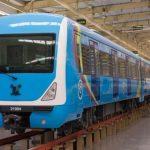
The two rail lines that are currently under construction are the Blue and Red lines and are being built by the China Civil Engineering Construction Corporation (CCECC).
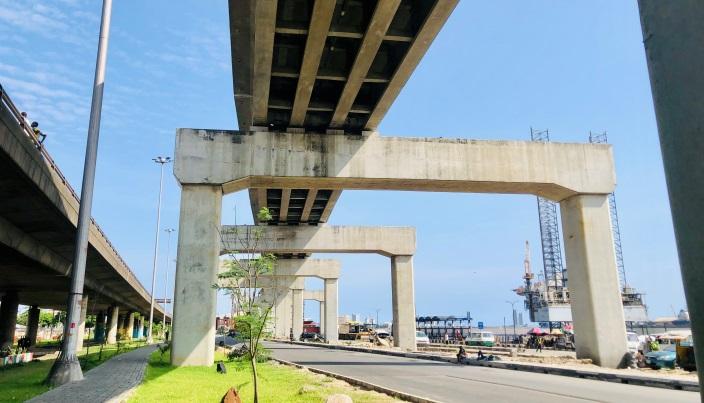
The first phase of the Blue line, a 27-km rail road from Okokomaiko to Marina, is under construction from Mile 2 to Marina and four stations are now ready at Mile 2, Alaba, Iganmu and National Theatre, BusinessDay learns.

A visit to CMS and Mile 2 reveals heavy construction work going on at the Marina Terminal, and also at Ecowas Road, Mile 2. For the Red Line, laying of tracks had been completed at Oshodi track.
By Lagos Metropolitan Area Transport Authority’s (LAMATA) projections, three sets of trains would be deployed to each of the lines for passenger operations with the potential of moving 1.5 million passengers daily when fully developed and operational.
The idea for a metro line network can be traced back to Lateef Jakande in his days as governor of Lagos in 1983, but the project has suffered false starts since then.

The project was scrapped in 1985 by Muhammadu Buhari, who together with his co-military junta, toppled the civilian administration of President Shehu Shagari, thus abruptly terminating the Jakande administration’s metro line idea.
In the early 2000s, Bola Tinubu, then governor, revived the initiative with a formal announcement of its construction in December 2003.

But the project passed from one administration to another until 2009, when Babatunde Fashola flagged off the Red Line.
The project has suffered many setbacks linked to financial shortfalls until recently when the present government recommenced construction, announcing that it would be completed by the last quarter of 2022.
Kunle, an employee of CCECC- the Chinese company building the rail lines, was ecstatic about the project when he spoke with BusinessDay.
Kunle, whose major job is to ensure the safety of workers at the Marina Terminal construction site and prevent movement inbound the axis, told BusinessDay that work was being fast-tracked at the site in a bid to meet the deadline next year.
According to Kunle, when completed by 2022, the light rail will make a lot of difference in the Lagos transportation system by significantly cutting down traffic congestion. He believes that many residents will park their cars and use the trains as it will also convey a lot of people.
“Just imagine a situation where you find yourself on the Island within five minutes from Mile 2 rather than spend hours trying to get there by road,” he said.

His sentiment about traffic congestion is shared by other residents—mostly businessmen and women—who spoke with BusinessDay about the ongoing project.
The residents who mostly live or work around the rail routes showed excitement after learning that operations will likely start next year as they imagine a Lagos devoid of its perennial traffic congestion.
“The rail will be good if it is executed as fast as possible,” said Kingsley Okoye, a shoe dealer and importer.
Okoye lives in Alagbado and has been doing business at Arena, Oshodi, for years. According to him, the congestion in Lagos State is “killing,” adding that he does not get enough sleep as he wakes up early.
He told BusinessDay that the traffic he faces to and from work has caused him some health challenges, and further urged the government not to dilly-dally in completing such a huge and significant project.
“My health is at stake,” he exclaimed. “I get home late and I don’t eat dinner again and because of that I’ve developed a peptic ulcer. So, whatever they are trying to do, they should be time conscious,” he said angrily, but calm enough to respond to a customer.
For Maria Ubah, a fish trader, the rail system will benefit traders like her, especially in terms of making transportation/logistics easier for them.
Aside from logistics gulping a significant portion of her cost of doing business, which makes her goods expensive thereby limiting patronage, Ubah, who lives in Iyana-Ipaja area, struggles to meet up with her business schedules.
“If I want to be at the shop, I’ll have to wake up by 4am to prepare and get on the road by 4:30am, else, I won’t be able to meet up because by around 6am., you begin to experience a lot of traffic congestion.

“The congestion gets so bad that you will have to come down and start trekking to Oshodi or take a bike to meet up.” According to her, going back home is the same headache.
She explained that as a business person, she ought to close by 8 p.m. so that she could sell to those returning from work. But due to the traffic, she does not wait.
She believes the rail transit system will bring significant relief and make life better for people in her line of business.
“The stress is just too much,” she said. “If the rail will be possible in December, as they said, I’ll be very happy.”
One major expectation from the completion of the Blue and Red rail lines is that it could cut traffic congestion by 50 percent in Lagos, a big boost for the economy.
Lagos residents have long complained about low productivity levels, as some miss out on business opportunities due to heavy traffic.
Read also: Lagos rail lines begin commercial operations 2023 – Sanwo-Olu
Using the extra cost of transport as a proxy, Danne Institute for Research in collaboration with Financial Derivatives Company calculated the economic cost of traffic congestion to an individual who lives and works in Lagos. That is the additional cost of public transport or fuel; money that could have been saved or spent on other things.
The survey found that public transport users spend N359.27 extra on average daily (N1,796.35 per week), due to traffic. The opportunity cost of this is either a reduction in consumption or a decline in savings.
The survey also found that due to traffic, the additional amount car owners spend on fuel weekly on the average is N3,044.97. The range – the difference between the highest and the lowest amount – is N16,800.
While Lagosians who own a car spend N133,978.68 extra on fuel each year, those who use public transport spend N79,039.40 each year.
In a country with a high unemployment rate and an extended family system, this is money that could have been spent on feeding or training relatives’ or simply saved for the future.
“On a daily basis, more than 8 million people move in 5 million vehicles on a tiny road network of 9,204 roads, including two toll ways and three bridges linking the Mainland to the Island,” notes Franca Ovadje, executive director of Danne Institute of Research.

According to research by Danne Institute, the state has spent 35 percent of its budget in the last two decades on infrastructure, but traffic in Lagos persists.
BusinessDay learns that LAMATA has been grappling with securing the right-of-way since construction of the rail lines commenced. But it says it is now managing the challenge effectively. The agency assures residents it is working assiduously to ensure the project is delivered at the announced timeline, but this is if all goes well.
“The project would be completed within the announced deadline. However, we are all subject to nature. If there is no force majeure, we should be able to complete it within the announced period,” LAMATA states.