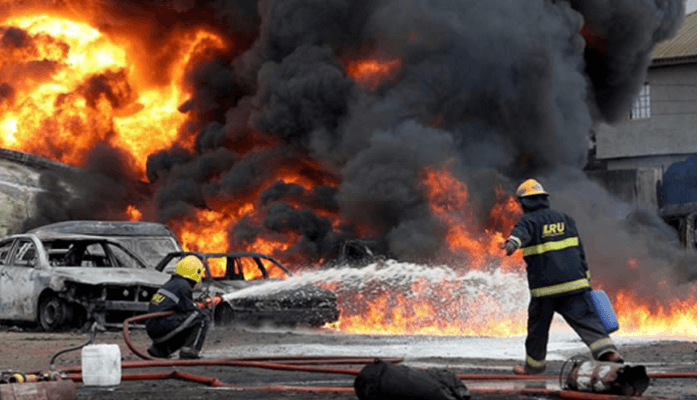
The spate of fire outbreaks that recently swept through major markets in Kano is exacting a heavy toll not only on traders but also on manufacturers, distributors and thousands of workers whose livelihoods depend on the state’s vast commercial ecosystem, economic analysts have said.
The destruction of over 1,000 shops and goods estimated at several billion dollars at the popular Singer (Singa) Market, followed within days by another blaze that razed about 50 shops at the Fatima Simra Multi-Purpose Market in Dakata, has exposed the scale of losses across the entire supply chain that feeds northern Nigeria’s largest trading hub.
While the immediate victims are retail traders, the deeper economic impact is being felt by companies that produced the burnt goods — from textile manufacturers in Kano and Lagos to food processing firms, plastic producers, pharmaceutical distributors and import-dependent wholesale merchants.
Industry sources said many of the destroyed items were supplied on credit by manufacturers and major distributors, meaning the losses will reflect in declining revenues, disrupted production cycles and possible job cuts.

“When a market like Singer goes up in flames, it is not just the trader that loses,” Kano-based Mohammed Aminu Aliyu, an economist in the Department of Economics, Bayero University, Kano, confided in BusinessDay.
“Factories that produced the textiles, the rice millers, the vegetable oil processors and transporters that moved the goods are all affected. Some of these goods were yet to be paid for. That is a direct hit on industrial output,”, he said.
Kano remains one of Nigeria’s most strategic commercial centres, serving as a distribution corridor for goods to the entire North-West, North-East and parts of neighbouring Niger, Chad and Cameroon.
According to available state economic data, trade and commerce account for a dominant share of Kano’s internally generated revenue and form a critical component of its Gross Domestic Product, with the wholesale and retail sector contributing a substantial proportion of the state’s non-agricultural output.
The commercial sector is also one of the largest employers in the state. From market traders and shop owners to transporters, warehouse workers, loaders, food vendors, artisans and financial service providers, hundreds of thousands of people depend directly or indirectly on daily market activities.
At Singer Market alone, trader associations estimate that each shop supports between three to five direct jobs and several other indirect ones in logistics and supply. With over 1,000 shops affected in the recent inferno, thousands of jobs have been temporarily or permanently disrupted.

“This is not just a market issue; it is an employment crisis in the making,” said a leader of a traders’ union. “Many of our members employ apprentices, sales boys and casual labourers. All of them are now out of work.”
The impact is further compounded by the fact that most small and medium-scale traders operate outside formal insurance coverage and rely heavily on cooperative financing and informal credit from suppliers. The destruction of their goods, therefore, translates into mounting debts to manufacturing and importing firms.
Manufacturers, particularly in the agro-processing subsectors, are expected to record slower turnover in the coming months as demand drops and outstanding payments remain unrecovered. Transport companies and logistics operators that move goods into Kano’s markets are also facing reduced activity.
Market leaders have begun efforts to coordinate relief and data collection for affected traders. Chairman of the Singer Market Development Association, Junaidu Muhammad Zakari, said the market administration had put in place a transparent process to document victims and warned against fraudulent individuals posing as officials.
“We have made all the necessary arrangements to ensure proper support for those affected,” he said, urging traders to rely only on information from recognised market authorities.
Beyond the immediate losses, economists warn of broader macroeconomic consequences, including reduced tax and levy collections for the state government, weakened purchasing power among households and potential increases in commodity prices across northern Nigeria due to supply disruptions.
Kano’s role as a re-export and redistribution centre means that any shock to its markets quickly spreads to other states. Traders from across the region who depend on its wholesale markets to stock their shops are now facing scarcity and higher replacement costs.
Fire safety experts attribute the recurring incidents to a mix of poor electrical wiring, overcrowded stalls, storage of flammable materials and limited access for emergency responders. They stress that without modern fire detection systems, functional hydrants and stricter market planning regulations, the economic losses will continue to escalate.
Stakeholders are therefore calling for a comprehensive recovery plan that includes financial intervention for victims, low-interest credit facilities to revive trading activities and large-scale investment in market infrastructure.
For a state whose economic strength is rooted in commerce, the repeated destruction of its trading centres represents more than a series of isolated disasters. It is a direct threat to output, employment and the survival of a commercial network that sustains millions within and beyond Kano.
As traders sift through the ashes of their shops, the challenge for policymakers is not only to rebuild the markets but also to protect the industrial and employment value chain that depends on them. Without urgent action, analysts warn, the fires could leave a lasting dent on Kano’s GDP and its long-standing status as northern Nigeria’s commercial powerhouse.