|
Getting your Trinity Audio player ready...
|
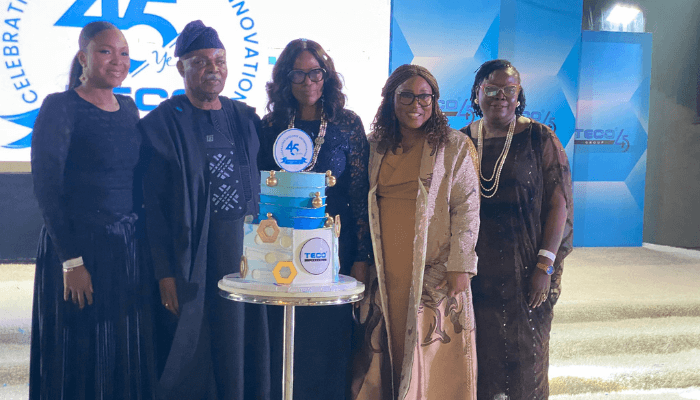
TECO Group’s 45th anniversary was more than a company celebration. For many guests, it felt like a rare moment of hope in a country where most businesses collapse long before their tenth birthday.
People spoke about survival, faith, community, and a long journey through some of Nigeria’s toughest years. They said TECO’s story showed what can happen when a simple vision grows into a national legacy.
The firm began in 1980 when young engineer Charles Aladewolu decided to solve a problem he had known since childhood. He grew up helping his grandmother process palm oil with her hands.
He remembered the stress and pain of the work. He believed machines could make life easier for farmers like her. That idea became TECO, which means Total Engineering Concept. It started as one man’s dream in a small space but slowly grew into a major engineering company.

Aladewolu gained early experience at UAC and later Art Briscoe, where he learned fabrication, workshop management and project delivery.
He said these skills gave him enough confidence to start his own firm. But the early years brought challenges. Nigeria’s economy struggled, and the business faced heavy pressure.
In the mid-1990s, a foreign loan taken in Dutch guilders grew almost overnight due to a sharp naira devaluation. What was once a manageable loan suddenly became a major threat. “It was an existential moment,” the founder recalled. But TECO renegotiated, cut costs and pushed on, saving the company at a time many Nigerian firms shut down.
Over time, TECO grew from basic fabrication to large engineering projects across different sectors. It now builds palm oil mills, food-processing equipment, electrical panels and full project systems.
The company also designs and assembles low-voltage and medium-voltage switchgear for the oil and gas industry. Its workshop in Lagos and its large fabrication site in Ondo State help it produce machines that many clients say rival imported systems.

Funmi Babatunde-Dada, Executive Director said TECO’s foundation rests on faith, discipline and a strong team. “The Holy Spirit guides our decisions,” she said. “We also have staff who stay for years. They call this place a family.”
She said TECO sees people, not numbers, and invests heavily in training. Staff are sent for courses and encouraged to grow. This long-term people strategy, she said, kept the company stable even during difficult years.
She also spoke about TECO’s culture of care, noting that the company stays engaged with clients during and after completion of projects.
“TECO also offers flexible payment plans that help small and medium businesses survive.”
One of the strongest testimonies at the event came from JB Farms, one of Nigeria’s leading palm-oil producers. Managing Director Ajibola Adebutu said he first met TECO when he needed equipment many years ago. When he saw the bill, he almost gave up. “My heart sank,” he said. “But they told me to bring whatever I had.” TECO agreed to an easy payment plan and began building.
Today, JB Farms has grown from eight hectares to over 15,000 hectares, and TECO has built seven mills for them over the last two decades.
But TECO’s impact goes beyond clients. The company helps develop rural communities. Mills are often built in areas with no roads, water or electricity, according to the executive director. TECO hires locals, trains them and creates jobs. Within two years, new homes, small markets and local businesses appear. “You see a whole town rise because one mill was built,” she said.
Similarly, the founder added that TECO is preparing for the future through succession planning. Ten years ago, the company began pairing older engineers with younger ones to ensure smooth knowledge transfer. He said this helped the company stay strong as many of its first-generation staff approach retirement.
Delivering the keynote address on behalf of Leye Akinola, the Ondo State Commissioner for Agriculture and Forestry, Caleb Olowojola, the Director of Engineering in the Ministry, Engr., acknowledged TECO’s contributions at the event.
Olowojola stated that TECO plays a key role in Nigeria’s “Red Gold” palm-oil program. He compared TECO to Baldan, a Brazilian company that began as a small workshop in 1928 but later became a global exporter. The speaker concluded that the lesson was clear, that “Greatness begins with vision, but vision must serve the many.”
The keynote message urged TECO to reach Nigeria’s millions of small farmers. Most farmers use manual labour, which limits output. Large mills help big players, but small mills help entire communities. The representative urged TECO to design one-ton-per-hour systems, 500kg systems, and even 200kg systems, machines that farmers can afford and maintain. “Scale down to scale up,” he said. “Build for the many, not just the few.”
For the future, TECO plans to expand into Ghana, Côte d’Ivoire and other West African markets. “We want to become a full African engineering powerhouse, not only in palm oil but also cassava, seed oils and other agro-processing lines,” she said.