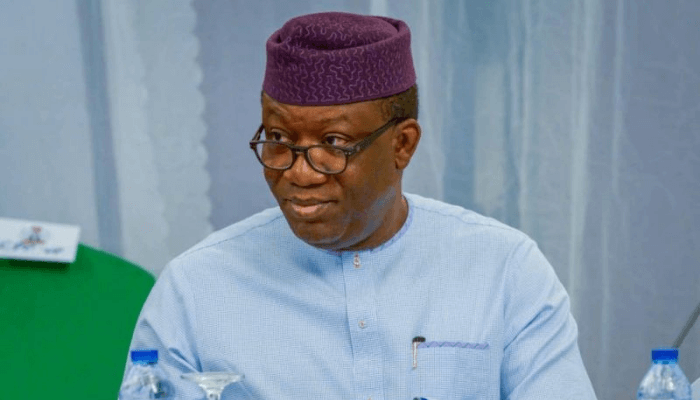
West Africa’s escalating insecurity is rooted less in the gunfire of insurgents and more in the failures of governance that have eroded public trust, Kayode Fayemi, former governor of Ekiti State has said.
Speaking at the opening ceremony of the African Public Square (APS) Second Continental Edition at the ECOWAS @50 Conference, themed: Future Proofing Regional Integration in Africa: ECOWAS @ 50 in Abuja, Fayemi argued that corruption, exclusion, and weak institutions have done greater damage to regional stability than armed groups.
He warned that no amount of military firepower would bring lasting peace without addressing the root causes of public discontent.
“What we face is not just a security deficit, it’s a governance deficit. Until we rebuild trust between leaders and citizens, insecurity will remain our daily reality,” Fayemi declared.

Fayemi who is also the co–founder of Amandla Institute said the resurgence of coups and violent extremism across the region reflected citizens’ deepening loss of faith in democratic governance.
According to him, military takeovers, however well-intentioned, cannot cure the underlying inequality, unemployment, and poverty that continue to feed instability.
Fayemi urged ECOWAS to move from rhetoric to reform, adopting a people-first security strategy anchored on justice, accountability, and inclusion.
“Genuine stability will only emerge when citizens see democracy working for them, not against them,” he said.
Fayemi described the golden jubilee as a “moment for deep reflection” on the trajectory of regional integration. He praised ECOWAS’s early role in promoting peace and democracy through interventions in Liberia, Sierra Leone, Côte d’Ivoire, The Gambia, and Guinea-Bissau. But he cautioned that the organisation now risks losing touch with its citizens.

“ECOWAS must move beyond an elite-driven community of rulers to one that truly represents its people, particularly the youth and women. Overdependence on donor funding and stalled reforms threaten its long-term relevance”, he said.
Representing Omar Touray, President of the ECOWAS Commission, Abdel-Fatau Musah, Commissioner for Political Affairs, Peace and Security, traced the evolution of ECOWAS through three defining eras: its 1975 formation amid linguistic and colonial divides; its resilience during post-Cold War conflicts; and its current struggle to navigate internal democratic crises in a shifting global order.
Touray warned that the world is entering what he termed a “warm war” era a phase of global realignments and strategic rivalry and urged West Africa to make deliberate choices to protect its collective interests.
He lamented that growing political exclusion in some member states has undermined democracy and contributed to recent withdrawals from the regional bloc.
“Only renewed commitment to inclusivity, good governance, and dialogue can bring estranged members back into the ECOWAS family,” he said.
In her remarks, Funmi Olonisakin, vice president for International Engagement at King’s College London, called for a “cross-generational pathway” to regional transformation. With an average age of just 18, she said, West Africa’s young population represents both a challenge and a reservoir of potential.
“The promise of ECOWAS as an equal community of peoples must now be reimagined for the next generation. This is a generation that learns, communicates, and innovates differently and must be part of the conversation”, she said.
Read also: Tinubu celebrates Fayemi at 60, hails his contributions to democracy
Similarly, Godwin Murunga, executive secretary of the Council for the Development of Social Science Research in Africa (CODESRIA), argued that integration must move beyond state-centric models to people-led movements. Citing the late Jacob Ade Ajayi, Nigerian historian, he said the continent’s youthful population is already driving “integration from below” through mobility, technology, and social networks.
“States must recognise this momentum or risk being left behind by the realities unfolding before them,” Murunga cautioned.
The event, convened by the Amandla Institute and African Leadership Centre, brought together thought leaders, policymakers, and academics to examine how ECOWAS can redefine its integration framework amid growing political, economic, and security challenges.