This article is based on Ember’s sixth annual Global Electricity Review released on April 8, 2025 – a must-read for power sector policymakers, technocrats, operators and related stakeholders. Ember is a global energy think tank with a strategic focus on accelerating the clean energy transition with policy and data. The overall purpose of this article is to place Nigeria’s renewable energy journey so far in a global perspective and, on that basis, suggest the way forward for public policy in the promotion of renewable energy as a viable alternative energy to fossil fuel in the short, medium and long terms, even with gas as Nigeria’s official energy transition fuel.
The Ember report “provides the first comprehensive overview of changes in global electricity generation in 2024, based on reported data.” It also “…analyses electricity data from 215 countries, including the latest 2024 data for 88 countries representing 93 percent of global electricity demand, as well as estimates for 2024 for all other countries.“ The highlight of the report: electricity generation from low-carbon sources – renewable energy and nuclear – increased by 30 percent in 2023 and by 40.9 percent in 2024, which was a remarkable feat; the growth rate of solar energy generation in 2024 was over 29 percent, a six-year high; and global electricity demand in 2024 was over 4 percent, amplified by heatwaves in the Northern Hemisphere.
Read also: REA: From rural electrification agency to renewable energy agency
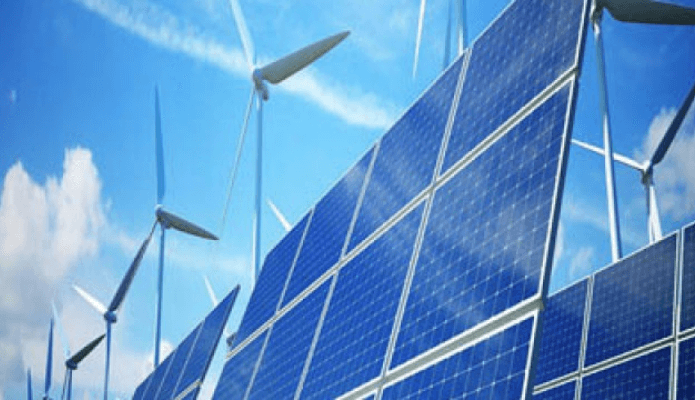
The solar and wind boom is responsible for pushing the renewable energy contribution to global electricity generation to over 40 percent, with solar and wind energy alone representing 15 percent of global electricity generation in 2024, compared to just about 1 percent in 2010. Solar power generation has doubled in the last three years to 2000 terawatt hours (TWh), and according to the report, it has become “the largest source of new electricity generation globally in the last three years and …the engine of the global energy transition, with both solar generation and capacity installations setting new records in 2024.” According to Mike Hemsley, Deputy Director, Energy Transitions, “As the cost of solar power and battery storage continues to fall, we are witnessing an unprecedented acceleration in global adoption. The combination of affordable solar and wind energy, supported by flexible grids and storage solutions, is enabling faster decarbonisation at a lower cost than previously imagined.”

“Besides, development of renewable energy is a core mandate of the Federal Ministry of Power.”
Total global renewable energy (solar, wind, hydro and other renewables) production in 2023 was 8,983 TWh and 9,843 TWh in 2024, a 9.6 percent rise or an increase of 858 TWh – enough electricity to power Britain and France. The five leading producers of renewable energy in 2023 – China, the United States, Brazil, Canada and India – produced 5,293 TWh, or 59 percent of global production, with China alone generating 2,894 TWh and the United States following at a distant second with 965 TWh. South Africa ranked 38th globally with 29 TWh; Egypt, 44th with 25 TWh; and Nigeria, 74th with 10 TWh. Ghana, with 18 percent of the population of Nigeria, came 75th with 9 TWh. On the whole, Nigeria ranked 10th in Africa, behind many smaller countries, a notable example being Zambia, which ranked 52nd globally with 17 TWh, with a population of a mere 9.2 percent of that of Nigeria.
From the foregoing, it is crystal clear that Nigeria is not only doing very badly in national grid transmitted electric power, mostly from fossil fuel (80 percent) and hydropower (20 percent), compared to African peers like South Africa and Egypt, but it is also doing very badly in renewable energy generation, compared with its smaller and less endowed African peers. That is why it is a bit of a surprise to read in the print media a news headline like “FG insists on ending N200bn solar panel imports.” I have read reports and listened to television interviews with Mr Abba Aliyu, Managing Director of the Rural Electrification Agency, and Dr Muda Yusuf, CEO, Centre for the Promotion of Private Enterprise (CPPE), on this matter. My point of view is that the Honourable Minister in charge of the Federal Ministry of Science, Technology and Innovation (FMSTI), from whom the announcement emanated, was basically flying a kite. He wanted the world to know what his ministry was doing in bridging the science, technology and innovation gap in Nigeria’s drive for energy security through renewable energy. To be fair to him, he has not been as attention-grabbing as one of his predecessors. As Dr Yusuf stated, the solar panel importation ban is a trade policy issue beyond the purview of FMSTI, coming directly under the domain of the Federal Ministry of Trade and Investment. Besides, development of renewable energy is a core mandate of the Federal Ministry of Power.
The fact that Nigeria spent N200 billion (about US $125 m) presumably in 2024 to import solar panels is not a strong argument to ban its imports. That is a drop in the ocean compared to the US$2.1 billion Pakistan used to import solar panels from China for 17,000 megawatts (MW) in 2024 alone. Besides, why should we ban the importation of a vitally needed product for Nigeria’s energy transition, which we do not yet produce in reasonable quantity, when we still import fuel despite the fact that we have technically achieved self-sufficiency in local production? Since the ban on rice imports in 2015 to encourage local rice production, a huge local production gap still exists, filled largely through rice smuggling. The suggested ban is a throwback to the era of the infant industry policy which shielded our nascent industries from foreign competition. Those ‘infant industries’ remained infants because they were inefficient producers, and the policy had to be scrapped decades later.
Read also: Renewable energy policy: The role of government in supporting clean energy transition

Consequences of a proposed ban on importation of solar panels include: 1) it will increase the cost of accessing renewable energy for homes, SMEs, schools, hospitals, etc.; jobs and lives will be lost; 2) it will disrupt the businesses and investment plans of our budding solar energy entrepreneurs and start-ups; 3) it will encourage smuggling; 4) it will run against the letter and spirit of Nigeria’s Energy Compact, which Nigeria committed to at the Africa Energy Summit in Dar Es Salam on January 27-28, 2025. What the Honourable Minister of STI should have said simply was that they were committed to encouraging growing the local capacity for the production of solar panels alongside efforts being made to adopt solar energy in Nigeria.
Finally, I wish to suggest that going forward, any idea, programme or proposal of a member of the Federal Executive Council remains theirs and should be personally attributed to them until it is approved by the Council. It is only then it should be pronounced as a federal government policy. I think media practitioners should take note.
Mr Igbinoba is Team Lead/CEO at ProServe Options Consulting, Lagos.