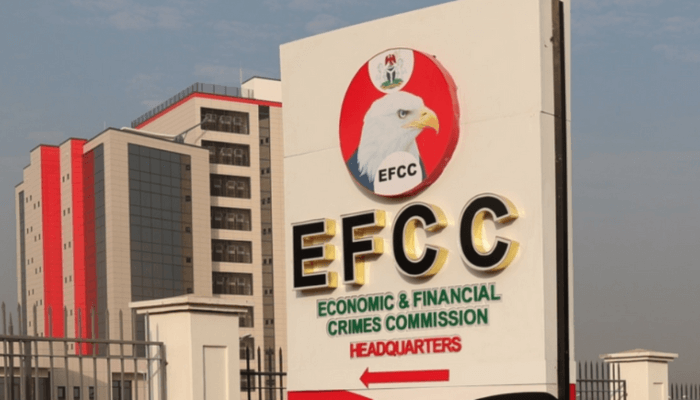
The Economic and Financial Crimes Commission (EFCC) has uncovered what it described as widespread negligence and compromise within Nigeria’s banking and fintech ecosystem, linking some financial institutions to two major fraudulent schemes that have cost victims a combined total of N18.74 billion.
The Commission disclosed this on Thursday, in Abuja during a press briefing by Wilson Uwujaren, its Director of Public Affairs, who detailed how fraudsters exploited gaps in banking controls to defraud thousands of Nigerians through airline discount scams and bogus investment schemes.
Uwujaren revealed that one new-generation commercial bank and six fintech and microfinance banks are under investigation for allegedly aiding the schemes through weak customer due diligence and compromised transaction monitoring processes.
According to the EFCC, the first scheme involved a sophisticated airline ticket discount scam targeted largely at unsuspecting travellers.

Fraudsters, Uwujaren explained, advertised what appeared to be discounted ticket offers for a foreign airline, using carefully crafted online promotions to gain victims’ trust.
“The payment module is designed to convince victims that they are paying directly into the airline’s official account.
“However, once payment is made, the fraudsters gain access to the victim’s bank account and completely drain the funds”, he said.
The Commission disclosed that over 700 victims fell prey to the scheme, losing a total of N651.1 million.
While the EFCC has so far recovered and returned N33.63 million to affected victims, Uwujaren warned that the operation remains a serious threat.

He noted that foreign actors behind the scam are now converting stolen funds into cryptocurrency and moving them offshore, particularly through the digital asset platform Bybit, making recovery more complex.
Read also: EFCC uncovers N162 billion cryptocurrency fraud involving banks, fintechs
The second and far larger fraud involved a company identified as Fred and Farid Investment Limited, popularly known as FF Investment, which allegedly lured Nigerians into fictitious investment opportunities with promises of high returns.
Uwujaren said the scheme, which operated through nine companies offering various investment packages, defrauded more than 200,000 victims, raking in a total of N18.09 billion.
He added that, in total, over 900 Nigerians were fleeced in the two schemes through what the EFCC described as the “connivance and negligence” of banks and other financial institutions.
According to the Commission, the schemes were masterminded by foreign nationals, working with three Nigerian accomplices who have been arrested, investigated, and charged to court.
Further insights into the role of financial institutions were provided by Abdulkarim Chukkol, Director of Investigations at the EFCC, and Michael Wetcas, Acting Director of the Commission’s Abuja Zonal Directorate.
They alleged that the implicated bank and fintechs clearly violated standard banking procedures, allowing fraudsters to move large volumes of illicit funds through the financial system without triggering red flags.
“A total sum of N18.74 billion was moved through the Nigerian financial system without proper customer due diligence.
“More troubling is the discovery that cryptocurrency transactions worth N162 billion passed through a new-generation bank without any meaningful checks”, the officials said.
They further revealed that investigations showed that a single customer operated as many as 960 accounts within the same bank, all of which were allegedly used for fraudulent activities.
The Commission called on financial sector regulators to enforce mandatory compliance with anti-money laundering and counter-terrorism financing regulations, including Know Your Customer (KYC), Customer Due Diligence (CDD) and Suspicious Transaction Reports (STRs).
Uwujaren urged regulators to suspend and refer for prosecution any Deposit Money Bank, fintech or microfinance institution found to be aiding and abetting fraud.
“Negligence and failure to monitor suspicious or structured transactions will no longer be tolerated,” he warned.
The EFCC reaffirmed its commitment to combating money laundering and financial crimes, stressing that financial institutions must strengthen internal controls to prevent economic leakages.
Uwujaren charged banks and fintech operators to “firm up their operational dynamics” and play their role in safeguarding the integrity of Nigeria’s financial system, which he said continues to bleed from avoidable compromises.