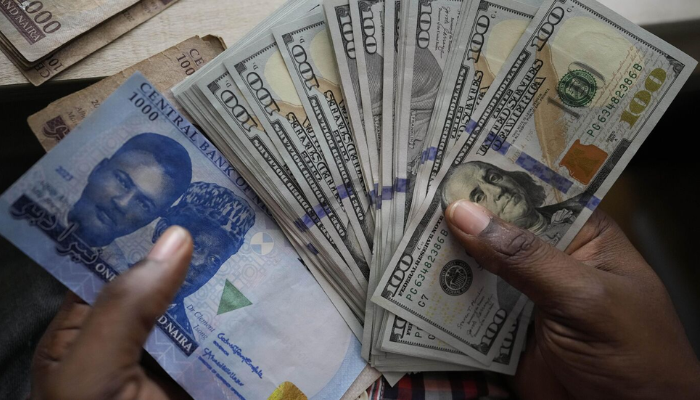
Chief Financial Officers and treasury managers across Nigeria are rethinking the strategy on their dollar stockpiles. For years, the corporate playbook used to be simple: hold dollars to avoid the naira’s collapse. However, improved liquidity in the official FX market and attractive returns on naira-based investments have eroded the appeal of the dollar as a safety net.
“We’re beginning to rethink our treasury strategy as the naira continues to strengthen. We’re seeing those that have large savings in dollars beginning to offload them,” a senior treasury manager with a Lagos-based multinational company told BusinessDay.
Historically, corporates and individuals hold large foreign exchange reserves to shield themselves against currency fluctuations and shocks. That strategy paid off in the wake of sweeping economic reforms in 2023 where the naira shed more than half of its value and 2024 when it lost 41 percent.
As the naira fell, companies with net dollar assets recorded sizable foreign-exchange revaluation gains. Banks in Africa’s most populous economy were the most beneficiaries of the devaluation of the naira as eight leading banks cupped N754.8 billion in FX revaluation gains in 2023, up 472.3 percent from N132 billion recorded in the prior year.

But that narrative has begun to change. Last year, the local currency closed at 7.5 percent, recording its first win in more than a decade, thanks to the series of policies introduced by the central bank, including the Electronic Foreign Exchange Matching Systems (EFEMS) which monitors FX transactions in real time to curb speculative activity and ensure transparency.
The naira has again gained about 7 percent year-to-date with the spread between the official and parallel markets narrowed to 0.29 percent from the N92 spread recorded two weeks ago.
That made the currency record its strongest convergence level in two years on Thursday, pushing the naira to a three-year high of N1,345 per dollar in the black market.
BusinessDay reported that by the end of last week, the naira closed stronger on the street, at N1,340 per dollar, compared to N1,346.32 per dollar at the official window.
“If we are seeing a strengthening of the currency within a parallel market rate, it simply means that those who are holding dollars are selling to save themselves from any exchange loss,” said Johnson Chukwu, chief executive officer of Cowry Asset Management.

Naira gains driven by fundamentals
Nigeria’s recent naira strength is largely driven by strong FX fundamentals, according to Tilewa Adebajo, chief executive officer of CFG Advisory, adding that sustainability “would require improved oil production, formal remittances, non‑oil exports and tight money conditions to remain aligned.”
Supporting sentiment around the rally is the growing external reserves which rose to its highest levels in 13 years climbing to 48.50 billion dollars as of February 17, 2026, according to data from the apex bank. The accretion in reserves continues to create buffers for the central bank to intervene in the market when necessary.
The $20 billion 650,000 barrels per day single-train Dangote Refinery has also been a game changer in rewriting Africa’s top crude producer’s FX stability. In 2026 alone, refined petroleum products are expected to generate $10.2 billion in export receipts, helping the strengthening of the naira as more dollar liquidity flows in.
Portfolio inflows have also aided the stability as the higher yield investment instruments in Nigeria’s FX market, buoyed by an elevated interest rate at 27 percent, has continued to keep investors locked in.
Combined inflows from foreign portfolio investors in the nine months ended September 2025 expanded 225.6 percent year-on-year to $14.3 billion, representing 85 percent of total capital importation, a figure that is expected to rise further as yields continue to decline globally.
However, the CEO of Cowry Asset Management warned that portfolio investors may also begin to weigh their options to exit when they feel the naira has reached its “intrinsic value” or sense some level of election-related risks.
“Once you see an increased level of exit by foreign portfolio investors, either ahead of the election, or because the naira has appreciated to a level they consider as unsustainable, then panic will also set in and you will see a reversal,” Chukwu said.
“I think whether this will continue, yes, probably before the election, depending on how stable the election environment is. If the election environment is very stable, then we may see sustained interest.”
Not everyone is rushing for the exit
Some finance chiefs say the narrative of a rapid unwind overstates how corporate treasury desks actually operate.
“Our treasury strategy isn’t driven by short-term currency speculation, but by the fundamental principle of asset-liability matching,” said Efosa Ajayi, finance lead at Shara.
The company keeps roughly 10 percent of its balance sheet in dollars to meet corresponding foreign-currency obligations, rather than to bet on exchange-rate direction. “Our priority is operational stability rather than trying to time the market,” he said.
Ajayi said the firm builds a 20 percent sensitivity buffer into its fiscal planning relative to the prior year’s closing rate — a cushion designed to absorb swings in a currency that has seen repeated bouts of volatility.
While he described the recent appreciation as “largely structural,” reflecting stronger reserves and reform momentum, he cautioned that global dollar dynamics could temper the pace of gains. “Currency pairs are a two-way street,” he said. “The underlying trend is encouraging, but normalisation is likely.”
A similar stance prevails at cross-border technology firm Tyrus Technologies. Finance lead Gift Emihia said the company isn’t actively converting dollars despite the naira’s roughly 7 percent year-to-date gain.
“We hold dollars primarily to meet settlement, regulatory and international obligations,” he said, adding that treasury decisions are guided by internal volatility bands rather than a fixed exchange-rate target.
A “meaningful portion” of the balance sheet remains dollar-denominated, but inflows are typically matched against liabilities to limit net exposure. “It’s encouraging,” Emihia said of the recent rally. “But we prefer sustained liquidity and policy consistency before viewing it as a structural shift.”