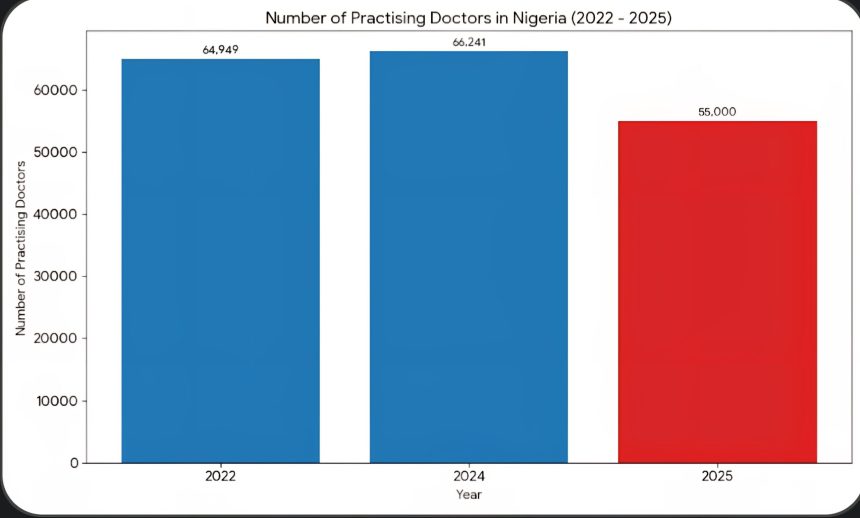
The number of practising doctors in Nigeria fell from 66,241 in 2024 to about 55,000 in 2025, representing a decline of 16.9% within one year, according to reports from the Federal Ministry of Health.
Data from the ministry showed that Nigeria currently has around 55,000 doctors practising in the country, down from the 66,214 doctors recorded in the 2024 State of Health Report published by the Ministry.
The same report showed that the number of doctors rose from 64,949 in 2022 to approximately 66,241 in 2024, a growth rate of about 2%, which was already insufficient to meet the country’s rapidly expanding healthcare needs.
Read also: FCT doctors hail Wike over 13 months hazard allowance, wage award

However, the 2025 Joint Annual Review report revealed a reversal. It cited high attrition rates, driven largely by external migration, as a major factor behind the decline.
According to the review, external migration surged by 200% across all health worker cadres between 2023 and 2024. In 2024 alone, a total of 4,193 doctors and dentists left Nigeria, with about 66% of them migrating to the United Kingdom.
The report further noted that significant licensing gaps persist within the health workforce, as only about half of registered health professionals are actively licensed to practise. It cited regulatory bottlenecks and widespread underutilisation of available personnel.
It also highlighted pronounced rural–urban and sectoral disparities, with the majority of health workers concentrated in urban areas and within the public sector.
According to the State of Health Report, the southern states account for 62% of Nigeria’s medical professionals, while the northern states hold 28%. The Federal Capital Territory (FCT) accounts for the remaining 10%. It noted that this uneven distribution leaves many regions, particularly in the North with severely limited access to medical care.

Nigeria’s doctor-to-population ratio remains far below international benchmarks. The World Health Organization (WHO) generally suggests a threshold of 10 to 17 medical doctors per 10,000 people (or roughly 1 doctor per 600–1000 people) to ensure adequate health coverage.
But the Nigerian Association of Resident Doctors (NARD) reported a doctor-to-patient ratio of 1:9,083.
The Federal Ministry of Health estimates that Nigeria would require approximately 391,230 doctors to meet the World Health Organisation’s recommended standard.
Health experts warn that the shrinking workforce could have serious consequences for service delivery. Adaobi Onyechi said fewer doctors would translate into longer waiting times for patients, declining quality of care, and increasing difficulty in reaching health services, particularly in underserved and remote areas.
Read also: Insecurity: Edo doctors extend strike, demand release of abducted colleague
The Ministry had unveiled a policy aimed at curbing health workforce migration, but many doctors say that the promised incentives and retention measures have either not been fully implemented or have had little practical impact.
Onyechi warned that without urgent and well-planned interventions, Nigeria risks sliding into a deeper healthcare crisis, as rising population growth and disease burden continue to outpace the country’s capacity to train, retain, and effectively deploy medical professionals.