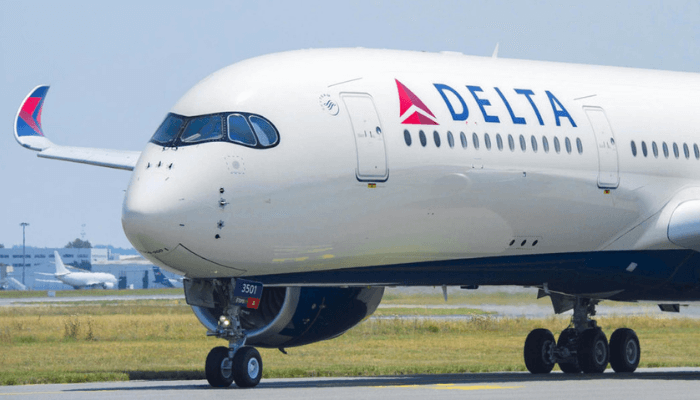
The world’s second largest airline, Delta Airlines which also operates a daily flight between Atlanta and Lagos, has announced the first quarter 2013 profit of $85 million, with year to year result improvement of $124 million.
“The results include $20 million of profit sharing expense in recognition of Delta employees’ contributions to the company’s financial performance. Delta also generated $1.1 billion of operating cash flow and $457 million of free cash flow in the March 2013 quarter, and ended the period with adjusted net debt of just under $11.0 billion”, said Richard Anderson, Delta’s chief executive officer.
Passenger revenue increased by $107 million compared to the prior year period, leaving Cargo and other revenues to decrease by $6 million and $14 million respectively.
The world’s second biggest airline, gave kudos to its own employees for meeting the company’s financial and operational goals with $43 million of incentives, including $20 million in employee profit sharing and $23 million in shared reward within 3 months.

Read also: Delta airlines airlifts 1.12m passengers between Atlanta-Lagos in 10 years
“Our results represent Delta’s strongest March quarter financial and operational performance in over a decade and I want to thank Delta people worldwide for all the hard work that went into producing these results for our company. This performance is proof that we are on the right path to making Delta the airline of choice for our shareholders, employees, and customers,” Anderson said.
“With a solid financial foundation and building momentum from initiatives like our LaGuardia expansion, Virgin Atlantic investment and new Terminal 4 at New York-JFK, we are well positioned to generate significant improvements in Delta’s profitability going forward.”
According to Ed Bastian, Delta’s president; the March quarter units revenues grew 4 percent, showing that the investments made in operations, products and service, combined with capacity discipline, have built a solid revenue-producing foundation.
“We are taking actions to mitigate the decline in close-in demand we saw in the last part of March, and we expect the impact of the sequester, combined with a softening of leisure demand, to result in a 2 – 3 percent decline in April’s unit revenues,” Bastian said.

“However, a key benefit from a consolidated industry is that we now see a much stronger correlation between revenue and fuel; so while we are seeing some revenue softness, we are also benefitting from lower fuel costs, allowing us to continue our path of margin expansion even in a sluggish economic environment.”