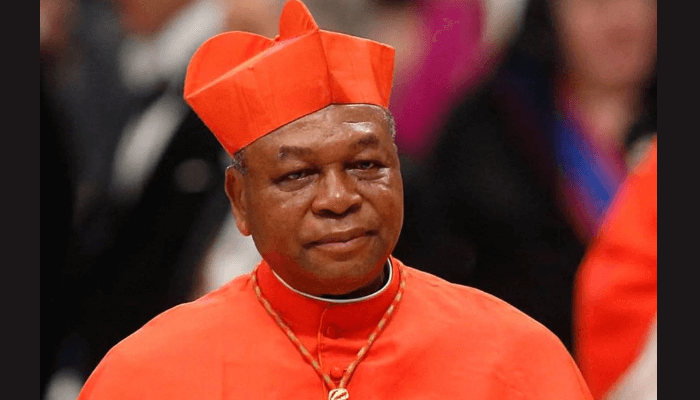
One of Nigeria’s most senior Catholic clergymen has said the country’s democratic institutions are in deeper trouble than official statements acknowledge, pointing to collapsing voter participation, unchecked insecurity, and a political class that appears comfortable with the status quo as evidence of a system that has drifted far from the will of its people.
Archbishop Emeritus John Onaiyekan of Abuja was speaking in an interview on Arise TV following the release of a communiqué by the Catholic Bishops’ Conference of Nigeria (CBCN), issued at the conclusion of its First Plenary Meeting held from 19 to 26 February 2026. The document, signed by Archbishop Lucius Iwejuru Ugorji of Owerri and Bishop Donatus Ogun of Uromi, described Nigeria as a country haemorrhaging its own wealth to criminal networks while its citizens grow poorer and its leaders grow more distant.
“We continue to experience tragic events of senseless massacre, mass burials, endless tears, and grief,” the communiqué read. “Bad leadership in our nation has caused systemic damage, showing up in a worsening economy, widespread and persistent insecurity, and extreme poverty, despite the blessing of rich human and natural resources.”
Onaiyekan, 82, who described himself as having been conscious of Nigerian public life for roughly 60 of those years, said the deterioration was not the work of any single administration but a long accumulation of institutional failure. His sharpest concern, however, was electoral. Citing INEC data, he said voter turnout had declined with every successive general election since 1999, reaching 23 per cent of registered voters at the last general election — a figure he described as a democratic crisis hiding in plain sight.

“Whoever emerges as winner has been elected by a very small minority of Nigerians,” he said. “What kind of democracy is that?”
Read Also: Tinubu promises automatic tickets for lawmakers, insists on State Police
He rejected suggestions that the National Assembly had adequately reformed the electoral framework, pointing specifically to the unresolved question of how an incumbent government that controls state institutions can be expected to conduct a free and impartial election. “It is not rocket science,” he said. “Other countries have managed it.”
On security, Onaiyekan recounted a visit to the presidential villa during which the National Security Adviser briefed the bishops on the administration’s progress. The account he gave was withering. “As he was doing that, we were all looking at one another,” he said. “He was telling us how much progress they have made, how successful they have been and how safe the country now is. And we asked if we were in the same country.”
The archbishop said the government’s recent outreach to foreign nations for security assistance was, paradoxically, the first honest signal that it was not coping — though he acknowledged it created its own complications. He was equally pointed on the question of illegal mining, which the communiqué described as stripping Nigeria of mineral wealth whilst destroying communities and displacing villagers, in some cases, he alleged, deliberately, to clear land for large-scale extraction operations.

“It is difficult for us as bishops to believe that those who are in charge of our affairs are not aware of this,” he said, invoking the Latin maxim quis custodiet ipsos custodes — who watches the watchmen — to describe the failure of regulatory oversight.
On food, he raised alarm over reports that the government had flooded the market with imported produce to suppress prices — a move he described, if accurate, as a political gesture that actively undermined Nigerian farmers by redirecting public money abroad rather than reducing the cost of local production.
Asked what he would demand of President Bola Tinubu if given a direct audience, Onaiyekan named three priorities without hesitation: security, accountability for corruption, and an honest reckoning with the ethnic and religious polarisation he said had worsened significantly over the past two decades.
“I have the strong conviction that the vast majority of Nigerians, Christians and Muslims, want nothing more but to live together in peace,” he said. “There are those fringe groups that have their own ideas. We should be able to deal with them — and deal with them decisively.”
The CBCN communiqué was signed on behalf of nearly 70 bishops drawn from across Nigeria’s ethnic and regional divides. Onaiyekan was careful to pre-empt the charge of political interference, stressing that the document was neither partisan nor opportunistic. “If anything is driving us,” he said, “it is purely the love of our nation, and we have what we consider a prophetic role — namely, to speak truth to power.”