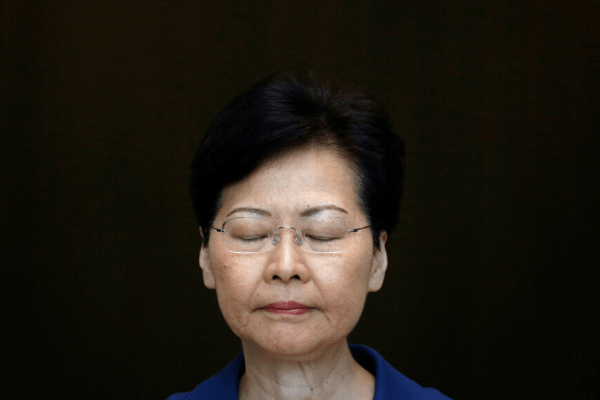
The Chinese government is drawing up a plan to replace Carrie Lam, Hong Kong’s leader, with an “interim” chief executive following violent protests against her administration, according to people briefed on the deliberations.
The people said that if Xi Jinping, China’s president, decided to go ahead, Ms Lam’s successor would be installed by March and cover the remainder of her term, which ends in 2022. They would not necessarily stay on for a full five-year term afterwards.
When Tung Chee-hwa, Hong Kong’s first Chinese chief executive, resigned in 2005, Donald Tsang, the territory’s then most senior bureaucrat, served out the remainder of his term and was reappointed chief executive for a full five-year term in 2007.
Leading candidates to succeed Ms Lam include Norman Chan, former head of the Hong Kong Monetary Authority, and Henry Tang, son of a textile magnate who has also served as the territory’s financial secretary and chief secretary for administration, the people added.

Read also: China and Hong Kong: the ultimate test of authoritarian rule
The protest movement, now in its fifth month, is seen as the most serious challenge to Communist party authority on Chinese soil in three decades. Protesters say they will not stop until the territory’s chief executive and legislators are chosen through democratic elections.
Chinese officials want the situation to stabilise before making a final decision on whether to proceed with a leadership change, as they don’t want to be seen to be giving in to violence, according to the people briefed on the discussions.
Officials are hoping the violence will subside as arrests mount and now weekly vandalisation dissipates public support for the protests. March is when China’s rubber stamp parliament, the National People’s Congress, holds its annual session.
Ms Lam’s handling of the crisis has been marred by a series of missteps, including her decision to press ahead with the controversial extradition bill that sparked the protests even after a series of massive and peaceful marches in early June, analysts said. She was later forced to drop the bill, which was formally withdrawn on Wednesday in the territory’s legislature.

The Financial Times reported in July that Ms Lam had offered to resign, but Beijing forced her to stay on. The Hong Kong and Chinese governments later denied that she had wanted to step down.
Mr Chan is one of the “three Chans” viewed as possible successors to Ms Lam. But the other two — Paul Chan, financial secretary, and Bernard Chan, convener of an “executive council” that advises Ms Lam — are viewed as being too close to her now discredited administration.
The Hong Kong Monetary Authority, which Norman Chan headed for a decade, is widely respected as an independent institution that has successfully managed the territory’s US dollar currency peg for almost 40 years.
Mr Tang, meanwhile, only served under Ms Lam’s predecessors.
“We have to look within at people who have served in government but also know how business operates here,” said one prominent member of Hong Kong’s pro-beijing establishment. “And of course they need to be trusted by Beijing.”